Obama Was the Most Pro-Israel President Since Truman

2987
“Netanyahu invariably repaid Obama’s generosity with ingratitude and abuse.” (photo: Stuxnet Documentary, LLC / BBC)

Believe it or not, Barack Obama had Israel’s best interest at heart. Trump, on the other hand, will drive a stake through hopes of peace.

By Avi Shlaim / The Guardian
January 17, 2017


That Obama detests Netanyahu is common knowledge. What is less well known is that Obama’s personal antipathy towards the prime minister co-exists with a genuine commitment to the welfare and security of the Jewish state.


America has not one but two special relationships: one with Britain and one with Israel. When the two clash, the alliance with Israel usually trumps the one with Britain, as Tony Blair discovered to his cost in 2003. For the sake of the special relationship Blair dragged Britain into a disastrous war in Iraq, but in the aftermath of the war his American allies reneged on their promise to push Israel into a settlement with the Palestinians. Blair was no match to the power of the Israel lobby in the US. With American complicity, Israel’s occupation of the Palestinian territories has now reached its 50th year and there is still no light at the end of the tunnel.

American politicians of both parties often use the mantra that the bond with Israel is unbreakable. But Israel’s continuing drift to the right has imposed serious strains on the relations with its principal ally and chief benefactor. In America, Israel is essentially an issue in domestic politics rather than foreign policy. And it is the subject of deep disagreement between the outgoing Obama administration and the incoming Trump administration.

Continue reading “Obama Was the Most Pro-Israel President Since Truman”

Perhaps the Messiah Will Come

uri-avnery
Uri Avnery (photo: countercurrents.org)

The only real solution is the much-maligned “Two States for Two peoples,” the one declared dead many times. It’s either that solution or the destruction of both peoples.

by Uri Avnery / antiwar.com
March 11, 2017


Right after the foundation of the State of Israel, God appeared to David Ben-Gurion and told him, “You have done good by my people. Utter a wish and I shall grant it.”
“I wish that Israel shall be a Jewish and a democratic state and encompass all the country between the Mediterranean and the Jordan,” Ben-Gurion replied.
“That is too much even for me!” God exclaimed. “But I will grant you two of the three.”


If someone had told me 50 years ago that the rulers of Israel, Jordan and Egypt had met in secret to make peace, I would have thought that I was dreaming.

If I had been told that the leaders of Egypt and Jordan had offered Israel complete peace in return for leaving the occupied territories, with some exchanges of territory and a token return of refugees, I would have thought that the Messiah had come. I would have started to believe in God or Allah or whoever there is up there.

Yet a few weeks ago it was disclosed that the rulers of Egypt and Jordan had indeed met in secret last year with the Prime Minister of Israel in Aqaba, the pleasant sea resort where the three states touch each other. The two Arab leaders, acting de facto for the entire Arab world, had made this offer. Benyamin Netanyahu gave no answer and went home.

So did the Messiah.

Continue reading “Perhaps the Messiah Will Come”

I Am a Muslim — Ask Me Anything

91f38914-06bb-11e7-ae41-8a339799fc20-1560x1040
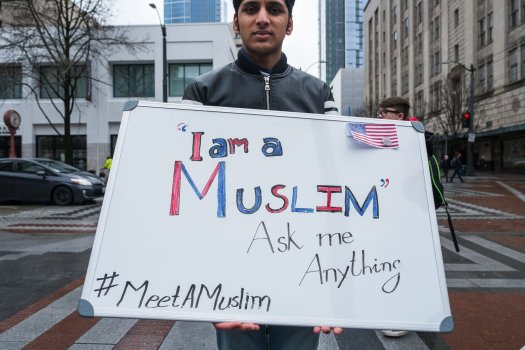
Faiez Ahmad joins two of his friends in Westlake Park. About 30 or 40 people stopped by to speak to them, including people attending a St. Patrick’s Day Parade. (photo: Dean Rutz / The Seattle Times)

Locals joined the national effort on “Meet a Muslim Day” to dispel myths about Islam.

By Tyrone Beason / The Seattle Times
March 11, 2017


“I’m here to say that our religion is for peace. Islam is for peace . . . Most people don’t care about religion. They care about peace.”
— Ahmad Bilal


Ahmad Bilal, Faiez Ahmad and Luqman Munir couldn’t have been better positioned to talk about being Muslims than the cultural crossroads of Fourth Avenue and Pine Street in downtown Seattle on Saturday.

The trio, all members of the Ahmadiyya Muslim Youth Association, took part in the organization’s “Meet a Muslim Day,” an effort in cities around the country to dispel myths about Islam and put a human face on a population that’s been the subject of stereotypes, public suspicion and in extreme cases, threats and violence.

For three hours on a showery Saturday, the men stood among the throngs of tourists and St. Patrick’s Day parade spectators at a corner of Fourth and Pine with a sign that read, “I am a Muslim: Ask me anything.”

Continue reading “I Am a Muslim — Ask Me Anything”

The 1930’s Were Humanity’s Darkest Hour. Are You Paying Attention?

2966
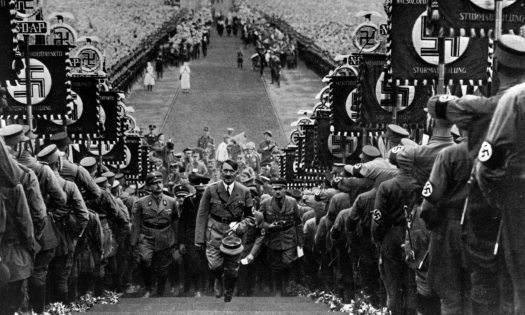
German chancellor Adolf Hitler amid huge crowds at a rally to mark the Bückeberg Harvest Festival on Oct 1, 1934. (photo: Hulton Archive / Getty)

A decade haunted by mass poverty, violent extremism and world war gives us one crucial advantage: the chance to learn the era’s lessons and avoid its mistakes.

By Jonathan Freedland / The Guardian
March 11, 2017


Witness the remarks of Steve Bannon, chief strategist in Donald Trump’s White House and the former chairman of the far-right Breitbart website. In an interview with the Hollywood Reporter, Bannon promised that the Trump era would be “as exciting as the 1930’s.” (In the same interview, he said “Darkness is good” – citing Satan, Darth Vader and Dick Cheney as examples.)


Even to mention the 1930s is to evoke the period when human civilization entered its darkest, bloodiest chapter. No case needs to be argued; just to name the decade is enough. It is a byword for mass poverty, violent extremism and the gathering storm of world war. “The 1930’s” is not so much a label for a period of time than it is rhetorical shorthand — a two-word warning from history.

Witness the impact of an otherwise boilerplate broadcast by the Prince of Wales last December that made headlines: “Prince Charles warns of return to the ‘dark days of the 1930s’ in Thought for the Day message.” Or consider the reflex response to reports that Donald Trump was to maintain his own private security force even once he had reached the White House. The Nobel prize-winning economist Paul Krugman’s tweet was typical: “That 1930s show returns.”

Continue reading “The 1930’s Were Humanity’s Darkest Hour. Are You Paying Attention?”

Muhammad Ali’s Son Detained … Again

House Democrats Hold Forum On Trump Administration Immigration Policies
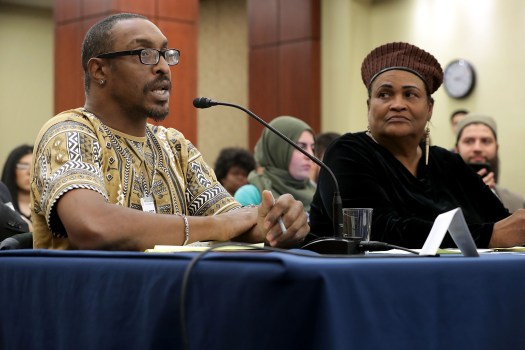
Muhammad Ali Jr. and his mother Khalilah Camacho-Ali participate in an immigration enforcement forum with Democratic members of the House of Representatives at the U.S. Capitol on Mar 9. (photo: Chip Somodevilla / Getty Images)

A month after being detain while returning to the U.S., the son of “The Greatest” was detained again before boarding a domestic flight in Washington, D.C.

By Marissa Payne and Des Bieler / The Washington Post
March 10, 2017


“We must step into the ring and fight this thing and keep fighting it until it’s done.”
— Khalilah Camacho-Ali, wife of the late Muhammad Ali


A month after Muhammad Ali’s son and his mother, Ali’s second wife Khalilah Camacho-Ali, were detained in a Florida airport allegedly for their “Arabic-sounding names,” he says he was held up again, this time at Reagan National Airport on Friday. He and his mother had come to Washington to lobby to end racial profiling, and he was trying to board a flight back to Fort Lauderdale, Fla.

A lawyer for Ali, Chris Mancini, said that as the son of the former heavyweight champion was trying to board a Jet Blue flight, he was detained by Department of Homeland Security officials for about 20 to 25 minutes. According to comments Mancini made to the New York Daily News, they rejected his identification and repeatedly asked where he was from, before allowing the 44-year-old to board after he produced his U.S. passport.

“None of this was happening Wednesday,” Mancini said of the Alis’ trip to D.C. in remarks to the Associated Press. “Going to Washington obviously opened up a can of worms at DHS.”

Continue reading “Muhammad Ali’s Son Detained … Again”

Capitol Hill Synagogue Vandalized

340ace20-05d5-11e7-8773-c90009b761d0-1560x1101
Anti-Semitic, Holocaust-denying graffiti was spray-painted on the facade of Temple De Hirsch Sinai on Capitol Hill. The temple has chosen to leave it in place for the moment. (photo: Alan Berner / The Seattle Times)

The Seattle synagogue Temple De Hirsch Sinai was vandalized with graffiti saying “The Holocaust is fake history.”

By Evan Bush / The Seattle Times
March 10, 2017


“[Since the election, people] previously marginalized or silenced now feel newly empowered. The majority of us need to push back against that and convey that America is still America . . . there is no place for hate or tolerance of toxic expression.”
— Rabbi Daniel Weiner, Temple De Hirsch Sinai


A synagogue in the Capitol Hill neighborhood was vandalized overnight Thursday with anti-Semitic, Holocaust-denying graffiti, said Rabbi Daniel Weiner of Temple De Hirsch Sinai.

A Seattle police officer discovered the spray-painted message Friday morning on the old sanctuary’s facade.

“It says, ‘The Holocaust is fake history,’ ” Weiner said. The “s” characters in the graffiti are dollar signs, Weiner said.

“It really is a toxic mix of Holocaust denial, the stereotypical charge that Jews are obsessed with money, and the notion coming from the (President Trump) administration that all facts are fungible . . . fake facts, fake history,” Weiner said.

Continue reading “Capitol Hill Synagogue Vandalized”

A Budding Symbiosis between Trump and Netanyahu

08prexy-master768
photo: Stephen Crowley / The New York Times

Political lift as both Netanyahu and Trump face mounting challenges on home front.

By Mark Landler / The New York Times
March 7, 2017


“It appears that President Trump is prepared to go a long way to help Prime Minister Netanyahu with his domestic difficulties and that Netanyahu, in return, is willing to provide a kosher seal of approval for a president who was slow to condemn anti-Semitism.”
— Martin S. Indyk, former special envoy to the Middle East


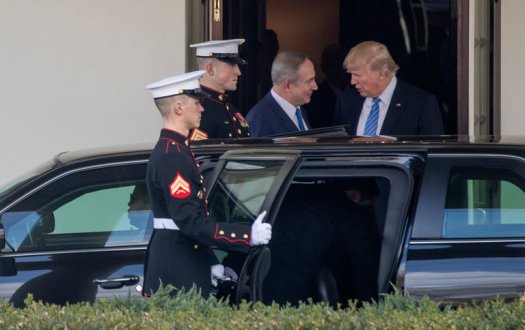
Prime Minister Benjamin Netanyahu of Israel was sitting in his residence in Jerusalem on Monday, being questioned by the police in a murky bribery and fraud investigation that could put an end to his political career, when the telephone rang.

On the line was President Trump, who wanted to talk to Mr. Netanyahu about Iran and a few other matters.

The prime minister excused himself for several minutes to take the call, and later issued a statement in which he thanked Mr. Trump “for his warm hospitality during his recent visit to Washington and expressed his appreciation for the president’s strong statement against anti-Semitism during the president’s speech before Congress.”

Continue reading “A Budding Symbiosis between Trump and Netanyahu”

Israel’s New Travel Ban Tells the World to Stay Away

restricted_area_private_property_keep_out

The new anti-BDS law marks a drastic shift in Israel’s relationship with the outside world by sending the message that many of those who deeply object to the occupation are no longer welcome to visit.

By Allison Kaplan Sommer / Haaretz
March 7, 2017


With this new law, the message to young Jews, and the rest of the world is no longer: “Come, see for yourself, let’s have a discussion — even an argument — in which I try to change your views. We know it’s complicated, but let’s not end our relationship.”

Instead, [the message] is: “Stay away. If you don’t agree with us, there is no place for you here.”


At first glance, Israel’s sweeping travel ban passed by the Knesset on Monday night essentially changes nothing. The authorities at Israel’s borders and airports already have complete discretion to keep anyone out, and numerous prospective visitors have been blacklisted and turned away because they are believed to be hostile to Israel.

They don’t need this law, which spells out support of boycotting of any Israeli institution or any area under its control as grounds to block their entrance as visitor.

But, actually, it changes everything. The statement it makes and the message it sends — that those who so deeply object to the occupation that they choose not to buy settlement products — are no longer welcome to visit, see and experience their country is a drastic shift in Israel’s relationship with the outside world.

Continue reading “Israel’s New Travel Ban Tells the World to Stay Away”

How Did It Start?

ncs_modified20140515191542maxw640imageversiondefaultar-140519321
(photo: U.N.)

So how the hell did it all start?

By Uri Avnery / Antiwar.com
February 18, 2017


In 1908, a group of Arab members of the Turkish parliament . . . had a brilliant idea: why not approach the Zionists and offer them an alliance against the Turks? . . . This was a historic moment, one of those moments when history holds its breath. A totally new vista opened up: an alliance between Arabs and Jews! A joint liberation movement!


So how the hell did it all start?

Last week I tried to describe the 1948 war, starting from the shooting at a Jewish bus on the morrow of the UN partition resolution. Some readers dispute the timing. They insist that the war started on May 15, on the morrow of the founding of the State of Israel, when the armies of the neighboring Arab states entered the country.

I have seen this many times. Every serious debate about the Israeli-Palestinian conflict raises the question: “When did it start?” Each side has its own date, proving that the other side started it.

The Arabs started it, the Zionists assert. The conflict started with the “invasion” of the Arab armies. (“Invasion” in quotation marks, since they entered the territories allotted by the UN to the Palestinian Arab state, though their declared aim was to crush the new Jewish state right at the beginning.)

The Jews started it, the Arabs assert. They began to drive the Arab population out, leading to the Naqba (“disaster”).

Continue reading “How Did It Start?”

A Great New Accidental Renaissance

03eganweb-master768
Congregation Beth Elohim in Brooklyn was filled on Feb. 6 for an evening of strategizing against President Trump. (photo: Demetrius Freeman / The New York Times)

By Timothy Egan / The New York Times
March 3, 2017


Trump has been good — indirectly — for a free press, an independent judiciary, high school civics, grass-roots political activity, cautionary tales in literature and theater, and spirituality. You don’t know what you’ve got, as the song says, till it’s gone — or nearly so.


My friend Sam laughed when I told him I was going to spend my Saturday at a “Search for Meaning” festival at a Jesuit college in the heart of seriously secular Seattle. He assumed, as I did, that a bare handful of the usual search-for-meaning suspects would be straining minutiae while still clinging to the meaninglessness of it all.

But nooooo — all the keynote events at Seattle University were completely sold out. In the winter of the American soul, people thronged to hear advice on how to “live a life of significance and impact” and to “find meaning in times of change, challenge and chaos.”

I credit President Trump. Not because he seems any more evolved than the first earthworms now appearing in the cold soil of my garden. But because the threats to truth, civility, rational thought and brotherly love coming from the White House have prompted a huge counterreaction.

Continue reading “A Great New Accidental Renaissance”