Israel’s Problem Isn’t Palestinian Nationalism — It’s Palestinians Themselves

006
Border police officers stand in front of Palestinians as they wait to cross from Qalandiya checkpoint outside Ramallah, West Bank, into Jerusalem. (photo: Activestills.org)

Most of the circumstances that made the Israeli-Palestinian conflict ripe for resolution — or at least made the peace process attractive to both parties — have all but disappeared over the past decade.

By Noam Sheizaf / +972 Magazine
August 20, 2017


A national movement requires genuine mass engagement in a political vision and a working project that cuts across boundaries of region, clan, and class, and a defined and acknowledged leadership with the legitimacy and representative standing that empowers it to act in its people’s name. This no longer holds for Fatah, the P.A., or the P.L.O.


Many Israelis were likely happy to read The New Yorker article titled “The End of This Road: The Decline of the Palestinian National Movement” earlier this month. The piece is of particular interest due to where it was published — the liberal elite’s most prominent magazine, which generally champions the Zionist Left and the American-backed two-state solution.

The identity of its authors is also noteworthy: Ahmad Samih Khalidi was involved in Israeli-Palestinian talks for years; Hussein Agha is a close associate of Palestinian President Mahmoud Abbas, who was charged with holding secret talks with Yitzhak Molcho — Netanyahu’s chief envoy to the negotiations — and Obama’s former Middle East envoy Dennis Ross in the run-up to John Kerry’s peace initiative in 2013.

For the same reason we should also take the authors’ main argument, according to which Abbas is the last remaining Palestinian who can sign a final-status agreement, with a grain of salt. Yet the headline is not misleading, and it joins a long list of publications that rightfully declare the end of the Oslo peace process.

Continue reading “Israel’s Problem Isn’t Palestinian Nationalism — It’s Palestinians Themselves”

The End of This Road: The Decline of the Palestinian National Movement

agha-khalidi_the-end-of-the-road-palestine-leaders
(photo: Simona Ghizzoni / Contrasto / Redux)

As their institutions wither and their leaders fade away, young Palestinians will redefine previous generations’ aspirations and agenda.

By Hussein Agha and Ahmad Samih Khalidi / The New Yorker
August 6, 2017


Without “armed struggle,” the national movement had no clear ideology, no specific discourse, no distinctive experience or character. In the absence of a genuine and independent state, it was unable to transform itself into a ruling party, as, for example, the African National Congress did, in South Africa. It remained incomplete and suspended: a liberation movement not doing much liberating, locked in a fruitless negotiating process, and denied the means of government by a combination of Israeli obduracy and its own inadequacies.


As President Trump prepares for yet another attempt to resolve the Palestinian-Israeli conflict, the ground is shifting under his feet. While Israel’s willingness to offer an acceptable deal is increasingly open to question, with nothing to suggest that its terms are likely to soften with time, the Palestinians are sliding toward the unknown. With the slow but sure decay of the Palestinian political scene, the President of the Palestinian Authority, Mahmoud Abbas (Abu Mazen), represents the last slender chance for a negotiated settlement: he is the sole remaining national leader of his people with sufficient, if dwindling, authority to sign and ratify a deal. For President Trump and his team, as well as for all those seeking to end this century-plus-old conflict, there should be no doubt about the moment’s urgency. After Abbas, there will be no other truly weighty representative and legitimate Palestinian leadership, and no coherent national movement to sustain it for a long time to come.

Over six days in late November and early December, 2016, Fatah, the Palestinian national liberation movement, convened its seventh congress in Ramallah, the de-facto capital of the Palestinian Authority. Despite the lengthy speeches and festive air, the conference did little to dispel what had become unmistakable: the slow expiry of a once vibrant movement. Long on show and short on substance, the meeting hardly touched on any of the mounting political challenges facing the Palestinian people. The Congress was no more than a confirmation of the current order and a reaffirmation of its total and unprecedented control over Fatah, the P.A., and its ostensible parent, the Palestine Liberation Organization.

The contemporary Palestinian national movement — founded and led by Yasser Arafat and embodied by the P.A., Fatah, and the P.L.O. over the past half century — is reaching its end. As its institutions wither and its leaders fade away, there is no obvious successor to take its place.

Continue reading “The End of This Road: The Decline of the Palestinian National Movement”

Gonzaga Sends Students to Israel and Palestine


img_3193
Gonzaga students sharing a home-cooked meal with a Palestinian family.

Study abroad program sends students to Israel, plans for program to return in 2019.

By Emily Klein / The Gonzaga Bulletin
August 30, 2017


“The students appreciated a place that I had never been before [The Tent of Nations outside Bethlehem in the West Bank] and this is my 10th time going to Israel. For me it was a very emotional experience, too, because I felt like it’s such a model, it’s such a lesson in life where when you’re stuck in these horrible situations you have to consider how to stand up and be a human being. They could have become suicide bombers, they could have become people who lie in garbage. They said that they were going to find another way. I think that lesson, for the students, was absolutely profound. It was for me, too.”
— Dr. Elizabeth Goldstein, Associate Professor of Religious Studies


Controversies are often told or experienced in a one-sided manner. Israel, its history and the Israeli-Palestinian conflict associated with it is often susceptible to such exclusive perspectives.

Every aspect of the Gonzaga-in-Israel program avoided limited perspectives by embracing duality and empathy.

Dr. Elizabeth Goldstein, associate professor of religious studies and a rabbi, proposed the creation of the Israel study abroad experience with dual purposes and perspectives in mind.

“I feel like Israel and knowledge of the Middle East is an important part of a full approach to both the background of the Old Testament/Hebrew Bible as well as anything to do with contemporary Judaism,” Goldstein said. “I also felt that it was a part of the mission of the university to look at issues of social justice between Israel and Palestine.”

Continue reading “Gonzaga Sends Students to Israel and Palestine”

Why Rabbis Like Me Oppose Israel’s Ban on BDS Activists

lufthansa
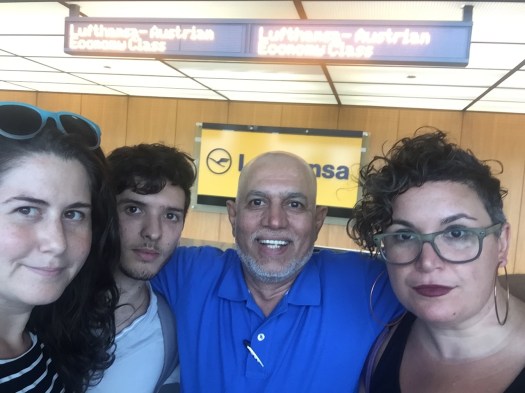
Rabbi Alissa Shira Wise, Deputy Director of Jewish Voice for Peace, and three other peace activists, were prevented from boarding a flight to Tel Aviv on July 24, 2017.

Over 200 rabbis publicly oppose Israel’s ban on BDS activists.

By Laurie Zimmerman / Cleveland Jewish News
August 29, 2017


For me, the issue is not about Rabbi Wise herself, nor is it about the BDS movement. While the image of a rabbi being prevented from boarding an airplane to Israel is disturbing, and the Jewish community’s hysteria about the BDS movement is frustrating, the incident reflects something even more distressing: the suppression of dissent in our community.

For a community that prides itself on a tradition that honors varied and opposing ideas and upholds a strong commitment to debate, I am disgusted by its refusal to tolerate divergent voices.


In March, the Israeli Knesset passed a law that denies entry to foreigners who support the Boycott, Divestment and Sanctions movement, or BDS.

At the time, the law felt so insidious because it introduced a political litmus test designed to exclude those who object to Israel’s policies. It served to stifle legitimate political debate. But it was all so theoretical.

Until last month, that is, when Rabbi Alissa Shira Wise, who was part of an interfaith delegation that had planned to meet with Israeli and Palestinian peace activists, was banned at Washington’s Dulles Airport. I was stunned.

Continue reading “Why Rabbis Like Me Oppose Israel’s Ban on BDS Activists”

U.N. Reiterates Support for Two-State Solution

08-29-guterres-palestine
Secretary-General António Guterres (left) and Prime Minister Rami Hamdallah of the State of Palestine brief the press in Ramallah, August 29, 2017. (photo: Katrin Hett / U.N.)

In Palestine, the U.N. Secretary-General says a two-state solution “only way to guarantee peace.”

By U.N. News Centre
August 29, 2017


“I have a dream, a dream to see in the Holy Land two states: A Palestinian state and an Israeli state, living together in peace and security, in mutual recognition and allowing for this kind of suffering not to be possible anymore.”
— U.N. Secretary-General António Guterres


United Nations Secretary-General António Guterres today reiterated his call for a political solution to the Middle East conflict that would end Israel’s occupation of Palestinian land and would create an independent Palestinian state, living side by side with Israel in peace and security.

“It is my deep belief that it is essential to restart a serious and credible political process of negotiation aiming at that objective — the two-state solution — as it is also important to create conditions on the ground to improve the situation of Palestinian populations,” Mr. Guterres said at a press conference in Ramallah after meeting with Palestinian Prime Minister Rami Hamdallah.

“A two-state solution that will end the occupation and, with the creation of conditions, also the suffering even to the Palestinian people, is in my opinion the only way to guarantee that peace is established and, at the same time, that two states can live together in security and in mutual recognition,” Mr. Guterres said.

He said that Israel’s settlement activity represented a major obstacle to the implementation of the two-state solution although there are other obstacles.

Continue reading “U.N. Reiterates Support for Two-State Solution”

Dangerous Escalation in Attacks on Freedom of Expression in Palestine

242595

By Amnesty International
August 23, 2017


“By rounding up journalists and shutting down opposition websites the Palestinian authorities in the West Bank and the Gaza Strip appear to be using police state tactics to silence critical media and arbitrarily block people’s access to information.”


The Palestinian authorities in the West Bank and their rivals, the de-facto Hamas administration in Gaza, have both tightened the noose on freedom of expression in recent months, launching a repressive clampdown on dissent that has seen journalists from opposition media outlets interrogated and detained in a bid to exert pressure on their political opponents, said Amnesty International.

In the West Bank, the Palestinian authorities have arrested six journalists in August so far, shut down 29 websites and introduced a controversial Electronic Crimes Law imposing tight controls on media freedom and banning online expression and dissent. In the Gaza Strip, Hamas security forces have arrested at least two journalists since June and hampered others from freely carrying out their work. At least 12 Palestinians, including activists, were also detained by Hamas for critical comments posted on Facebook.

“The last few months have seen a sharp escalation in attacks by the Palestinian authorities in the West Bank and Hamas in Gaza, on journalists and the media in a bid to silence dissent. This is a chilling setback for freedom of expression in Palestine,” said Magdalena Mughrabi, Deputy Middle East and North Africa Director at Amnesty International.

Continue reading “Dangerous Escalation in Attacks on Freedom of Expression in Palestine”

Frankfurt Bans BDS

375375c
(photo: AFP)

Frankfurt becomes the first German city to ban BDS movement.

By Ma’an News Agency
August 25, 2017


“[The BDS movement] strongly attacks the fundamental basis of the legitimation of the Jewish State [and used anti-zionism as a detour] to spread anti semitism. That’s why we decided to ban any municipal funding or the renting of rooms for any activities of groups or individuals, who support the anti-semitic BDS movement. We also instructed our city-owned companies and called upon private landlords to act in the same way.”
— Uwe Becker, deputy mayor and city treasurer of Frankfurt


The city of Frankfurt, Germany, passed a bill on Friday outlawing municipal funding for and the use of public spaces for activities that aim to boycott Israel, according to the Jerusalem Post.

The Jerusalem Post reported that the anti-Boycott, Divestment, and Sanctions (BDS) movement bill was initiated and pushed by Uwe Becker, the deputy mayor and city treasurer of Frankfurt, who has argued that the BDS movement is anti-semitic and “strongly resembles the ‘Don’t buy from Jews’ argumentation of former times of the National Socialists.”

The BDS movement was founded in July 2005 by a swath of Palestinian civil society as a peaceful movement to restore Palestinian rights in accordance with international law through strategies of boycotting Israeli products and cultural institutions, divesting from companies complicit in violations against Palestinians, and implementing state sanctions against the Israeli government.

The movement falls within the traditions of the nonviolent boycott movement against the apartheid regime in South Africa.

Continue reading “Frankfurt Bans BDS”

Jared Kushner’s Mission Impossible

epa-jared-kushner-ml-170621_16x9_992
Jared Kushner and Benjamin Netanyahu. (photo: ABC News)

Jared Kushner’s quest for peace looks increasingly doomed.

By Adam Taylor / The Washington Post
August 25, 2017


Kushner’s trip has only highlighted the sizable obstacles he faces. Here are five of the biggest:

  1. The Israelis
  2. The Palestinians
  3. The rest of the Middle East
  4. President Trump
  5. Kushner himself

White House adviser Jared Kushner headed back to Israel and the West Bank this week in a renewed push to broker Middle East peace, just one of several responsibilities the administration has handed to President Trump’s 36-year-old son-in-law.

Despite Kushner’s unusually varied workload — he’s also tasked with reforming veterans’ care, solving the opioid crisis, something to do with “American innovation,” and more — this is his second trip to the region in the space of just three months. That may be a sign of how keenly the new administration is chasing peace between Israel and the Palestinians, which Trump has described as the “ultimate deal.”

A few months ago, there was actually some cautious optimism among Middle East watchers that Trump might be able to make some progress. Sure, he and Kushner don’t have any diplomatic or political experience, but so what? Trump was a self-described dealmaker who didn’t have much of the political baggage of his predecessors. The experts hadn’t done so well finding a solution, so why not give them a try?

Continue reading “Jared Kushner’s Mission Impossible”

Former Israeli Officials: Anti-BDS Bill Hurts Israel

istock-813848364-1502372319
Israeli settlement in the West Bank. (photo: iStock)

Former Israeli officials argue that the Anti-Israel Boycott bill hurts Israel by legitimizing illegal settlements and expanding the definition of Israeli territory.

By Ami Ayalon, Gilead Sher and Orni Petruschka / Forward
August 10, 2017

[Ami Ayalon is a former director Shin Bet, Gilead Sher is the former Chief of Staff for Israeli Prime Minister Ehud Barak, Orni Petruschka is a high-tech entrepreneur in Israel.]

As Israelis committed to the future of our country as the secure, democratic home of the Jewish people, we wish to underscore, expand and add perspective to a critical point J.J. Goldberg makes in his August 4th column about the anti-BDS bill now before the U.S. Congress.

The bill proposes to criminalize explicit boycotts of Israel. But Goldberg points out that while the debate about the bill has focused on whether or not the bill violates freedom of speech, a much more controversial issue embedded in it is its tacit recognition of settlements, contravening official US policy. And settlements have posed one of the most serious obstacles to efforts by successive U.S. administrations to achieve an Israeli-Palestinian agreement.

As Goldberg notes, “The bill commits the United States for the first time to extending protection, including legal protection, to Israeli settlements in the West Bank.” The bill does that, Goldberg explains, by blurring the distinction between Israel and “territories under its control,” i.e. the occupied territories.


The significance of eroding this distinction cannot be overstated. It endangers the future of Israel as a Jewish-democratic state. It delegitimizes the entire Zionist enterprise. And it actually plays into the hands of BDS advocates.

Here’s how: If Israel includes the territories, it cannot be a democracy, because the approximate 2.5 million Palestinians residing in the West Bank have no civic rights, unlike their settler neighbors, who are Israeli citizens.

This concept cannot be stated enough times. No country that does not mandate full civic equality to millions of people can legitimately claim to be a democracy and have that claim accepted by the world’s democratic states.


That is exactly what BDS advocates point to when they assert that Israel is an apartheid state. And if Israel is defined as including the territories, as it is in this bill, they are correct.

Thus, the legitimacy of Israel hinges on the distinction between Israel proper, where Jews have a right for self-determination, and the territories, in which a Palestinian state should be established in order to fulfill the aspirations of the Palestinian people for freedom and dignity.

Continue reading “Former Israeli Officials: Anti-BDS Bill Hurts Israel”

Interfaith Leaders Denied Entry into Israel for Supporting BDS

lufthansa

Five leaders on an interfaith delegation to Israel/Palestine were refused permission to board their plane in the United States, in what appears to be an implementation of Israel’s travel ban on supporters of Palestinian rights and Boycott, Divestment Sanctions (BDS).

By Naomi Dann / Jewish Voice for Peace
July 24, 2017

Five members of an interfaith delegation were prevented from boarding their flight to Israel because of their public criticism of the Israeli government’s policies towards Palestinians. The group of Jewish, Muslim and Christian leaders were apparently singled out for their public support of the Palestinian call for Boycott, Divestment and Sanctions (BDS) on the state of Israel. Upon arrival at the Lufthansa check-in counter at Dulles International Airport, an airline employee informed the group that the Israeli government had told the airline not to let them board.

The five people prohibited from flying are Rabbi Alissa Wise, Jewish Voice for Peace (JVP) deputy director, Philadelphia, PA; Alana Krivo-Kaufman, Brooklyn, NY and Noah Habeeb, Virginia, both also of JVP; Rick Ufford Chase, of the Presbyterian Peace Fellowship, Rockland County, NY; and Shakeel Syed, a national board member with American Muslims for Palestine, Los Angeles, CA.


“Israel denied me the ability to travel there because of my work for justice for Palestinians, even though I’m Jewish and a rabbi,” said Rabbi Alissa Wise. “I’m heartbroken and outraged. This is yet another demonstration that democracy and tolerance in Israel only extends to those who fall in line with its increasingly repressive policies against Palestinians.”


The Israeli Knesset (parliament) passed a bill in March banning entry to those who support boycott, divestment and sanctions of Israel until Palestinians have full equal rights. Israel’s BDS ban includes those who have endorsed boycotts of products from Israeli settlements built on occupied Palestinian land in violation of international law and longstanding official U.S. policy. It is believed that this is the first time that the policy has been enforced before people even board their flight. It is also the first time that Israel has denied entry to Jews, including a rabbi, for their political positions. This new political litmus test for entry into the country is an extension of the longstanding practices of racial, religious and ethnic profiling of Palestinian, Arab and Muslim visitors to Israel.

Continue reading “Interfaith Leaders Denied Entry into Israel for Supporting BDS”