US Ambassador Friedman says “settlements are part of Israel”

170929-friedman
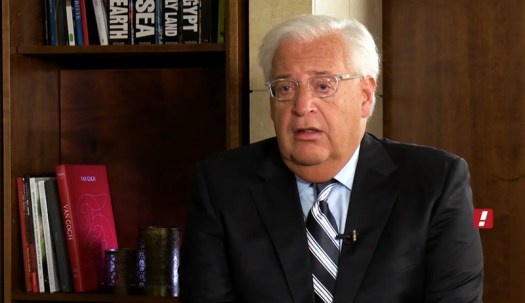
US Ambassador to Israel David Friedman during an interview with Walla News on September 28, 2017. (photo: Walla News)

David Friedman’s comments draw accusations of unilaterally changing US policy and “absolute ignorance of facts and laws.”

By Jacob Magid / The Times of Israel / Sep 28, 2017


“There was always supposed to be some notion of expansion into the West Bank, but not necessarily expansion into the entire West Bank; and I think that’s exactly what Israel has done. I mean, they’re only occupying two percent of the West Bank.”
— David Friedman, US Ambassador to Israel

[Ed note: Both US policy and international law recognize Israel as the occupying power in 100% of the West Bank.]


US Ambassador to Israel David Friedman said Thursday that West Bank settlements “are part of Israel” and that the two-state solution “is not a helpful term” and “has largely lost its meaning,” drawing an angry response from the Palestinians.

Speaking in an interview broadcast on the Walla news website, Friedman was asked for his views on the Israeli-Palestinian conflict and to speculate on the Trump administration’s plans moving forward on the issue. Some of his answers largely contradicted long-held US positions.

Continue reading “US Ambassador Friedman says “settlements are part of Israel””

The Israeli Right’s “coexistence” in the West Bank

MIDEAST ISRAEL PALESTINIANS
The separation wall near the Qalandiya checkpoint outside of Jerusalem. (photo: Maya Levin / Flash90)

The “colonialists” accept the status quo, the “apartheidists” want complete separation, and the “transferists” openly await a third Nakba.

By Naam Sheizaf / +972 Magazine / Sep 11, 2017


The Right’s imagined coexistence in the occupied territories is uncannily similar to the kind whites dreamed of in Rhodesia. That is, we can get our cars fixed for cheap, and they can come work for us, bereft of any rights. In the meantime, they can continue living in their crowded cities and squalid refugee camps.


There is nothing the Israel Right loves more than adopting the criticism of its rivals on the Left in order to justify its rule. Strangely, this criticism has turned into a main aspect of the language settlers use when describing their “coexistence” with the Palestinians in the occupied territories.

Their argument goes as such: while Tel Aviv is a bubble where rich, liberal Jews love Arabs in theory only, in the West Bank we truly see the Palestinians as humans and as neighbors. The Left fantasizes about peace agreements with people it doesn’t even know, but the Right’s version of coexistence includes real people — who are sometimes filled with hate and sometimes are not, who work and live together but want to keep their own culture, and who see each other as equals.

Sounds great, doesn’t it?

Continue reading “The Israeli Right’s “coexistence” in the West Bank”

BDS is the only lever against Israeli occupation and apartheid

2308535375
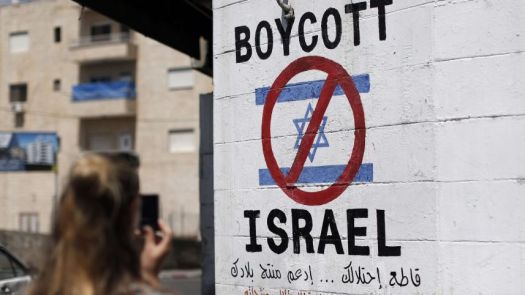
A BDS poster in the West Bank town of Bethlehem on June 5, 2015. (photo: AFP)

Thinking that Israel can fix a colonial, apartheid regime without outside help is a dangerous illusion.

By Ruchama Marton / Haaretz / Sep 26, 2017


As long as Jewish Israelis who do not support BDS think it is possible to change from within, they are like the parable of the rabbit who wanted to change the lion from within. So the lion ate him. The rabbit did enter the lion but there his story ended.


In his article in Haaretz, Uri Avnery responds to what I said at my 80th birthday party. “Some of my friends believe the fight is lost, that it’s no longer possible to change Israel ‘from within,’ that only outside pressure can help and that the external pressure that is capable of doing this is the boycott, divestment and sanctions movement. One of these friends is Dr. Ruchama Marton,” he writes.

“First of all, I profoundly reject the argument that there is nothing we can do to save the state, and that we must trust foreigners to do our job for us. Israel is our state. We are responsible for it,” says Avnery.

Here is my response to him.

Continue reading “BDS is the only lever against Israeli occupation and apartheid”

Trump limits refugee admissions at all-time low

3500
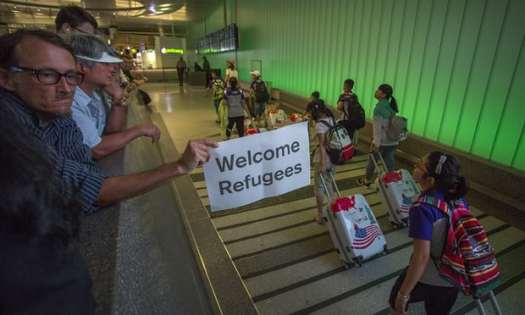
A man displays a welcome sign near arriving travellers on the first day of the partial reinstatement of the Trump travel ban in Los Angeles on June 29, 2017. (photo: David McNew / Getty Images)

45,000 is lowest number since the caps were put in place in 1980. The previous low was 67,000 requested by Ronald Reagan in 1986.

By Oliver Laughland / The Guardian / Sep 27, 2017


“The U.S. refugee program was created in the aftermath of World War II. At that time, we rightly rejected antisemitic ideology and embraced our role as a beacon of hope and freedom for those in need. Since that time, US refugee protection has never been a partisan issue, nor a political one. Presidents from both parties have long recognized that the U.S. refugee admissions program is essential to global stability and our reputation as a leader on the world stage.”
— U.S. Representatives John Conyers and Zoe Lofgren


Donald Trump intends to cap America’s annual refugee admissions at a historic low, marking the administration’s latest crackdown on immigrants from some of the world’s most vulnerable groups.

A U.S. state department report seen by the Guardian shows that the administration has briefed Congress it will admit just 45,000 refugees in 2018, the lowest number requested by any president in over three decades and less than half the 110,000 cap issued in the last year of the Obama administration.

Continue reading “Trump limits refugee admissions at all-time low”

Is it bad for Israel that Palestine joined Interpol?

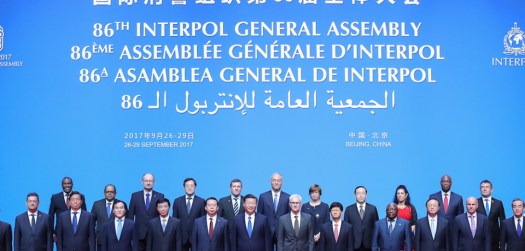
86th INTERPOL General Assembly

Palestine’s membership shouldn’t pose a new concern for Israel.

By Bethany Allen-Ebrahimian / Foreign Policy / Sep 27, 2017


“Almost every country in the world is a member of Interpol, with the notable exception of North Korea. Saudi Arabia, Eritrea, Syria, Yemen, Iran — these are all member countries I’m assuming that, for Israel, would be not particularly friendly countries.”
— Bruno Min, a legal and policy officer at Fair Trials


Interpol, the international police organization, has voted to accept Palestine as a member country — which will heighten fears in Israel that Palestine could use Interpol to target Israeli officials.

Interpol membership will bring several benefits to Palestinian police. They’ll get access to information that other police agencies around the world have shared about criminal activity and will be able to issue red notices, which function as international nonbinding warrants requesting the extradition of criminal fugitives.

And that’s what makes Israel nervous.

Continue reading “Is it bad for Israel that Palestine joined Interpol?”

State of Palestine joins Interpol

3360
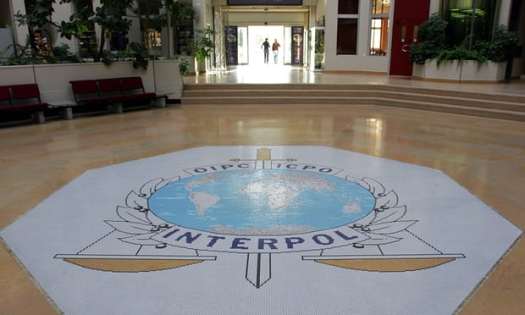
Interpol’s headquarters in Lyon, France. (photo: Laurent Cipriani / AP)

Despite strong opposition from Israel, the international police organization approves Palestine’s membership by a vote of 75–24.

By Peter Meaumont / The Guardian / Sep 27, 2017


Israel campaigned to block the Interpol move and made a series of procedural moves in an attempt to prevent the issue coming to a vote. . . . After Israel blocked the last Palestinian attempt to join Interpol — at last year’s annual general meeting in Indonesia — the Israeli prime minister, Benjamin Netanyahu, said his country’s diplomatic efforts had secured a major victory. The Israeli foreign ministry made no immediate comment on Wednesday’s decision.


Interpol has voted to admit Palestine as a full member, dealing a significant diplomatic blow to Israel, which has strenuously lobbied against Palestinian admission.

In a secret vote of representatives of the international police organization’s members in China, Palestinian membership was approved by 75 to 24 votes, with 34 abstentions — exceeding the two-thirds requirement of yes to no votes.

“The State of Palestine and the Solomon Islands are now Interpol member countries,” the organization tweeted after the ballot.

Continue reading “State of Palestine joins Interpol”

Muslim Ban 3.0 prohibits travel from 8 countries

4000
Donald Trump answers questions after arriving in Washington on Sunday. (photo: Getty Images)

In a far-reaching move, President Trump orders permanent restrictions on travel from six Muslim-majority countries.

By Oliver Laughland / The Guardian / September 25, 2017


“Six of President Trump’s targeted countries are Muslim. The fact that Trump has added North Korea — with few visitors to the U.S. — and a few government officials from Venezuela doesn’t obfuscate the real fact that the administration’s order is still a Muslim ban. President Trump’s original sin of targeting Muslims cannot be cured by throwing other countries onto his enemies list.”
— Anthony D. Romero, the executive director of the American Civil Liberties Union


On Sunday evening the Trump administration issued its third travel ban in less than a year, opening yet another chapter in the heated legal and civil rights battle that has dominated much of the president’s first nine months in office.

Trump’s ban has gone through many iterations, from a chaotically implemented first attempt that was blocked by a series of federal courts, to a streamlined version that was refined even further by the supreme court and eventually allowed to come into effect in June.

With all the legal challenges, policy revisions, and Trump’s own incendiary rhetoric on immigration, it has been hard to keep up with what has often felt like a set of ever-evolving restrictions. In the latest twist, the supreme court announced on Monday it had cancelled arguments on the ban set for 10 October, asking for updated briefings from the government and the ban’s challengers.

Here we answer some of the key questions about the new ban.

Continue reading “Muslim Ban 3.0 prohibits travel from 8 countries”

“1984” in Israel and Palestine

3440984596
Nablus, 1990. (photo: Alex Levac)

We must get the Israeli public to recognize this basic human truth: Occupation by a foreign government cannot be a substitute for sovereignty, just as slavery isn’t freedom, war isn’t peace and ignorance isn’t strength.

By Dmitry Shumsky / Haaretz / July 13, 2017


A Palestinian state that faithfully reflects the national yearnings of all parts of the Palestinian people, which deserves national freedom like any other people  . . . will only come about with the end of the Israeli occupation and liquidation of the lion’s share of the settlement enterprise.


In one of the most trenchant articles ever written here against the occupation, Prof. Shlomo Avineri wrote that any denials of the fundamental fact that Palestinian residents of the territories — who have been under Israel’s direct or indirect control since 1967 — are under Israeli occupation “recall George Orwell’s book ‘1984,’ in which the government declares that slavery is freedom, war is peace and ignorance is strength” (Haaretz Hebrew Edition, March 17).

A recent op-ed by former Defense Minister Moshe Arens (“Gaza, a failed Palestinian state,” June 26), which claimed that the Gaza Strip is a “sovereign Palestinian state,” is clear confirmation of Avineri’s diagnosis.

Continue reading ““1984” in Israel and Palestine”

Why the Occupation is No Accident

pappeex2gestureportlock
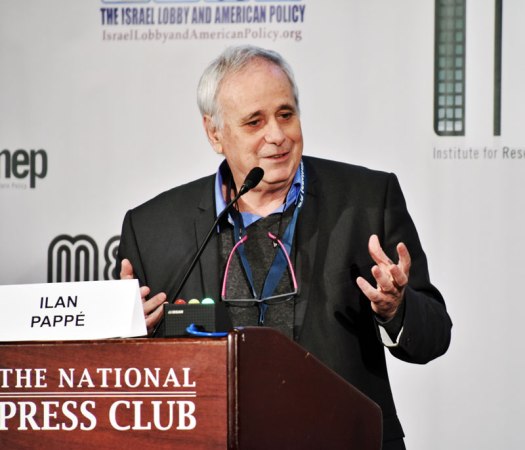
Ilan Pappé speaking at the conference The Israel Lobby and American Policy in Washington, DC, on March 24, 2017. (photo: Phil Portlock)

The Biggest Prison on Earth: A History of the Occupied Territories by Ilan Pappe, Oneworld Books (2017)

By Rod Such / The Electronic Intifada
September 18, 2017


Everything that followed the 1967 War, notes Pappe, follows the “logic of settler colonialism” and that logic in turn foresees the eventual elimination of the indigenous Palestinians. That outcome, however, is not inevitable. An alternative is possible, Pappe maintains, if Israel decolonizes and makes “way for the logic of human and civil rights.”


As early as 1963 — four years before the 1967 War — the Israeli government was planning the military and administrative takeover of the West Bank, according to The Biggest Prison on Earth, a new book by the Israeli historian Ilan Pappe.

The planning for that operation — codenamed Granit (granite) — took place over a month on the campus of Hebrew University in the Givat Ram neighborhood of western Jerusalem. Israeli military administrators responsible for overseeing Palestinians within Israel joined military legal officials, interior ministry figures and private attorneys to create the judicial and administrative decrees required to rule over the one million Palestinians then living in the West Bank.

These plans were part of a larger strategy for placing the West Bank under military occupation. That strategy was codenamed the Shacham Plan for the Israeli colonel, Mishael Shacham, who authored it, and was formally presented by the Israeli chief of general staff to the army on 1 May 1963.

Continue reading “Why the Occupation is No Accident”

Crusaders and Zionists

68407
(image: Christianity Today)

By Uri Avnery / Antiwar.com
September 2, 2017


“When you were writing your book, did you ever think about the similarities between the Crusaders and the modern Zionists?” [the author inquired.]
“Actually, I hardly thought about anything else. I wanted to subtitle the book ‘A Guidebook For the Zionist About How Not To Do It,’ but my Jewish friends advised me to abstain from doing so.”
— British Historian Seven Runciman


A few days ago I found myself in Caesarea, sitting in a restaurant and looking out over the sea. The sunbeams were dancing on the little waves, the mysterious ruins of the ancient town arrayed behind me. It was hot, but not too hot, and I was thinking about the crusaders.

Caesarea was built by King Herod some 2000 years ago and named after his Roman master, Augustus Caesar. It once again became an important town under the Crusaders, who fortified it. These fortifications are what now makes the place a tourist attraction.

For some years in my life I was obsessed with the Crusaders. It started during the 1948 “War of Independence,” when I chanced to read a book about the crusaders and found that they had occupied the same locations opposite the Gaza strip which my battalion was occupying. It took the crusaders several decades to conquer the strip, which at the time extended to Ashkelon. Today it is still there in Muslim hands.

After the war, I read everything I could about these Crusaders. The more I read, the more fascinated I became. So much so, that I did something I have never done before or after: I wrote a letter to the author of the most authoritative book about the period, the British historian Steven Runciman.

To my surprise, I received a handwritten reply by return of post, inviting me to come and see him when I happened to be in London. I happened to be in London a few weeks later and called him up. He insisted I come over immediately.

Continue reading “Crusaders and Zionists”