

Omaha schools cancel Palestinian speaker

Parents and Anti-Defamation League complained in advance of a visit by a Palestinian Christian activist.
By The Times of Israel / Oct 6, 2017
Officials in a Nebraska school district have canceled scheduled talks at two high schools by a Palestinian Christian speaker due to concerns that Jewish students at one of the schools were being harassed ahead of her visit.
Nora Carmi is a Palestinian Boycott, Divestment and Sanctions (BDS) activist from Jerusalem who’s holding talks around the US this year, including a stop last week at Creighton University in Omaha.
University of Chicago faculty and students smeared as “terrorist supporters”

The David Horowitz Freedom Center targets supporters of Palestine and brands them as “terrorists” or “terrorist supporters.”
By Alex Ward / The Chicago Maroon / Oct 1, 2017
“I was scarcely aware of the existence of the Horowitz Center [before seeing my picture on the poster]. But a few minutes researching their activities reveal it to be a front organization for a hate group that seeks to defame and intimidate anyone who dares to criticize the state of Israel by calling them a terrorist, linking them to Hamas, and (of course) denouncing them as an anti-Semite. This is a thoroughly despicable group that perpetrates lies and slander directed at American universities and their students and faculty. I recommend that you look at the Southern Poverty Law Center’s account of David Horowitz’s career.”
— University of Chicago professor W. J. T. Mitchell
Over the past week, posters targeting members of the University of Chicago community as “terrorist supporters” appeared around campus and have since been removed by the University. The posters included the names of 26 members of the University community, including the names and drawings of the faces of two members of the faculty.
The students named on the posters are affiliated with the Muslim Students Association (MSA), Students for Justice in Palestine (SJP), Jewish Voice for Peace (JVP), and U of C Divest. The David Horowitz Freedom Center placed similar posters on campus in October of 2016 and May of this year, after College Council (CC) approved a resolution calling for the University to divest from companies connected to the Israeli occupation in May 2016.
Continue reading “University of Chicago faculty and students smeared as “terrorist supporters””
Save the Children says Gaza has become unlivable for its one million children
What is BDS?
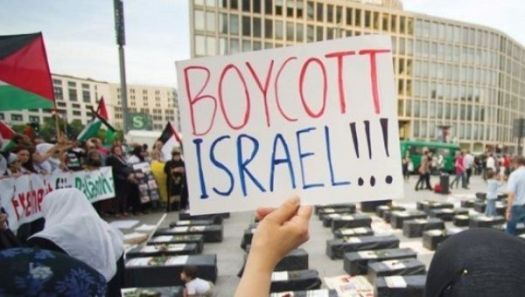
BDS is a global non-violent movement using economic pressure to oppose to Israel’s military occupation of the West Bank and Gaza.
By Ramzy Baroud / Telesur / Oct 1, 2017
What are the goals of BDS?
- End the military occupation of the West Bank, Gaza, and other Palestinian lands.
- Allow Palestinian refugees to return to their homes.
- Assure equal rights for all Israeli citizens, regardless of ethnicity or religion.
The BDS Movement was the outcome of several events that shaped the Palestinian national struggle and international solidarity with the Palestinian people.
BDS stands for Boycott, Divestment and Sanctions. The BDS Movement was the outcome of several events that shaped the Palestinian national struggle and international solidarity with the Palestinian people following the Second Uprising (Intifada) in 2000.
Building on a decades-long tradition of civil disobedience and popular resistance, and invigorated by growing international solidarity with the Palestinian struggle as exhibited in the World Conference against Racism in Durban, South Africa in 2001, Palestinians moved into action.
Israeli settlers turn archeological sites into political tools
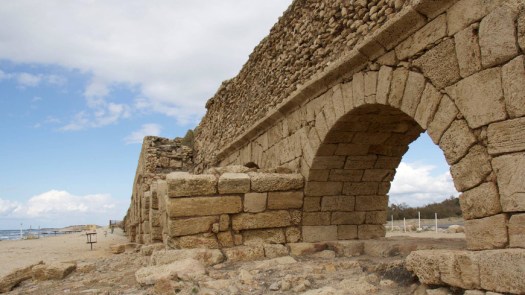
Every year, some 100,000 women, children and men visit the Biyar Aqueduct, built some 2,000 years ago to supply water to Jerusalem and the Jewish Temple.
By Akiva Eldar / Al-Monitor / Oct 3, 2017
“There is clear evidence at the Biyar Aqueduct — as there is at other sites — of the presence of the sons of the Judean Kingdom or of Jews at various periods. The problem is that these sites are being used as propaganda tools to establish the right of Jews to those lands, and the multicultural aspect of thousands of years of history is sidelined or even wiped out of the whole story.”
— Archaeologist Yonathan Mizrachi
The Israeli left made no bones about its glee over the empty bleachers at the September 27 jubilee celebration of the liberation of Judea, Samaria, the Jordan Valley and Golan Heights organized by the settlers in the occupied West Bank. The left views the photos of the empty seats as proof of the settlers’ failure to occupy the hearts and minds of the general Israeli public. The leftists argue that not only did the billions poured by successive Israeli governments into the settlements for 50 years lure fewer than 5% of Israelis to live there — about 400,000 according to the Israel Central Bureau of Statistics — the vast majority avoided the wasteful “liberation festival.”
Yet the pleasure taken by the left in the seeming failure of the settlers and their patrons is somewhat pathetic. Granted, the right-wing concept of a return to the land of the forefathers has not created a major demographic shift of Israelis moving to the settlements. Nonetheless, the notion has ingrained itself in the minds of broad swathes of the Israeli public and of tens of thousands of visitors from around the world. It happens daily in Jerusalem’s Old City and throughout the West Bank.
Continue reading “Israeli settlers turn archeological sites into political tools”
Administrative detention “worst of all possible worlds”
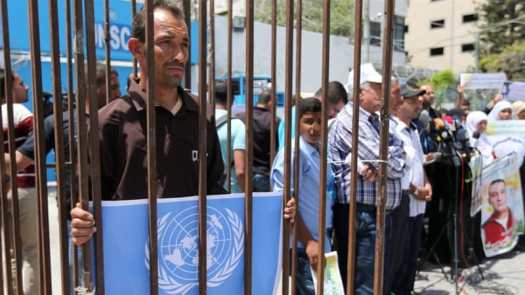
Critics blast Israel’s practice of holding Palestinians on secret evidence, without charge or trial.
By Dalia Hatuqa / Al Jazeera / Oct 3, 2017
“For the last 50 years, Israeli authorities have been using administrative detention as a substitute for criminal proceedings in cases where there’s not enough evidence [for formal proceedings].”
— Magdalena Mughrabi, Amnesty International deputy director for the Middle East and North Africa
At first glance, a legislator, a circus performer and an NGO worker might not appear to have much in common. But all three Palestinians are former or current political prisoners who have been subjected to an obscure legal procedure called administrative detention, which allows Israel to imprison people without charge or trial for an indefinite amount of time.
Israeli authorities have been using this procedure for more than half a century, basing it on secret evidence. The Palestinian Prisoners Society, a detainee support group, noted a sharp rise in administrative detentions in August, with more Palestinians held without trial than during any other month this year. The rise, to 84 detentions, came amid increased tensions in the occupied West Bank after the stabbing of three Israeli settlers by a Palestinian on July 21.
As of September, there were 449 administrative detainees being held in prisons inside Israel, almost all of them Palestinian, according to data provided to rights group Hamoked by the Israel Prison Service.
Continue reading “Administrative detention “worst of all possible worlds””
Majority of Britains think UK should recognize the State of Palestine
A majority of the British public believe the UK should recognize Palestine as a state, according to a recent poll.
By Middle East Monitor / Sep 25, 2017
“I have been here for 11 years and have noticed dramatic changes in the British public’s views on Palestine. That only 14 percent say they wouldn’t want the Palestinian state to receive recognition is an indication of the Palestinian cause worldwide being accepted.”
— Manuel Hassassian, Palestinian ambassador to the UK
A majority of the British public believe the UK should recognize Palestine as a state, according to the results of a new YouGov poll published Monday.
53 percent of respondents said they agree with such a step, as opposed to just 14 percent who disagreed (33 percent said they were “neutral”).
Responding to the poll, Manuel Hassassian, Palestinian ambassador to the UK, said public opinion has been shifting. “I have been here for 11 years and have noticed dramatic changes in the British public’s views on Palestine,” he said.
“That only 14 percent say they wouldn’t want the Palestinian state to receive recognition is an indication of the Palestinian cause worldwide being accepted,” he added.
Continue reading “Majority of Britains think UK should recognize the State of Palestine”
Catholic monastery near Jerusalem vandalized
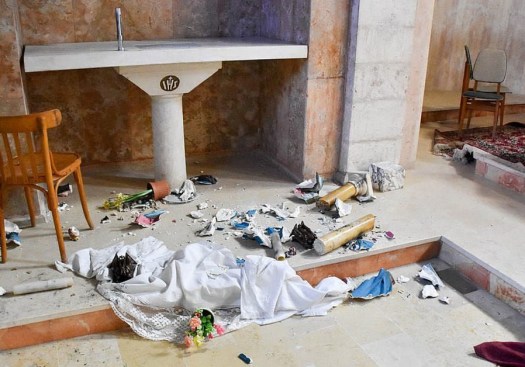
For the third time in four years, the Beit Jimal Monastery has been vandalized in a “price tag” attack.
By Daniel Eisenbud / The Jerusalem Post / Sep 23, 2017
Ed. note: “Price tag” attacks are acts of vandalism by Jewish fundamentalist settler youths aimed Palestinians, Christians, left-wing Israeli Jews, Israeli security forces, and others seen as opposing the settlement enterprise.
According to the Latin Patriarchate of Jerusalem, vandals on Wednesday night shattered stained-glass windows depicting passages from Jesus; destroyed a statue of the Virgin Mary; and damaged furniture.
Bishop Boulos Marcuzzo, patriarchal vicar in Jerusalem, called for tolerance after deeming the ransacking “not only an act of vandalism, but an action against the sacredness of the holy places and the faith of people.”
“The Holy Land is deep [in] faith and culture,” Marcuzzo said in a Friday statement. “We must live together with the diversity of beliefs. It is absolutely necessary to accept others, to accept each other in our diversity.”
Continue reading “Catholic monastery near Jerusalem vandalized”
Holocaust survivor’s speech censored in UK
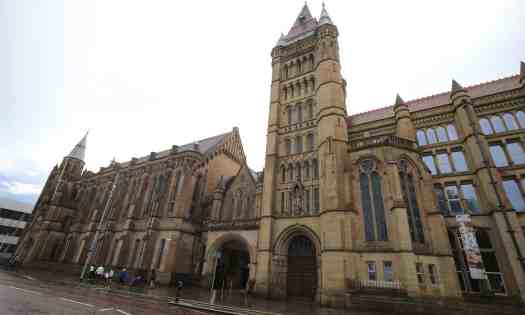
Manchester University censored the title of a Holocaust survivor’s criticism of Israel and insisted that her campus talk be recorded, after Israeli diplomats said its billing amounted to antisemitic hate speech.
By Damien Gayle / The Guardian / Sep 29, 2017
“These events will cause Jewish students to feel uncomfortable on campus and that they are being targeted and harassed for their identity as a people and connection to the Jewish state of Israel.”
—Michael Freeman, Israeli embassy’s counsellor for civil society affairs“In educational institutions there shouldn’t be any sort of lobbying from foreign governments. You couldn’t imagine [the administration] sitting down with the Saudi embassy for an event about what’s going on in Yemen.”
— Huda Ammori, event organizer
Marika Sherwood, a Jewish survivor of the Budapest ghetto, was due to give a talk in March about Israel’s treatment of the Palestinians, headlined: “You’re doing to the Palestinians what the Nazis did to me.”
But after a visit by Mark Regev, the Israeli ambassador, and his civil affairs attaché, university officials banned organizers from using the “unduly provocative” title and set out a range of conditions before it could go ahead.
Continue reading “Holocaust survivor’s speech censored in UK”
 HolyLandJustice.org
You must be logged in to post a comment.