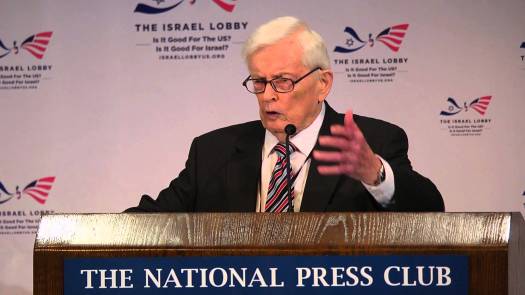
Findley was that rare member of the U.S. Congress who ignored memos from foreign governments. He understood the danger of allowing the state of Israel to control American foreign policy in the Middle East.
On the day Yasser Arafat died, Nov 9, 2004, former Illinois Republican Congressman Paul Findley wrote an article to describe the relationship he had with the Palestinian leader.
Paul Findley knew then, and he knows now, that if enough members of Congress had joined with him in favor of talking with Yasser Arafat, Israel’s control over American policy might well have shifted in a different direction.
His article was published in the Daily Star, a Beirut, Lebanon, publication, on the occasion of Arafat’s death, 75, in a Paris hospital. Arafat had been under essential house arrest in his Ramallah headquarters. When he became ill, Israel moved him to Paris.
The failure of Finley’s news-worthy piece to find significant American exposure was further evidence of just how much Israel and its American allies fear an influential man like Paul Findley.
“Removing a respected Palestinian academic as chair of a panel event based on an unsubstantiated assumption about her lack of ‘neutrality,’ and in doing so bowing to external pressure from a pro-Israel lobby group, cannot be construed as anything other than a naked attack on free speech and, more particularly academic freedom.”
— Cambridge University student Ed McNally
The University of Cambridge is facing accusations of censorship after it allegedly threatened to ban a meeting about the Boycott, Divestment, and Sanctions (BDS) movement unless the Palestinian academic chairing it was removed and replaced with its own choice.
Ruba Salih from the School of African and Oriental Studies (SOAS) was set to oversee Wednesday’s event featuring Palestinian BDS activist, Omar Barghouti, but organizers say they were forced to cancel her participation hours before it was due to start after the university intervened citing concerns over her neutrality.
Israel, [Kairos] states, is the “enemy” who stands in opposition to God himself. Its “occupation,” according to Kairos Palestine, “is an evil that must be resisted.”
[Kairos] advocates peace with justice, rejects and condemns violence and extremism . . . . It offers a word of hope and of love, while naming the injustice of the occupation.
From AJC New England:
Over the last decade, a number of mainline Protestant Churches, including some with a significant presence in New England, have adopted resolutions harshly critical of Israel. During the summer two more were passed by the United Church of Christ and the Disciples of Christ. These measures share three core elements: Each assigns Israel near total culpability for the conflict with the Palestinians; each overlooks decades of Palestinian activity that has undermined prospects for peace with Israel; and each justifies its claims by referring to a document called Kairos Palestine. . . .
This appeal reduces the complex, painful history of the Palestinian-Israeli conflict to a single word: “occupation.” Information that might contradict Kairos Palestine’s far-reaching declaration is ignored. Gone from the historical narrative are . . . multiple Israeli peace proposals, rejected by Palestinian leadership, that included withdrawal from nearly all of the West Bank; acts of terror that have caused thousands of Israeli casualties; thousands of missiles that followed Israel’s withdrawal from Gaza; and repeated calls by Palestinian religious, civic, and political leaders to reject peaceful coexistence with Israel on any terms.
. . . Because the voices of Palestinian Christians are among the voices that need to be heard, our churches commended Kairos Palestine for study, reflection, and response in April 2010, five months after it was issued. The document is written by Palestinian Christians who have lived under Israeli occupation for half a century — a people whose rights are denied every day. Kairos Palestine is an authentic and legitimate voice of a community with which we have close relations, a document that advocates peace with justice, rejects and condemns violence and extremism, and seeks better relationships among all the people of Israel and Palestine. It offers a word of hope and of love, while naming the injustice of the occupation.
We are eager to engage with the multiple perspectives of our sisters and brothers in the Jewish community on Israel and Palestine, and hope that Leikind and the American Jewish Committee would be willing to speak more publicly and critically of the settlements and of occupation, which cannot go on indefinitely, but which must be addressed more urgently.
The crimes against the Palestinians should not have to match the Holocaust before we can express our horror or outrage.
Dear Professor Schama,
I’ve just read your letter to The Times this week about Zionism and antisemitism in the Labour Party, co-signed by your fellow historian Simon Sebag Montefiore and novelist Howard Jacobson. As you’re the senior academic, I’m addressing my concerns to you, although I’m slightly embarrassed at having to offer someone of your reputation a history lesson.
While I’m sympathetic to some of your points over the language and tone of the Israel/Palestine debate in some parts of the British left, overall your letter only adds to the lock down of freedom of speech on Israel by attempting to make criticism of Zionism toxic by association. That doesn’t feel like a good position for you to take as a public intellectual.
Your letter makes questioning either the theory or outcomes of Zionism politically, socially and morally unacceptable. In my view, that does little to help our understanding of Zionism, modern Jewish history, or traditional rabbinic Judaism. And, like others before you, you are muddying the meaning of antisemitism.
“Whilst we do not ban independent travel to, or study in, the Palestinian territories, students cannot choose to spend their Year Abroad in the West Bank for the time being due to recent difficulties faced by students in securing visa renewals from the Israeli authorities.”
The University of Cambridge has banned its students from studying in the Palestinian territories on their year abroad.
In a statement, the University said that the decision was made “due to recent difficulties faced by students in securing visa renewals from the Israeli authorities.”
It is the first time that a destination of study has been marked unacceptable since 2011, when Syria was removed as a result of the civil war.
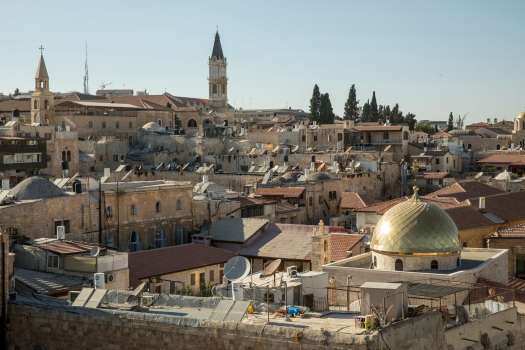
The view from the roof of the Citadel youth hostel in the Old City of Jerusalem. (photo: David Levene / The Guardian)
For its Season of Culture, the ancient capital has thrown open its rooftops to encourage residents to see beyond their blinkered boundaries. But the reality is a city where the divides are growing deeper.
“All three religions are here on this roof. It is a holy place. Sometimes I sit here and I pray to God and I feel that the angels come and sit here with me. Up here it does not matter if you are a Muslim or a Jew: we are all just human beings. Real peace will only come when we remember this. And I’m talking about real peace — not the peace that politicians speak about — and that’s why I open up my house, to bring people together with food.”
— Abu Yehia
The rooftops of Jerusalem can be deceptive. From up here, the domes and towers of the hundreds of churches, mosques and synagogues glimmer on the skyline in what seems like peaceful coexistence; the neighborhoods below come together in a unified sprawl.
But down below, it is a city defined by barriers. They may not be as tangible as the towering security wall that divides Israel and the Palestinian territories a few miles east, but they are just as divisive and inviolable. Living side by side in Jerusalem are communities who exist with no interaction with one another — kept apart by fear, nationalism and religion.
Pray not for Arab or Jew,
For Palestinian or Israeli,
But pray rather for ourselves,
That we might not divide them
In our prayers, but keep them
Both together in our hearts.
— Based on a prayer by a Palestinian Christian
The dollar cost of supporting injustice and oppression in the occupation of the residents of the West Bank, East Jerusalem and Gaza is in the billions. In “The True Cost of Israel,” Philip Giraldi, a former CIA officer who is executive director of the Council for the National Interest wrote in April 2017, that according to the Congressional Research Service, Israel has been “the largest recipient of US foreign assistance since World War II.” The US has given Israel financial aid averaging about 3.6 billion dollars per year since 1948, not including extra defense appropriations, and this calculation of funding is an underestimate because US appropriations are redeposited in the US treasury, which operates on a deficit. As Israel draws down its account, the US taxpayer pays about $100 million more in interest per year. Furthermore, loans have been made that are not repaid, and Israel enjoys preferential trade status with the US. This year, congress approved $3.8 billion to begin on October 1.
In addition to “public assistance” to Israel, private foundations and tax-exempt charities, covered by “religious exemption,” are raising billions of dollars in donations that benefit Jewish settlements. Says Giraldi, “money being fungible, some American Jews have been surprised to learn that the donations they had presumed were going to what they regard as charitable causes have instead wound up in expanding the illegal settlements on the West Bank.” Not long ago, it came to light that a foundation of the family of Jared Kushner, the President’s son-in-law, had made contributions to an Israeli settlement. In his report, Giraldi cites additional ways and means that AIPAC (American Israel Public Affairs Committee) raises US funds for Israel.[1]Continue reading “Where do we go from here?”
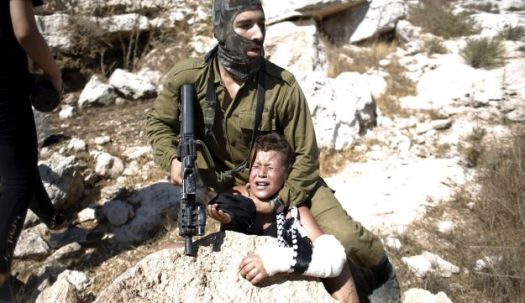
Israel has the distinction of being the only country in the world that each year detains and prosecutes in military courts between 500 and 700 children, some as young as 12 years, most often for throwing stones, In February 2016, 440 children were in the military system, a quarter of them between 12 and 15 years. The Israel Prison System stopped releasing data after May 2016.
Restrictions on economic development and trade
Many Palestinians now work for the Israelis — most often in construction. About 60,000 of an estimated 100,000 have work permits that allow them to work in the settlements or over the Green Line. Most of those who do not have permits work in menial, low-paid jobs and take the risk of working illegally because unemployment is now so high in Palestine. As such, these workers have little control over their working conditions or compensation.
The productive sectors, including agriculture, manufacturing and tourism are on “artificial respiration” according to Ha’aretz (Nov. 2016). Agricultural and industrial output was now only about 15% of the economy. Because of Israeli restrictions on development, control of land and water resources as well as transportation and trade, regulation of the import and export of materials and goods, Israel has significantly impacted the sustainability of the Palestinian economy. Amira Haas writing in Ha’aretz in 2013 on restrictions that weaken competitiveness of Palestinian business vis-a-vis Israeli farmers, manufacturers and hi-tech companies quoted an outgoing World Bank director saying that “. . . unleashing the potential from ‘withheld land’ — access to which constrained by layers of restrictions and allowing the Palestinians to put these resources to work would provide whole new areas of economic activity and set the economy on the path to sustainable growth.” Continue reading “Why Palestinians are leaving, part 2”
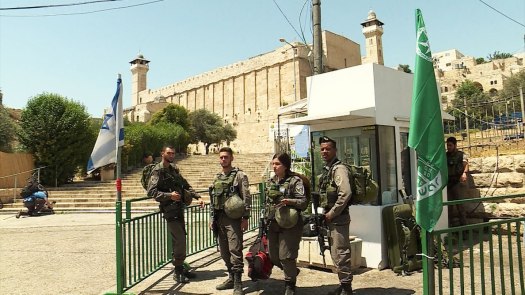
Following the death of Abraham . . . we read: “his sons Isaac and Ishmael buried him in the cave of Machpelah near Mamre.” (Genesis 25:9) I can’t help but think this short verse says all that needs to be said about that godforsaken cave. It’s long past time to bury the dead and get on with living.
The Torah portion for this Shabbat, Chayei Sarah (Genesis 21:1-25:18) begins with a complex description of Abraham’s purchase of the cave of Machpelah as a burial place for his wife Sarah — a site that eventually becomes the familial burial plot for the Patriarchs and Matriarchs.
The name “Machpelah” literally means “the doubled one” for reasons that are not entirely clear. According the Midrashic legend, Adam and Eve were the first to be buried there. In a Talmudic debate (Eruvin 53a), Rav suggests the cave had two levels, while Rabbi Shmuel says it contained tombs in pairs. Abahu comments that anyone buried in the cave had a double portion in the world to come.
But there is a more compelling reason why this site might be called “the doubled one.” It has literally functioned for centuries as both a synagogue and a mosque.
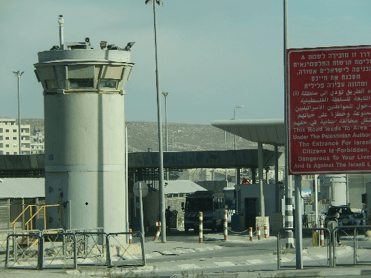
Not too long ago, I rode with a priest who had such a permit to visit Bethlehem, about five miles south of Jerusalem. His mother and the mother of his fiancée planned to ride along to visit the Church of the Nativity. We were stopped at the checkpoint and refused entry because the women, who lived near Nazareth, were Israeli citizens — no other reasons given.
A comprehensive report published in December 2016, by B’tselem (Israeli Information Center for Human Rights in the Occupied Territories) lays out the various ways and means that Israel has continued to appropriate and transfer Palestinian lands to Jewish settlers. Established in 1987 by prominent Israeli academics, lawyers and journalists to educate the Israeli public and members of parliament about human right violations in the occupied territories, this organization conducts in-depth research and publishes well documented reports about the “devastating repercussions [of] the fragmentation of Palestinian space into isolated enclaves, cutting communities off from essential land resources that are vital to their development.” The report concludes that “the forced separation of the Palestinian villages from their farmlands, pastureland and natural water resources [has] severely infringed upon their rights, devastated the local economy and propelled them into poverty and dependence on external bodies” at many levels of insecurity — social, economic, food and water. An encyclopedia of human and civil rights abuses must include an expanding array of restrictions on land use, water access, freedom of movement of people and goods, educational and economic development, and civil and political rights that have been imposed upon the Palestinian population.
For hundreds of years, Palestinian villages have been largely self-sufficient, depending on sustainable dry-land farms and orchards, livestock and shepherding for a living. Conservation of rainwater that has seeped into the limestone and the use of cisterns to collect surface runoff have provided a sufficient water supply. Most of the produce was consumed by the people themselves, but road access to larger towns and cities allowed them to reach bigger markets for agricultural surplus and the products of small business. Continue reading “Why Palestinians are leaving, part 1”
You must be logged in to post a comment.