I was always concerned about the brainwashing that’s built in to [Birthright] trips.
But I also believe in young people’s hearts and minds; I believe that awareness and exposure can change mindsets. I insist on meeting Birthright groups, I insist on speaking to people who disagree with me.
Birthright is reportedly ordering their trip providers to stop meetings between their participants and Arab citizens of Israel. In their own words, “there is a need for further analysis of this module.”
I read these lines over and over again and could not trace my thoughts fast enough. My responses went from laughing out loud, to wanting to smash the nearest available wall, to being entirely unsurprised.
“Further analysis” on how and if to meet Arabs?
Maybe they mean to say Birthright participants should meet only the properly vetted and defanged “good pro-Israel Arabs,” because they’re scared delicate Birthrighters might be exposed to critical thought? After all, what a disaster it would be to raise a generation of Jews who dare to think critically about Israel. Continue reading “Birthright is so scared of Arabs, it has banned them!”
Birthright’s conviction that its participants should not encounter Palestinian citizens is a troubling sanitization — one that does justice neither to young Diaspora Jews nor to Israel itself. Rather than ask American Jews to face Israel in all its complexities and contradictions, Birthright has chosen to offer what one congressman once described to me as “Disneyland Israel” after a trip by the American Israel Public Affairs Committee that met with no Palestinians.
So they will never know Wadeea.
This was the thought that came to me as I read the disappointing news that Birthright has chosen to end meetings with Arab citizens of Israel, who make up one-fifth of Israel’s population. Birthright’s official statement explained that “there is a need for further analysis” of such meetings before they can proceed.
Wadeea and I met in his hometown of Kafr Qasim, a city of Palestinian citizens of Israel, t2 miles east of Tel Aviv. Wadeea heard I was from New York, and he wanted to make sure I knew how much he hated the Knicks. I challenged him to a game of one-on-one. We found a court between Kafr Qasim and Rosh HaAyin and played well past dusk. The next time I was in Israel we smoked hookah, watched Barcelona beat Madrid and discovered that we both write fiction. Continue reading “Why doesn’t Birthright believe in Israeli democracy?”
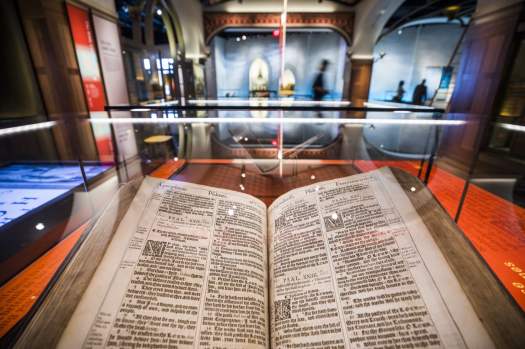
The Museum of the Bible reflects the discouraging state of Christianity — especially evangelicalism — in the United States today. It is lavishly funded and larger than life to the point of performance, often literally. Yet the approach is strangely superficial given the wealth of complexity inherent to its subject. There are dozens of illuminated manuscripts, but it’s unclear whether they’ve been read.
Somewhere between the surround-screen animation of the New Testament and the backlit glass case containing Elvis Presley’s personal Bible, I began to feel a bit overwhelmed. It was bound to happen; the guide made it clear that the Museum of the Bible was meant to be a highly stimulating experience.
Educational too, of course. The new museum’s purpose, as stated in its promotional materials and in the carefully bland speeches of its largely evangelical Christian board, is to invite all people to “engage” (their preferred word) with the most popular book in the world. There was a lot to see: more than $500 million worth of artifacts, interactive exhibits and performance space in a 430,000-square-foot building three blocks from the Capitol. But actual grappling with the Bible and its implications was an afterthought.
Then-Prime Minister Levi Eshkol and Defense Minister Moshe Dayan onboard a helicopter while touring army installations in the West Bank, Sep 1967. (photo: Ilan Bruner / GPO)
Newly declassified Israeli Security Cabinet documents show government ministers planning to force Palestinians from their land.
“We should deal with this issue quietly, calmly and covertly, and we should work on finding a way for [the Palestinians] to emigrate to other countries and not just over the Jordan [River]. Perhaps if we don’t give them enough water they won’t have a choice, because the orchards will yellow and wither. Perhaps we can expect another war and then this problem will be solved.”
— Israeli Prime Minister Levi Eshkol, 1967
“Empty” the Gaza Strip, “thin out” the Galilee, rewrite textbooks and censor political cartoons in Haaretz: These are among the proposals discussed by cabinet ministers after the Six-Day War that will be available to the public in a major release of declassified government documents by the Israel State Archives on Thursday.
The material being posted on the state archives’ website includes hundreds of pages of minutes from meetings of the security cabinet between August and December 1967. From reading them, it is clear that in the several months that followed the June 1967 war, members of the security cabinet were perplexed, confused and sometimes helpless in the face of the new challenges to the state.
Israel conquered East Jerusalem, the West Bank, the Gaza Strip, the Golan Heights and the Sinai Peninsula in under a week. It was not even remotely prepared for this scenario, and had to hit the ground running. Continue reading “Planning the ethnic cleansing of Palestine”
A Palestinian worker on a construction site in the city of Bethlehem, in the southern occupied West Bank, Sep 27, 2017. (photo: Chloé Benoist / Equal Times)
The land isn’t the only thing that is occupied in Palestinian — so is the economy.
The hundreds of thousands of Palestinians who found themselves under Israeli military control in 1967 quickly became a source of blue-collar labor for the Israeli economy, performing jobs that few Israelis were willing to do, for far less money and with far fewer legal protections.
Despite having spent 30 years of his life working as a carpenter in Israel, and the past 17 years as a farmer in the southern part of occupied West Bank, Mohammad Issa Salah, 70, still finds himself struggling to make ends meet.
“Here, the cost of living is like Europe, but the wages are like Africa,” the elderly Palestinian from the village of al-Khader tells Equal Times, in what little English he remembers from school.
The old man’s situation is hardly an exception. With a quarter of Palestinians living under the poverty line, and a similar unemployment rate, Palestinians have struggled for decades to make a living and assert their rights in the workplace.
You start out framing JVP as so bad that when you say white nationalists are bad, you say it by saying they are as bad as the JVP. So JVP becomes the standard of badness against which to measure just how bad neo-Nazis are.
Here is a clever but repellent variation of hasbara, or propaganda for Israel: New York Times columnist Bret Stephens equates Jewish Voice for Peace with white nationalists, because JVP supports Palestinian rights. In “Steve Bannon Is Bad for the Jews,” Stephens sets out to condemn the Zionist Organization of America for welcoming Steve Bannon to its gala the other night. Why? Because Bannon is an anti-Semite, just like JVP.
Here’s Stephens’s logic:
[W]hen a far-left group such as Jewish Voice for Peace makes common cause with someone like Linda Sarsour — the Palestinian-American activist who advocates the elimination of Israel as a Jewish state and publicly praised a convicted terrorist — it disqualifies itself as an advocate of any Jewish interest save its own. To deny Israel’s right to exist, as U.N. Secretary General António Guterres noted in April, is “a form of modern anti-Semitism.”
It also means that when a right-wing Jewish group such as the ZOA chooses to overlook Bannon’s well-documented links to anti-Semitic white nationalists, it puts itself on a moral par with JVP.
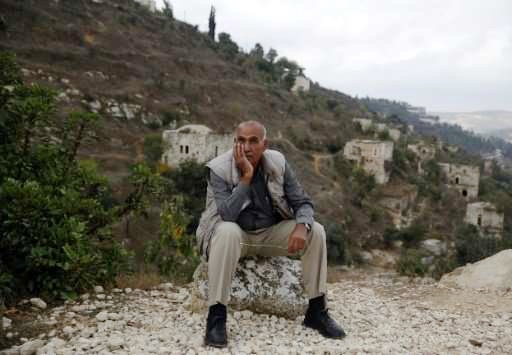
Yacoub Odeh, a 77-year-old Palestinian, who grew up in the ghost village of Lifta, before fleeing during the 1948 war and the creation of Israel. (photo: phys.org)
The 13th-Century-BCE village is on a list of tentative UNESCO World Heritage sites, but is slated for commercial development.
“It is frozen evidence of the issue of the destroyed villages. That’s why it annoys the Israeli land authority, because they don’t want it turned into a sort of non-official monument for the destroyed villages.”
— architect Shmuel Groag
Near the stone ruins of the home where he says he lived as a boy, Yacoub Odeh laments that his native village on Jerusalem’s hillside may soon be transformed forever.
“I want to come back to my home, to my house, to my village, to my land,” the 77-year-old said.
Lifta, an abandoned former Palestinian village in a bucolic spot at the entrance to Jerusalem, is at the centre of a preservation fight over an Israeli plan to build villas there.
It is a rare example of a village that still exists after its Palestinian inhabitants fled in the 1948 war surrounding the creation of Israel, though its history extends much farther back in time.
The village, in mainly Jewish West Jerusalem, is on a tentative list of UNESCO World Heritage sites, and the World Monuments Fund organization has put it on its list of sites under threat. Continue reading “Ghost village in Jerusalem may soon vanish”
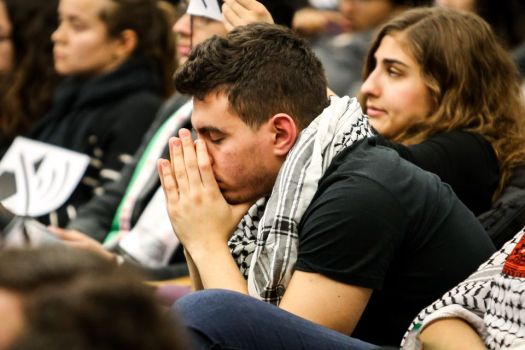
A student listens to a speaker during a University of Michigan Student Government meeting to vote on a resolution to divest in businesses connected to Israel, Nov 14, 2017. (photo: Hunter Dyke / The Ann Arbor News)
The resolution passed after an 8-hour meeting, following a series of failed attempts dating back to 2002.
“By passing [the resolution] what we are saying to Palestinian students is we acknowledge for the first time that this is an issue that deeply affects their everyday campus experiences, and that the broader campus owes it to them to have a real institutional conversation about it. Nowhere in that validation and humanization of one group of students does this resolution isolate or marginalize another group.”
— student government member Hafsa Tout
The University of Michigan’s Central Student Government is calling on university leaders to investigate divestment from companies that do business with Israel.
UM’s student government passed the motion with 23 members voting in favor and 17 against the motion stating that three companies “violate Palestinian human rights,” while five members abstained.
The meeting stretched nearly eight hours — the longest in student government history — before a vote was conducted under secret ballot, which was done after much debate to protect pro-Palestinian and divestment members from being subject to damaging online blacklists.
The resolution was passed to investigate divesting in Israel after 10 previous attempts since 2002. The vote tally was dramatically different than last year’s resolution, which was voted down 34–13.
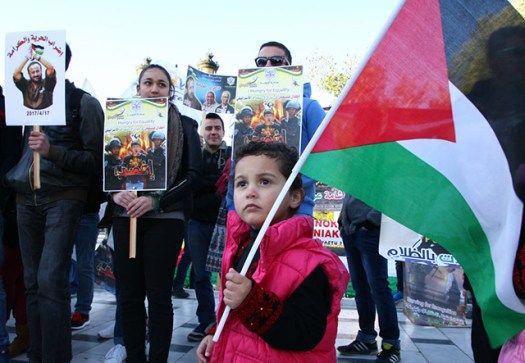
People take part in a demonstration of Palestinians living in Greece to mark the Palestinian Prisoners Day, in Thessaloniki, Greece, on Apr 21, 2017. (photo: Grigoris Siamidis / NurPhoto via Getty Images)
The No Way to Treat a Child movement bears legislative fruit.
The bill [introduced in] Congress this week is a significant step forward for all those who want to align our values with the actions — and aid monies — of our government. Now we need the rest of Congress to act by swiftly passing this breakthrough legislation. Looking at what has been accomplished since a small group of us sat at my kitchen table three years ago, agonizing over how to end these abuses, I know this vital change is possible.
Imagine you are a child between the ages of 12 and 17 years old. The army comes to your home in the middle of the night, wakes you from your bed, blindfolds you and ties your hands with plastic cuffs.
Your parents’ pleas do not stop the soldiers from roughly taking you and throwing you in their Jeep, never telling you or your parents what you are charged with or where you are going.
You arrive at a detention cell in an Israeli settlement where you are interrogated without a lawyer or family member present, and you are pressured to confess to throwing stones so you can go back home to your family. Once you sign the confession, written in a language you can’t read, you then face a military court hearing where a military judge sentences you to prison for three months, in a detention center in Israel where your family members are likely unable to visit.
An Israeli soldier detains a Palestinian boy during a protest against Jewish settlements in the West Bank village of Nabi Saleh, near Ramallah Aug 28, 2015. (photo: Reuters)
This legislation would prohibit US funding from supporting Israeli military detention, interrogation, abuse, or ill-treatment of Palestinian children.
“[We] strongly endorse Rep. Betty McCollum’s Promoting Human Rights by Ending Israeli Military Detention of Palestinian Children Act. In order for the US to play a constructive role in bringing about a comprehensive and sustainable end to the Israeli-Palestinian conflict, we must ensure we are not supporting the continued trauma inflicted on Palestinian youth entangled in the Israeli Military Detention system.”
— Churches for Middle East Peace
“Jewish tradition teaches that each and every single person has inherent dignity and worth and must be treated accordingly. This legislation recognizes and acts upon the inherent dignity and worth of Palestinian children and sends the message that the United States is committed to a future with freedom, safety, and equality for both Palestinians and Israelis.”
— Jewish Voices for Peace
Congresswoman Betty McCollum (DFL-Minn.) today introduced legislation — the Promoting Human Rights by Ending Israeli Military Detention of Palestinian Children Act — to prevent United States tax dollars from supporting the Israeli military’s ongoing detention and mistreatment of Palestinian children. The full text of the bill can be found here.
An estimated 10,000 Palestinian children have been detained by Israeli security forces and prosecuted in the Israeli military court system since 2000. Independent monitors such as Human Rights Watch have documented that these children are subject to abuse and, in some cases, torture — specifically citing the use of chokeholds, beatings, and coercive interrogation on children between the ages of 11 and 15. In addition, the United Nations Children’s Fund (UNICEF) has found that Palestinian children are frequently held for extended periods without access to either their parents or attorneys.
“This legislation highlights Israel’s system of military detention of Palestinian children and ensures that no American assistance to Israel supports human rights violations,” Congresswoman McCollum said. “Peace can only be achieved by respecting human rights, especially the rights of children. Congress must not turn a blind eye the unjust and ongoing mistreatment of Palestinian children living under Israeli occupation.”
You must be logged in to post a comment.