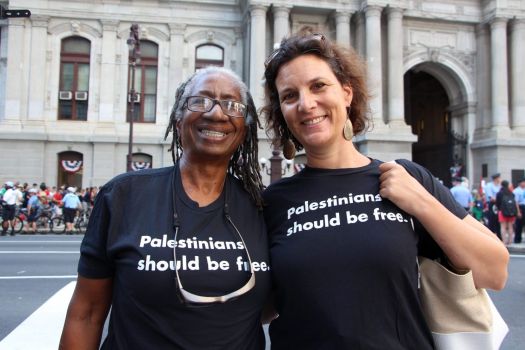
Members of Jewish Voice for Peace and Code Pink, both on Israel’s newly announced BDS blacklist, demonstrate against Israeli military operations in Gaza, Washington, DC, Jul 21, 2014. (photo: Atheer Ahmed Kakan / Anadolu Age)
Here is the complete list of international NGO’s blacklisted by Israel.
US Organizations
American Friends Service Committee
American Muslims for Palestine
Code Pink
Jewish Voice for Peace
National Students for Justice in Palestine
US Campaign for Palestinian Rights
European Organizations
The France Association Palestine Solidarity
BDS France
BDS Italy
The European Coordination of Committees and Associations for Palestine
As long as Israel continues to violate the fundamental rights of Palestinians, people will continue to speak out — Palestinians, Jews, and people of conscience the world over.
The first time I went to Israel I was four months old. Throughout my childhood and young adulthood I visited regularly: My grandparents, in Haifa; and my aunt, uncle and cousins, on a religious kibbutz near the Jordanian border. There was no place, with the exception of the town where I grew up, to which I felt more connected.
As an adult, married to an Israeli, we spent three years living in Tel Aviv with our two young daughters, who also have Israeli citizenship.
In March last year, the Israeli Knesset passed a bill that forbids entry to “foreign nationals who call for economic, cultural or academic boycotts of either Israel or the settlements,” and yesterday, the Ministry of Foreign Affairs announced that as a result 20 organizations have been placed on a blacklist that would prohibit entry specifically to its leaders. That list was published in full Sunday. Jewish Voice for Peace, the organization of which I am executive director, is one of the organizations named.
Despite the fact that my grandparents are buried there, that my aging in-laws still live there, and my extensive ties of friendship and family, my support for the Boycott, Divestment and Sanctions movement (BDS) for Palestinian rights now excludes me from Israel.
Palestinians walk past a sign on a wall in Bethlehem calling for a boycott of Israeli products from Jewish settlements. (photo: Thomas Coex / AFP / Getty Images)
Israel imposes travel ban on 20 foreign NGOs over boycott movement.
“This move is reminiscent of South Africa’s apartheid regime which also prepared blacklists in order to punish people and prevent the entry of those opposed to its racist policies.”
— Hassan Jabareen, of the Legal Centre for Arab Minority Rights in Israel
The prominent British campaign group War on Want has been listed as one of 20 foreign NGOs whose representatives are banned from visiting Israel over their support of the pro-Palestinian boycott, sanctions and divestment (BDS) movement.
The publication of the list, which also includes a well-known Jewish anti-occupation group and a Nobel peace prize-winning US Quaker group, had been threatened for months by Israel.
The organizations were singled out by Israel’s rightwing strategic affairs and public security minister, Gilad Erdan, for advocating boycotts of Israel over its treatment of Palestinians.
Human rights groups condemned the move as an assault on free speech. A number of individuals have been refused entry into Israel in recent months, including a prominent African theologian and official of the World Council of Churches.
“When Israel, which aims to portray itself to the world as liberal and democratic, blacklists activists dedicated to nonviolent organizing and dissent, it only further exposes itself as a fraud.”
— Yousef Munayyer, the director of the Campaign for Palestinian Rights
Israel on Sunday published a blacklist of 20 organizations, including a Jewish group in the United States, whose leaders it has barred from entering the country for supporting an economic, cultural and academic boycott of Israel.
The list was drawn up under a nearly year-old law enacted to combat the so-called boycott, divestment and sanctions movement, which Israelis overwhelmingly oppose, consider anti-Semitic and view as calling for the country’s destruction.
Supporters of the pressure strategy favor the boycott of Israel until it ends the occupation of the West Bank, provides full equality under the law to Palestinian citizens of Israel and grants a right of return to Palestinian refugees. But refugees number in the millions, and their return would probably spell the end of Israel as a Jewish state.
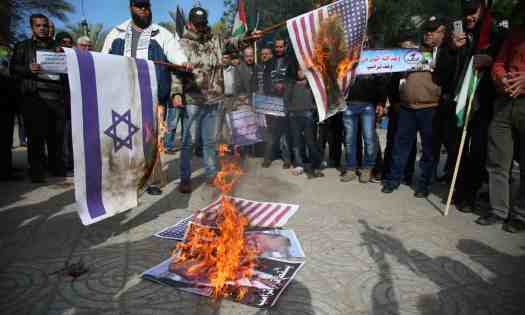
As Palestinian protesters clashed with Israeli soldiers in the West Bank, an Egyptian intelligence officer was quietly working to persuade Egyptians to accept the decision. (photo: Shadi Hatem / European Pressphoto Agency)
Arab governments publicly condemned President Trump’s statement on Jerusalem but criticism in state-owned and pro-government media across the Arab world was muted.
“How is Jerusalem different from Ramallah, really?”
— Egyptian intelligence officer Capt. Ashraf al-Kholi
As President Trump moved last month to recognize Jerusalem as the capital of Israel, an Egyptian intelligence officer quietly placed phone calls to the hosts of several influential talk shows in Egypt.
“Like all our Arab brothers,” Egypt would denounce the decision in public, the officer, Capt. Ashraf al-Kholi, told the hosts.
But strife with Israel was not in Egypt’s national interest, Captain Kholi said. He told the hosts that instead of condemning the decision, they should persuade their viewers to accept it. Palestinians, he suggested, should content themselves with the dreary West Bank town that currently houses the Palestinian Authority, Ramallah.
“It’s over. By tweeting that he has taken Jerusalem ‘off the table’ as an issue he has admitted that US diplomats were lying when they said Jerusalem’s status has not been decided. Instead he is trying to use blackmail and a blame game against the Palestinians. What he is admitting is there is no peace process and no peace plan.”
— Palestinian official, speaking anonymously
Donald Trump’s latest intervention in the Middle East peace process — one he has already upended by recognizing Jerusalem as Israel’s capital — looks to be his most chaotic move yet.
After appointing his son-in-law Jared Kushner as regional adviser and naming the fiercely pro-settlement lawyer David Friedman as his ambassador to Israel, the US president has blundered from crisis to crisis in recent weeks.
His speech recognizing Jerusalem as the Israeli capital breached international consensus and UN resolutions. But the latest move — a threat to cut funding to UNRWA, the UN agency that supports Palestinian refugees, and to the Palestinian Authority — is more dangerous still, demonstrating a lack of understanding of the delicate mechanics that help maintain relative peace between Israelis and Palestinians.
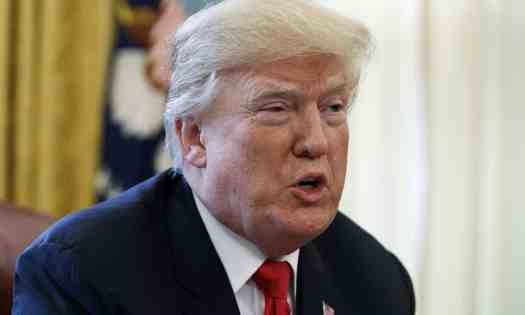
President Trump formally recognizes Jerusalem as the capital of Israel in an address from the White House on Dec 6, 2017. (photo: Kevin Lamarque / Reuters)
Cutting US aid would simultaneously weaken the Palestinian Authority, jeopardize Israeli security, and reduce the ability of the US to broker the peace process.
“Cutting aid to the Palestinians at this stage would have the opposite effect to what the Americans want. . . . The situation in Gaza is terrible. If America cuts its aid, it would be catastrophic.”
— Moshe Maoz, an Israeli professor of Islamic and Middle Eastern studies at the Hebrew University of Jerusalem
“Traditionally, the Israeli defense establishment has resisted pressure by Israeli hawks who want to shut down UNRWA funding. They say, if it’s not UNRWA, then education will be provided by Hamas.”
— Ofer Zalzberg, a senior analyst at the International Crisis Group
President Trump’s threat to cut aid to the Palestinians has the potential to backfire, Israeli security officials and analysts warned Wednesday, saying it could weaken a Palestinian leadership that cooperates with Israel on security matters and fuel extremism by worsening already dire humanitarian conditions.
Palestinian officials accused the United States of using bullying tactics after both Trump and U.N. Ambassador Nikki Haley indicated that the administration may cut funding to the Palestinians if they do not enter into peace talks with Israel. Palestinians “will not be blackmailed,” said Hanan Ashrawi, a member of the Palestine Liberation Organization’s executive committee.
Donald Trump said negotiating on Jerusalem as Israel’s capital was “off the table,” a move that caused protests in Gaza and elsewhere. (photo: ZUMA Wire / Rex / Shutterstock)
Tuesday’s tweets mark a tacit admission by Trump that his decision to move the US embassy in Israel from Tel Aviv to Jerusalem had thrown a wrench into his administration’s plans to restart the peace process.
“The only thing the president has accomplished by saying he’s taking Jerusalem ‘off the table’ is to ensure he’ll have no place at the table where the conflict will be resolved diplomatically and a peaceful, secure future for the Jewish or Palestinian peoples ensured.
“In threatening to cut off future ‘huge’ payments to the Palestinians, the president is actually posing a direct threat to Israel’s security & well-being. American aid supports training for Palestinian security forces who have been partners of the IDF in preventing terror.”
— Jeremy Ben-Ami, President of J Street
Donald Trump has dramatically escalated his conflict with the Palestinian leadership, threatening to cut funding for the Palestinian Authority unless it recommences peace talks.
The US ambassador to the United Nations, Nikki Haley, earlier said the US would cut funds to UNRWA, the UN’s agency for Palestinian refugees, unless the Palestinian Authority went back to the negotiating table.
In what appeared to be an angry and defensive acknowledgement that his quest for the “ultimate deal” of Middle East peace has foundered following his controversial recognition in December of Jerusalem as Israel’s capital, Trump lashed out at the Palestinian leadership.
One can create a fantasy world in one’s head, if one wishes, in which Silicon Valley executives use their power to protect marginalized peoples around the world by censoring those who wish to harm them. But in the real world, that is nothing but a sad pipe dream. Just as governments will, these companies will use their censorship power to serve, not to undermine, the world’s most powerful factions.
In September of last year, we noted that Facebook representatives were meeting with the Israeli government to determine which Facebook accounts of Palestinians should be deleted on the ground that they constituted “incitement.” The meetings — called for and presided over by one of the most extremist and authoritarian Israeli officials, pro-settlement Justice Minister Ayelet Shaked — came after Israel threatened Facebook that its failure to voluntarily comply with Israeli deletion orders would result in the enactment of laws requiring Facebook to do so, upon pain of being severely fined or even blocked in the country.
The predictable results of those meetings are now clear and well-documented. Ever since, Facebook has been on a censorship rampage against Palestinian activists who protest the decades-long, illegal Israeli occupation, all directed and determined by Israeli officials. Continue reading “Facebook deleting Palestinian accounts at Israel’s direction”
“When they talk about Christian minorities in danger, they talk about Iraq and other regions where ISIS is the threat. They never, ever address the issue of Palestinian Christians under Israeli occupation. . . . Our mere existence as Christians here is inconvenient as it means this conflict can’t be framed as a religious war between Jews and Muslims. It’s not about religion. It’s a political conflict over land and resources.”
— Rev. Mitri Raheb, a Lutheran pastor in Bethlehem
Some of the festive cheer was missing this weekend at a public Christmas tree lighting near the site where Christians believe an angel proclaimed Christ’s birth to local shepherds.
“Our oppressors have decided to deprive us from the joy of Christmas,” Patriarch Michel Sabbah, the former archbishop and Latin patriarch of Jerusalem, told the crowd in the town of Beit Sahour in the Israeli-occupied West Bank. “Mr. Trump told us clearly Jerusalem is not yours.”
The Trump administration’s decision to recognize Jerusalem as Israel’s capital and move the U.S. Embassy there has provoked widespread opposition among Christians across the Middle East. When Vice President Pence arrives next week on a trip touted as a chance to check on the region’s persecuted Christians, he will be facing an awkward backlash.
You must be logged in to post a comment.