“By asking the state legislature to pass a bill that strikes at free speech, [supporters] forced legislators to choose between supporting Israel’s occupation and supporting free speech.”
— Cole Harrison of Massachusetts Peace Action
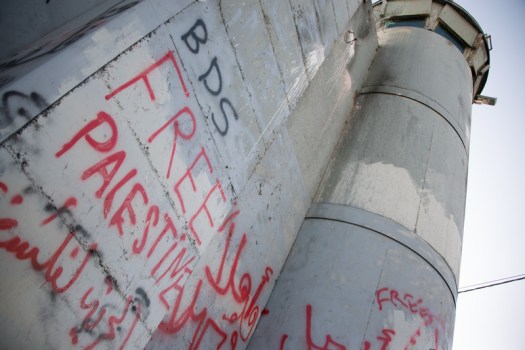
Activists in Massachusetts successfully pressured state lawmakers to stop a bill on February 8 that would have classified the boycott, divestment and sanctions (BDS) campaign for Palestinian rights as “discrimination.”
The bill requires anyone who enters into a contract with the state worth more than $10,000 to pledge that they will not refuse to do business with any person based on the person’s “race, color, creed, religion, sex, national origin, gender identity or sexual orientation.”
It has no chance of being passed this session as a key committee declined to advance it.
“[The Prime Minister is] up to his neck in investigations. He does not have a public or moral mandate to determine such fateful matters for the state of Israel when there is the fear, and I have to say it is real and not without basis, that he will make decisions based on his personal interest in political survival and not based on the national interest.”
— Benjamin Netanyahu, speaking about former Israeli Prime Minister Ehud Olmert, who was forced to resign in 2008
The Israeli police recommended on Tuesday that Prime Minister Benjamin Netanyahu be charged with bribery, fraud and breach of trust, casting a pall over the future of a tenacious leader who has become almost synonymous with his country. The announcement instantly raised doubts about his ability to stay in office.
Concluding a yearlong graft investigation, the police recommended that Mr. Netanyahu face prosecution in two corruption cases: a gifts-for-favors affair known as Case 1000, and a second scandal, called Case 2000, in which Mr. Netanyahu is suspected of back-room dealings with Arnon Mozes, publisher of the popular newspaper Yediot Aharonot, to ensure more favorable coverage.
Ahed Tamimi at Ofer Military Prison. (photo: Jerusalem Online)
Arrested in December for slapping an Israeli soldier who had entered her yard, 17-year-old Ahed Tamimi was later arrested in the middle of the night, is currently being held in a military prison, and is being tried in a closed military courtroom.
“The Israeli military supposes by arresting Ahed Tamimi they can silence their activism. But although painful, it’s definitely put a spotlight on Palestinian children in detention.”
— Fadi Quran, senior campaigner with the activist group Avaaz
Slouching in her chair and mouthing messages to her friends and family from under a cascade of strawberry-blond curls, Ahed Tamimi in many ways appears to be an everyday teenager.
But the tussle of television cameras and photographers that crowded in for a shot of her in the dock of a small Israeli military court in Ofer for a bail hearing last month was a reminder that she is far from it.
Ahed, who recently turned 17, was arrested after a video of her slapping and kicking two Israeli soldiers who had entered her front yard went viral last year. On Tuesday, after nearly two months in detention, she went on trial on 12 charges, including assault of a soldier and incitement.
The Israeli government needs the “new anti-Semitism” to justify its actions and to protect it from international and domestic condemnation. Anti-Semitism is effectively weaponized, not only to stifle speech — “It does not matter if the accusation is true.” . . . [Its] purpose is “to cause pain, to produce shame, and to reduce the accused to silence” — but also to suppress a politics of liberation.
Not long after the eruption of the Second Intifada in September 2000, I became active in a Jewish-Palestinian political movement called Ta’ayush, which conducts non-violent direct action against Israel’s military siege of the West Bank and Gaza. Its objective isn’t merely to protest against Israel’s violation of human rights but to join the Palestinian people in their struggle for self-determination. For a number of years, I spent most weekends with Ta’ayush in the West Bank; during the week I would write about our activities for the local and international press.
My pieces caught the eye of a professor from Haifa University, who wrote a series of articles accusing me first of being a traitor and a supporter of terrorism, then later a “Judenrat wannabe” and an anti-Semite. The charges began to circulate on right-wing websites; I received death threats and scores of hate messages by email; administrators at my university received letters, some from big donors, demanding that I be fired.
I mention this personal experience because although people within Israel and abroad have expressed concern for my wellbeing and offered their support, my feeling is that in their genuine alarm about my safety, they have missed something very important about the charge of the ‘new anti-Semitism’ and whom, ultimately, its target is.
“Florida has no tolerance for anti-Semitism and boycotts intended to destroy the State of Israel. Current statutes are clear — local governments cannot do business with companies that participate in anti-Semitic boycotts of Israel. When Lorde joined the boycott in December, she and her companies became subject to that statute.”
— Florida State Representative Randy Fine
Last December, Grammy-award winning pop-singer Lorde canceled a planned concert in Tel Aviv after activists called for her to join what’s called the “Boycott, Divestment and Sanctions Movement,” which campaigns for a global boycott of Israel until it withdraws from Palestinian territories.
“I have had a lot of discussions with people holding many views, and I think the right decision at this time is to cancel the show,” said Lorde in a statement. “I’m not too proud to admit I didn’t make the right call on this one.”
Now, Republican state Rep. Randy Fine is trying to get Miami and Tampa to cancel Lorde’s upcoming shows, citing a state statute that prohibits businesses from conducting business over $1 million with any organization engaged in a boycott of Israel.
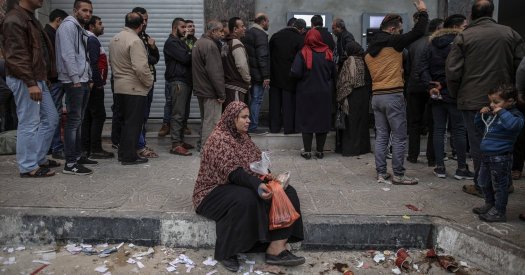
A woman begged for money as residents of Gaza lined up to withdraw what money they could from A.T.M.s at the Bank of Palestine in Gaza City. (photo: Wissam Nassar | The New York Times)
Across Gaza, the densely populated enclave of two million Palestinians sandwiched between Israel and Egypt, daily life, long a struggle, is unraveling before people’s eyes.
United Nations officials warn that Gaza is nearing total collapse, with medical supplies dwindling, clinics closing and 12-hour power outages threatening hospitals. The water is almost entirely undrinkable, and raw sewage is befouling beaches and fishing grounds. Israeli officials and aid workers are bracing for a cholera outbreak any day.
The payday line at a downtown A.T.M. here in Gaza City was dozens deep with government clerks and pensioners, waiting to get what cash they could.
Muhammad Abu Shaaban, 45, forced into retirement two months ago, stood six hours to withdraw a $285 monthly check — a steep reduction from his $1,320 salary as a member of the Palestinian Authority’s presidential guard.
“Life has become completely different,” Mr. Abu Shaaban said, his eyes welling up. He has stopped paying a son’s college tuition. He buys his wife vegetables to cook for their six children, not meat.
And the pay he had just collected was almost entirely spoken for to pay off last month’s grocery bills. “At most, I’ll have no money left in five days,” he said.
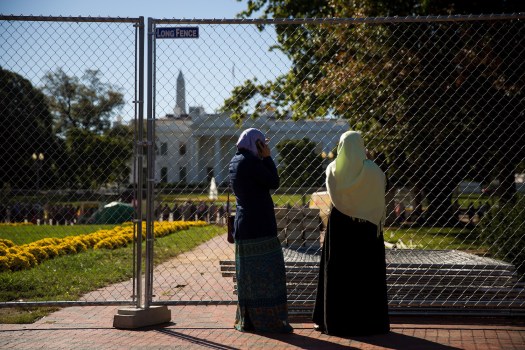
Two Muslim women stand near a fence across the street from the White House before the start of a protest against the Trump administration’s proposed travel ban, in Washington, DC, on Oct 18, 2017. (photo: Drew Angerer / Getty Images)
Those fitting broad “at-risk” profiles would be targeted for continuous vetting.
[The report] identifies a broad swath of Sunni Muslim residents as being potentially “vulnerable to terrorist narratives,” based on a set of risk indicators, such as being young, male, and having national origins in “the Middle East, South Asia or Africa.”
Department of Homeland Security draft report from late January called on authorities to continuously vet Sunni Muslim immigrants deemed to have “at-risk” demographic profiles.
The draft report, a copy of which was obtained by Foreign Policy, looks at 25 terrorist attacks in the United States between October 2001 and December 2017, concluding there would be “great value for the United States Government in dedicating resources to continuously evaluate persons of interest” and suggesting that immigrants to the United States be tracked on a “long-term basis.”
If the report’s recommendations were implemented, it would represent a vast expansion of the Trump administration’s policies aimed at many Muslim immigrants, extending vetting from those trying to enter the United States to those already legally in the country, including permanent residents.
The Supreme Court ruled decades ago that boycotts are constitutionally protected speech. Nonetheless, Kansas passed a law requiring all those who contract with the state to certify that they are not boycotting Israel.
“Speech, assembly, and petition . . . to change a social order. . . [are] on the highest rung of the hierarchy of First Amendment values.”
— US Supreme Court
“The Supreme Court has held that the First Amendment protects the right to participate in a boycott like the one punished by the Kansas law.”
— US District Judge Daniel Crabtree
A federal judge in Topeka has ruled that Kansas cannot tell contractors what they can and cannot boycott. That would seem obvious to anyone familiar with free speech protections under the First Amendment.
But last summer, Kansas passed a law requiring all those who contract with the state to certify that they are not boycotting Israel.
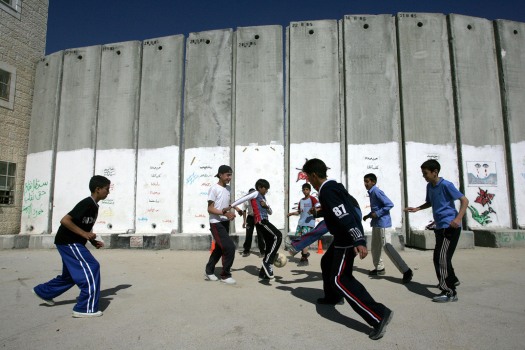
Palestinian boys playing soccer against the backdrop of the Israeli separation barrier that bisects their school playground in East Jerusalem, 2006. (photo: AWAD / AFP / Getty Images)
Talk of confederation sounds wistful in the current environment, but any talk of peace does. What’s really naïve is to suppose that only bad faith or ideological fanaticism has caused the two-state solution to fall into disrepute.
The justification for the two-state solution is rooted, after all, in two persistent truths: first, that two separate national communities, each with a different language, historical grievance, sense of identity in the wider world, and dominant religious culture, have been squeezed by tragic events into a single small space. . . . Second, that a majority on each side prefers some form of compromise to a fight to the finish. . . . [But] moderate majorities “increasingly doubt its viability,” largely because they have grown jaded regarding the intentions of the other side, not because, in principle, they refuse the compromises two states would entail.
“The two-state solution is over,” Palestinian negotiator Saeb Erekat told reporters, responding to Donald Trump’s recognition of Jerusalem as Israel’s capital. “Now is the time to transform the struggle for one state with equal rights for everyone living in historic Palestine, from the river to the sea.” As The New York Times subsequently reported, Erekat is hardly alone. The “over”-ness of “two states” — albeit with radical disagreements about the character of a hypothetical single state — has been claimed by ideological zealots, severe liberals, and exasperated peacemakers alike.
On the Palestinian side, one hears about the almost 700,000 Israeli settlers’ making annexation an established fact; on the Israeli side, about preventing recalcitrant Palestinian terrorists from firing missiles at Ben-Gurion Airport. For those of us living in Jerusalem, just speaking of two states, implying two capitals — but also, vaguely, some redivision of the city — invites skeptical, or pitying, stares from most Jews, as well as from Arabs, over a thousand of whom applied for Israeli citizenship in 2016.
Jerusalem enjoys an annual “capital grant” from the [Israeli Finance Ministry] that helps it offset low tax revenue due to large populations with relatively high percentages that are not part of the taxpaying workforce, including roughly a third of the city’s population that is made up of ultra-Orthodox Jews and another third of Palestinian Arabs.
The Jerusalem municipality has handed out fines totaling millions of dollars to properties owned by the United Nations and by churches, citing a new legal opinion that says the properties are not legally defined as places of worship and therefore aren’t entitled to exemptions from property tax.
The step appeared to be an escalation of a dispute between the municipality and the Finance Ministry over funds. Mayor Nir Barkat has been conducting a high-profile campaign against Finance Minister Moshe Kahlon that included instructing workers to dump trash at the entrance to the ministry offices in Jerusalem and threatening to lay off more than 2,000 city employees.








You must be logged in to post a comment.