“We continue to be alarmed by the treatment of Palestinian minors in Israeli military detention. We have also seen horrific terrorist violence against Israelis, which must be condemned in the strongest terms. All of this gravely undermines the viability of a two-state solution.”
— UK representative to the UN Human Rights Council
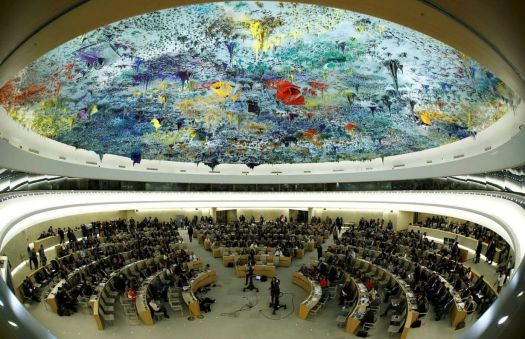
The United Nations Human Rights Council called on the international community to halt arms sales to Israel as it wrapped up its month-long 37th session in Geneva.
It approved five anti-Israel resolutions, including one called “Ensuring accountability and justice for all violations of international law in the Occupied Palestinian Territory, including East Jerusalem.”
By a 27 to 4 vote, with 15 abstentions, the UNHRC called upon “all states to promote compliance under international law” with regard to Israeli actions.
Mothers are advised to tell the truth. That was okay until my kids asked if Israeli soldiers could enter our city at night and harm us at anytime. I did not want to say yes, but I realized that as a Palestinian mother I could not hide the reality of occupation from them. So I told them the truth. As a mother, I don’t want my kids to lose faith in me, but at the same time, I can’t stop thinking about how they are just kids: they deserve a decent childhood and upbringing away from all the violence and insecurity of the ongoing conflict.
Raising kids in Palestine is exhausting — not just physically but also mentally. For as soon as kids become aware of the reality surrounding them, at around the age of three or four, every Palestinian mother must find explanations to help them comprehend what’s going on around them.
Even a simple trip from the West Bank to Jerusalem requires a strategic plan, especially after Mr. Trump’s recognition of Jerusalem as the capital of Israel. Couldn’t Mr. Trump have declared Jerusalem to be an open, global city as way of resolving the conflict between Israelis and Palestinians? How do you explain all this to a four-year-old?
March 21 is Mother’s Day in Palestine, which is why I am writing to you, Melania and Ivanka.
“The Israel Police will complete the investigation and bring to justice those who could have prevented or limited the attack, which may well have saved the life of the victim.”
— Israel Police statement
The police arrested eight residents of Jerusalem’s Old City suspected of failing to intervene in Sunday’s fatal stabbing attack near the entrance to Temple Mount, the city’s police spokesman said Tuesday.
Those arrested, residents and market vendors between ages 15–67, were brought in for questioning to the police station on a charge of failing to prevent a crime, which is considered a misdemeanor in Israel.
“Half a century of occupation has taken a heavy toll on the human rights of virtually every Palestinian, regardless of where in the occupied territory they reside. The feelings of despair among Palestinians in the face of these developments cannot be overstated. . . . [Human rights violations include] home demolitions and forced evictions, restricted access to services, threats of violence — including violence at the hands of settlers — restrictions on freedom of movement, and a strict residency regime for Palestinian residents of East Jerusalem.”
— Kate Gilmore, the UN deputy high commissioner for human rights
United Nations officials condemned the continued arbitrary detention of Palestinian children by Israel saying the practice has become “systematic and widely spread.”
A series of UN reports presented at the Human Rights Council shows how the living conditions of Palestinians across the West Bank and Gaza have dramatically worsened over the past year, and how children are bearing the brunt of the Israeli occupation, said Kate Gilmore, the UN deputy high commissioner for human rights.
ÆThe past year saw hundreds of Palestinian children detained by Israel, some without charge under administrative detention,Æ Gilmore said, addressing the council in Geneva on Tuesday.
“The impact of the conflict on the lives of children is entirely unacceptable. In this year alone, six children have been shot and killed in the context of protests.”
Palestinians take part in a protest against aid cuts, outside the UN offices in Khan Younis in the southern Gaza Strip, Jan 28, 2018. (photo: Abed Rahim Khatib / Flash90)
The Palestinian people have become dependent on foreign humanitarian aid to survive, but its adverse effects are strangling their economy.
Since the end of the Cold War, states have preferred humanitarian aid over development funds as a means of influencing international politics. Humanitarian aid is not an end in and of itself, but a tool to solve conflicts and promote state building. As such, it is dependent on the interests of the donor countries.
International aid to the Palestinians is very generous. The United Nations is aiming to raise approximately $540 million per year for the five million Palestinians living in the West Bank and Gaza. That’s a lot of money when compared to sums raised for other countries in crisis. For example, take Afghanistan, where the UN hopes to raise $437 million for the 34 million citizens of the country, despite the enormous difficulties it faces. In Iraq, a country in desperate need of rehabilitation, the UN seeks to raise $550 million for a population of 37 million. When compared to African countries such as Burundi ($113 million in aid for 10 million people) or Cameroon ($304.5 million for 23 million people), the gap is even more alarming.
Ironically, despite the vast sums, humanitarian aid doesn’t just help the Palestinians — it also harms them. Since the signing of the Oslo Accords in 1993, the occupied territories have seen a steady economic decline and a rise in unemployment. These phenomena are tied, of course, largely due to the IDF’s closures and checkpoints, which have dismembered the West Bank and prevent both people and goods from moving about freely. Humanitarian organizations, however, also play a role.
Israeli soldiers arrest a Youth Against Settlements protester demanding the reopening of Shuhada Street in the West Bank city of Hebron, Feb 27, 2015. (photo: Nasser Shiyoukhi / AP)
The Open Shuhada Street Campaign takes place annually during the last week of February to commemorate the massacre at the Ibrahimi Mosque and raise international awareness of the horrifying reality in Hebron.
The creation of settlements in Hebron included three stages:
Stage One, expropriate land from Palestinians claiming it is for military use;
Stage Two, build civilian housing on the military base and then allow Jewish settlers to move in; and
Stage Three, recognize it as a legitimate Jewish settlement.
This sets a precedent for the creation of facts on the ground that would become the model for the expansion of the settlement enterprise in the West Bank.
In order to fully understand the reality in Palestine, one must come to terms with the idea that the conquest of Palestine by the Zionists was done with the intent of committing genocide and ethnic cleansing of the native inhabitants of Palestine. This was true when, in 1948, 78 percent of Palestine was conquered and renamed Israel and it was also true when, in 1967, the conquest was completed and Israel took the remaining 22 percent of the country.
The intention was and remains taking over the land and populating it with Jews at the expense of Palestinians. It is true in the villages and in the towns, in the cities and in the countryside. It is crucial to examine how the Zionist regime accomplishes its goals on a case by case basis, and how local Palestinian leaders and grassroots groups resist. One particularly troubling example is the Zionist takeover of the old city of El-Khalil, Hebron, and the actions taken by Youth Against Settlements (YAS), and its leader and cofounder Issa Amro, to resist this takeover.
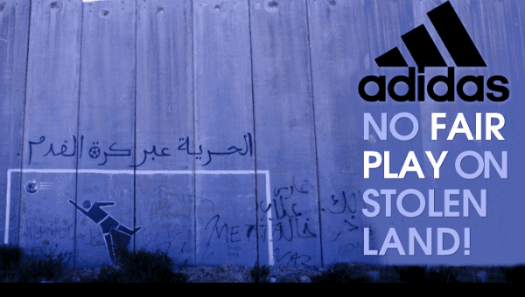
“Adidas is lending its brand to cover up and whitewash Israel’s human rights abuses [giving] international cover to Israel’s illegal settlements.”
— letter to Adidas CEO Kasper Rorsted
Over 130 Palestinian football clubs urged Adidas to end its sponsorship of the Israel Football Association (IFA) over its inclusion of teams based in illegal Israeli settlements across Palestinian land in the West Bank.
Currently there are at least 250 Israeli settlements in the West Bank. They are normally accompanied by the expulsion of Palestinians from their land, increased restrictions on Palestinians’ right to movement due to roadblocks and checkpoints, resource grabbing, increased presence of Israeli occupation forces to provide security, and settler-related violence.
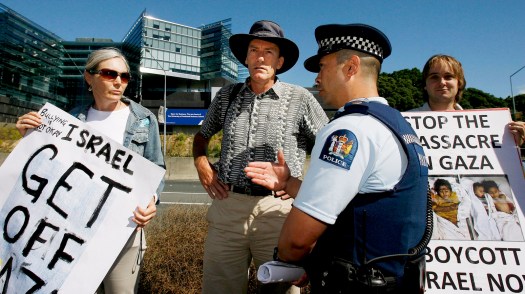
A police officer talks to protesters in Auckland, New Zealand, following Israel’s bombing of a UN school in a Gaza, Jan 8, 2008. (photo: Greg Bowker / AP / New Zealand Herald)
Progress on the Israel question is slowly but surely being made, owing to the strong commitment of places like New Zealand, who continue to move forward unafraid of the consequences.
“New Zealand has and has always had an independent foreign policy — we base our decisions on principle, not being bullied. We will always take a principled foreign policy.”
— Jacinda Ardern, New Zealand’s Prime Minister
If we were to truly honor the late, great Stephen Hawking, perhaps it would pay to remind ourselves of the principles the acclaimed physicist really stood for. One of those principles was Hawking’s commitment to the boycott of Israel in response to Israel’s longstanding policy of egregiously violating the rights of millions of ordinary Palestinians.
In 2013, Hawking publicly withdrew himself from a conference in Jerusalem on the future of Israel — stating that he had decided to “respect the boycott,” having received advice from Palestinian academics.
“A people under occupation will continue to resist in any way it can. If Israel wants peace it will have to talk to Hamas like Britain did with the IRA [Irish Republican Army],” Hawking said in 2009, speaking in regard to Israel’s brutal assault of Gaza during Operation Cast Lead. “Hamas are the democratically elected leaders of the Palestinian people and cannot be ignored.” . . .
However, boycotting Israel is nowhere near as risk-free as boycotting and sanctioning states such as Syria, North Korea or Iran. Boycotting Israel comes with unforeseen consequences that shed light not only on the power and reach of the Zionist lobby and to adherents of the Zionist agenda, but also on how weak the argument in favor of promoting Israel’s human rights-abusing agenda is. If their argument were strong, would they need to actively and forcibly silence those who dissent?
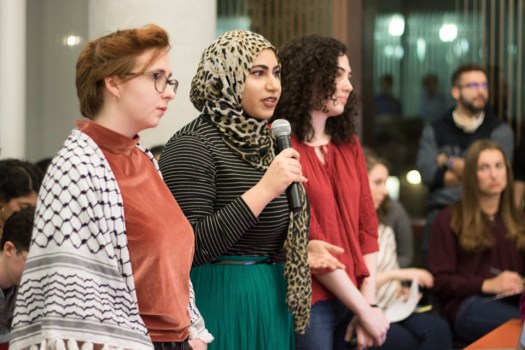
Members of Students for Justice in Palestine (SJP) and Jewish Voice for Peace (JVP) speak on behalf of Columbia University Apartheid Divest on Mar 19, 2018. (photo: Columbia Spectator)
The presenters invoked Barnard and Columbia’s history of being the first colleges to divest from South African apartheid and more recently from private prison systems in the United States.
“I believe that racism, white supremacy, and settler colonialism are evils upon this world. . . . It shouldn’t be how our college is investing it’s money — our money should be reflecting the values of Barnard students.”
— Caroline Oliver, Barnard College sophomore
Columbia-Barnard Jewish Voice for Peace and Students for Justice in Palestine urged Barnard’s Student Government Association to encourage the Barnard administration to boycott, divest, and sanction companies that profit from or contribute to the subjugation of Palestinian people at an SGA meeting on Monday night.
The groups that collectively launched the Columbia University Apartheid Divest campaign in 2016 requested to meet with SGA several weeks ago and were offered a time to speak. After the release of the SGA meeting’s agenda on Sunday, the executive board of Columbia/Barnard Hillel, a Jewish students group, encouraged its members to attend the meeting to ensure their viewpoint was also represented.
Over 150 students attended, both in support and in contention of the presentation for the “Boycott, Divest, Sanctions” movement. . . .
Ahed Tamimi is seen before her hearing at Ofer Military Court near the West Bank city of Ramallah, Jan 17, 2018. (photo: Oren Ziv / Activestills.org)
The 17-year-old was filmed slapping an Israeli soldier on her patio shortly after her cousin was shot by Israeli soldiers. She has already spent three months in prison.
In late February, the army arrested Ahed’s cousin Mohammed Tamimi — still awaiting surgery to reconstruct the part of his skull that was removed—in a pre-dawn raid. He was interrogated without a lawyer or a parent present, and released a few hours later after being pressured to confess that his head injury was caused by falling off a bicycle — and not by an Israeli rubber-bullet, fragments of which were extracted from his skull.
Ahed Tamimi, the teenager from Nabi Saleh arrested after a video of her attempting to push two armed Israeli soldiers off of her family’s porch went viral, signed a plea deal in Israeli military court on Wednesday, and will serve eight months in prison including three months time served.
Her mother, Nariman, and cousin, Nur, also signed plea deals. Nariman will serve eight months, and Nur was sentenced to time served.
The now-famous video of Ahed was filmed shortly after Israeli soldiers shot her cousin, Mohammed, in the head with a rubber-coated bullet and fractured his skull. An Israeli military court denied bail to Ahed and her mother, Nariman — the latter charged with incitement for live-streaming the video of Ahed and the soldiers — in January.




 HolyLandJustice.org
You must be logged in to post a comment.