Australian, Canadian firms pull out of Israeli settler railway

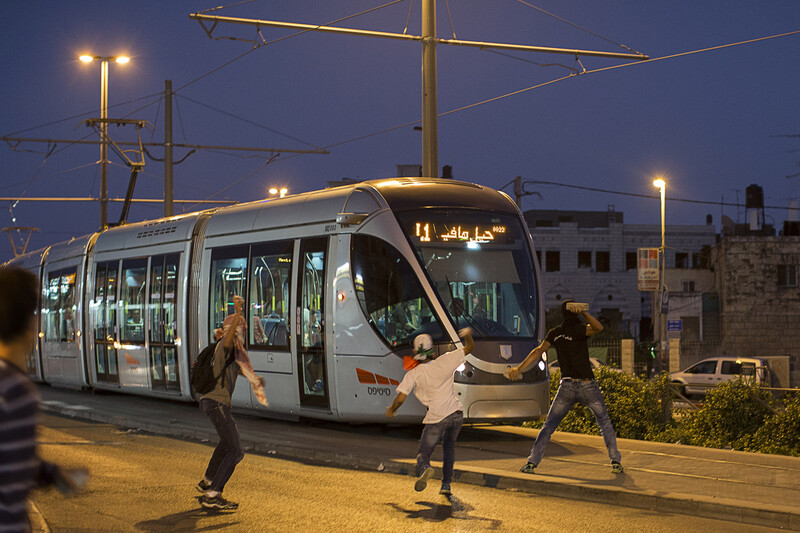
Youths throw stones at a tram
The Jerusalem light rail which links Israel’s illegal West Bank colonies is a symbol of oppression to Palestinians. (photo: Faiz Abu Rmeleh / ActiveStills)
There is a growing acknowledgement that doing business with Israel’s settlements makes companies complicit in human rights violations.
By Ali Abunimah | The Electric Intifada | May 8, 2019

Palestinian campaigners see the latest withdrawals as victories for their efforts to hold companies complicit in Israel’s occupation and colonization accountable.

The Electronic Intifada can exclusively reveal that Canadian engineering giant Bombardier has pulled out of a bid to expand and operate an Israeli tramway linking settlements in the occupied West Bank.

Bombardier is one of several global firms – two others being Australia’s Macquarie and Germany’s Siemens – to drop out of the tender to build the next phase of the Jerusalem light rail.

The light rail system links settlements to each other and to Jerusalem, helping to entrench and facilitate Israel’s colonial expansion in the occupied territory – a war crime.

The tramway is a symbol of oppression for Palestinians.

Continue reading “Australian, Canadian firms pull out of Israeli settler railway”

Reps. Omar and Schakowsky: We must confront threat of white nationalism — together

Reps. Jan Schakowsky (D-IL) and Ilhan Omar (D-MN) call on Jews and Muslims to stand united against white nationalism, in new op-ed
Reps. Jan Schakowsky (D-IL) and Ilhan Omar (D-MN) call on Jews and Muslims to stand united against white nationalism, in new op-ed. (photo credit: Alex Wong / Getty Images)
An appeal to a shared concern to unify against anti-Semitic and Islamphobic violence.

By Ilhan Omar and Jan Schakowsky | CNN | May 14, 2019

White nationalists win when our two communities are divided.

Just over two weeks ago, we watched in horror after a man walked into Chabad of Poway synagogue in California and opened fire on worshippers, killing 60-year-old Lori Gilbert Kaye and injuring three others. The attack on the synagogue took place on Shabbat, the holiest day of the week, and Acharon Shel Pesach — the final day of Passover.

As information about the attack came in, we learned more shocking details. The same terrorist who attacked the Chabad Synagogue allegedly set fire to a nearby mosque, Dar-ul-Arqam, just weeks earlier. Evidence also suggests that the suspected Poway shooter was inspired by the Christchurch mosque massacre in New Zealand, which took the lives of 50 Muslim worshippers in New Zealand in March.

As a Muslim American and a Jewish American elected to the United States Congress, we can no longer sit silently as terror strikes our communities. We cannot allow those who seek to divide and intimidate us to succeed. Whatever our differences, our two communities, Muslim and Jewish, must come together to confront the twin evils of anti-Semitic and Islamophobic violence.

Continue reading “Reps. Omar and Schakowsky: We must confront threat of white nationalism — together”

End the Nakba: 71 years of Palestinian dispossession 1948-2019

Please join our brothers and sisters from Voices for Palestine and Palestine Solidarity Committee to remember the Nakba (Arabic for “catastrophe”) of 1948, when Zionists forces destroyed over 400 villages and drove over 700,000 Palestinians out of historic Palestine to create what is now called Israel.
Date: Friday, May 10, 2019
Time: 4:00 – 6:00 pm
Location: Westlake Park
4th & Pine Street
Seattle
Information: Event information here →
Tickets: Free
Event Details

The ongoing Nakba of ethnic cleansing and apartheid still continues as Palestinians are attacked, besieged, and driven out of their homes by the Israeli military, and as the Great March of Return continues and Israel shoots down unarmed Palestinian protestors.

This year’s Nakba remembrance will include the call to Boycott of Israel on the arches at Westlake Park, and we will reach out to commuters during Friday rush hour. We will also evoke the ongoing Palestine refugee experience with PALESTINE: STOLEN HOMELAND, a display of more than 100 white tents inscribed with the names of over 400 of the destroyed villages from 1948 Palestine.

More information here →

Ethical travel to Palestine & challenging apartheid tourism

concrete stairs in between walls
Old City, Jerusalem. (photo:  Dan Gold / Unsplash)
Considerations to be aware of when planning travel that is ethical, responsible and sensitive to the land and culture.

By US Campaign for Palestinian Rights

And always, keep in mind that the privilege of non-Palestinians to travel to Palestine is, by design, premised on the denial of Palestinians to travel freely—and return—to their homeland.

A crucial component to challenging Israel’s oppression of the Palestinian people is examining the harmful role of tourism in Israel. Palestinians, wherever they are, are denied the freedom to move freely to and within their homeland by Israel. At the same time, Israel cultivates a tourism industry that quite literally erases Palestinians from the landscape and history, appropriates Palestinian culture and cuisine, and whitewashes the reality of Israel’s state violence.

Whether in Palestine, Hawaii, Puerto Rico, or New Orleans, typical travel and tourism enable ongoing colonization, gentrification, appropriation of native culture. Native lands and gentrifying neighborhoods are packaged and sold as tourist destinations, often featuring local culture as exotic entertainment while reinforcing negative and patronizing stereotypes of those communities. Many tourists travel effortlessly across borders and in places where oppressive governments are erecting walls, militarizing borders, dividing families, and denying freedom of movement to local communities. From Palestine to Mexico, from the Israeli-occupied Syrian Golan Heights to New Orleans, resisting racism means listening to the voices of those impacted by these systems of harm rather than normalizing and contributing to those systems through tourism.

Continue reading “Ethical travel to Palestine & challenging apartheid tourism”

A pipeline protest in Amman


Demonstration against pipeline from Israel outside Jordanian Parliament. March 2019. (photo: S. Komarovsky)
A 3rd in series of reports from Dr. Alice Rothchild in Amman, Jordan after attending the Lancet Palestinian Health Alliance Annual conference.

By Alice Rothchild | Mondoweiss | May 2, 2019

Demonstrators hold red signs translated as: ‘The gas of our enemy [Israel] is occupation.’

I find traveling in a foreign country is a strange mix of exhilaration and confusion, a humbling struggle to understand and decode what I am seeing, along with a regular dose of bewildering frustration. Like the nightly ritual of searching for an adequate number of electrical outlets to recharge our assortment of computers, phones, and cameras. We managed to break two adapters in the sockets last night, leaving an exposed arm of the adapter sticking out ready to electrocute me when I get up in the middle of the night, disoriented, and try to remember, where am I now and where did they put the bathroom?

Today we learn that for the past few weeks, once a week people from distant municipalities have been marching to Amman’s city hall to demand better employment opportunities, increased wages, and better working conditions in the field of education. We come upon a demonstration outside of the Ministry of Education. We see a crowd of men, chanting, holding signs and flags, flanked by rows of police who appear armed with billy clubs. When a van of riot police pulls up and starts emptying into the street we decide it is time to leave.

Continue reading “A pipeline protest in Amman”

Britain needs to recognize Palestine as an independent state

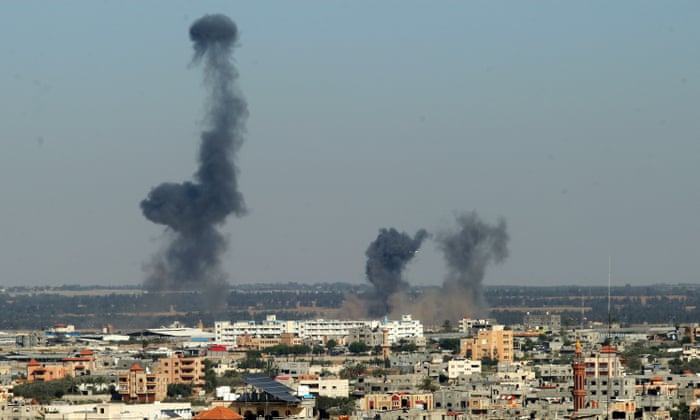
Israeli airstrikes in Gaza. (photo: UPI / Barcroft Images)
It’s time for British recognition of the state of Palestine.

By Ian Black | The Guardian | May 7, 2019

No one doubts that Gazans need urgent relief, but the latest eruption is a bleak and timely illustration of the fact that economic development alone will not resolve the Palestinian question as long as an overwhelmingly powerful Israel, backed uncritically by the US, retains overall control and prioritizes its own settlement. project and security needs.

Over the Bank Holiday weekend, coinciding with the start of the Ramadan fast for Muslims and the run-up to Israel’s Independence Day, it was touch and go whether the latest outbreak of violence – fatalities on the border, rockets fired into Israel, airstrikes against the Gaza Strip – would escalate into all-out war. Twenty-five Palestinians and four Israelis was a modest death toll compared with summer 2014, when 2,250 Palestinians and 67 Israelis were killed in Operation Protective Edge.

The ceasefire negotiated by Egypt and the UN should ease the punishing blockade imposed by Israel since the Islamists of Hamas took over Gaza in 2007. Millions of dollars donated by the Gulf state of Qatar will continue to pay official salaries and help needy families. Palestinian fishermen will be able to operate farther out to sea. Electricity and fuel supplies should be boosted.

Continue reading “Britain needs to recognize Palestine as an independent state”

Gaza has made its choice: It will continue to resist

A wounded Palestinian boy is evacuated during a protest at the Israel-Gaza fence, in the southern Gaza Strip on May 3, 2019. (photo: Reuters / Ibraheem Abu Mustafa)
Weekly peaceful protesters continue to resist settler-colonial occupation.

By Haidar Eid | Al Jazeera | May 6, 2019

What is happening in Gaza is incremental genocide, not a ‘security operation’.

We have spent sleepless nights under Israeli bombs before – in 2006, 2008, 2012, 2014 and 2018. On Saturday, apartheid Israel decided to launch yet another murderous campaign of bombardment against one of the most densely populated areas on earth.

Again, the victims were children and women. Fourteen-month-old Palestinian toddler, Siba Abu Arrar, was killed along with her pregnant aunt, Falastine, who succumbed to her wounds shortly after American-made, Israeli warplanes targeted their home in Zeitoun neighbourhood.

On Friday, like all the previous 57 Fridays, I joined thousands of peaceful protesters at the eastern fence of the Gaza concentration camp, where Israeli snipers shot and killed four Palestinians and injured 51, including children. One of those killed was 19-year-old Raed Abu Teir, who was walking on crutches, having been injured during previous protests.

Continue reading “Gaza has made its choice: It will continue to resist”

From God to art to politics, in Amman

Abdul Hay Mosallam’s frieze of Gaza, at the Darat al-Funun museum in Amman Jordan. March 2019. (photo:  Alice Rothchild)
Rothchild’s second dispatch from a Middle East trip describes the political messiness and the heartache of a complicated country facing many challenges.

By Alice Rothchild | Mondoweiss | Apr 28, 2019

Jordan has ‘the second highest share of refugees compared to its population in the world.’

March 23, 2019

Leaving the Nazarene Church, I meet up with a reporter from the Electronic Intifada, Tamara Nassar, who is excited to inform me that this week is Israeli Apartheid Week, organized by the Jordanian BDS chapter. I learn that there is a general sentiment here that supports boycotting Israel and Israelis broadly rather than just complicit institutions. Tamara talks of another unaffiliated group focused on anti-normalization called Etharrak that recently was critical of Netflix for filming a new TV series using Amman as Tel Aviv. These activists denounced this effort as normalizing relations with Israel. As Tamara wrote in a piece for Electronic Intifada, two Jordanian actors pulled out of the show and there were protests at one of the film locations.

Etharrak condemned the filming in a letter to the Royal Film Commission of Jordan, an official body that promotes and facilitates foreign film and television production in the country.

Israel uses cultural normalization “to beautify and whitewash its crimes, terrorism and occupation,” the letter stated.

Continue reading “From God to art to politics, in Amman”

Indivisible justice: Why supporters of Palestine must stand with other oppressed communities

Black Lives Matter protesters march through the streets Mar 4, 2019.  (photo: Justin Sullivan / Getty Images)
Intersectional struggles and solidarity hinge on the understanding that we are enmeshed in a global web.

By Nada Elia | Middle East Eye | Apr 28, 2019

Justice is indivisible: as soon as we deny it to a people, we are privileging another, and that is not justice – it is racism.

An “earthquake” happened in Congress, Mondoweiss reported last month, as a bill initially proposed by Democratic leaders to condemn anti-semitism was significantly modified, within a matter of hours, after intense organizing and activism that denounced it as inappropriate.

The bill had been drafted with the intention of silencing Minnesota Congresswoman Ilhan Omar, who has come under attack for denouncing the pervasive influence of the American Israel Public Affairs Committee (AIPAC) on US politics, and for speaking in support of justice for Palestinians.

Anti-racist grassroots organizers were quick to detect the extreme Islamophobia and racism behind the attacks on Omar – whose advocacy for other marginalized communities has not brought any “progressive” ire upon her – and were outraged at the text of a bill that denounced anti-semitism, but not the rampant anti-black, anti-Muslim, anti-Arab and anti-immigrant current also spreading across the nation.

Continue reading “Indivisible justice: Why supporters of Palestine must stand with other oppressed communities”

Falling off the edge: Iraqi and Syrian refugees

A refugee child’s picture on the wall of the Evangelical Philadelphia Nazarene Church of Marka, in Amman. March 2019. (photo: S. Komarovsky)
Jordanian church welcoming those displaced by war and trauma as “guests” not refugees.

By Alice Rothchild | Mondoweiss | Apr 24, 2019

The pictures of Syrian families walking from their homes, carrying pillows and belongings, evokes for me the iconic photos of Palestinian expulsions in 1948. I feel my tears rising. How many more refugees will suffer this fate?

The day begins at The Evangelical Philadelphia Nazarene Church of Marka, a church in Amman that has a particular focus on refugee care. I am told that the number of refugees has doubled since 2010 with mostly Syrians followed by Iraqis (who are classified by the Jordanian government as “guests” rather than refugees). For older data see the UNHCR report here. In the never ending bureaucratic craziness, after 2007 Iraqi children were allowed to go to government schools, but many did not because of displacement due to war (arriving in the middle of the school year, falling behind), confusion over valid residency permits, financial challenges, or the already overburdened public schools. “Many Iraqis still face barriers to education as many families are running out of resources and sending their children out to work, especially in female headed households. In addition, some vulnerable Iraqis are unwilling to register their children at state schools because they do not have legal status in Jordan.”

Continue reading “Falling off the edge: Iraqi and Syrian refugees”