Democrats press Trump administration on US gear used by Israel to demolish homes

Illustration. Israeli security forces stand guard during the demolition of a family home built without a permit in the East Jerusalem neighborhood of Al-Tur on April 24, 2013. (Sliman Khader/Flash90)
Israeli security forces stand guard during the demolition of a family home built without a permit in the East Jerusalem neighborhood of Al-Tur on April 24, 2013. (photo: Sliman Khader / Flash90)
Group of lawmakers seeking to halt practice of razing of domiciles, enforced against families of suspected attackers and Palestinians who built without permits

By Ron Kampeas | The Times of Israel | Mar 16, 2020

‘My hope is that Israel will stop the home demolitions and will see that there are many supporters of the US-Israel relationship on this letter…’
— U.S. Rep. Ro Khanna, California

More than 60 Democrats in the US House of Representatives want the Trump administration to ensure that Israel is using military equipment in compliance with US law, and to press Israel not to use the equipment to demolish Palestinian homes.

The letter to US Secretary of State Mike Pompeo, spearheaded by Reps. Ro Khanna and Anna Eshoo of California and Steve Cohen of Tennessee, notes recent demolitions in East Jerusalem and UN reports last year of a 45 percent increase in home demolitions.

“We urge you to press the Israeli government to prevent more families from being forcibly transferred and having their homes destroyed,” said the letter sent Monday.

Continue reading “Democrats press Trump administration on US gear used by Israel to demolish homes”
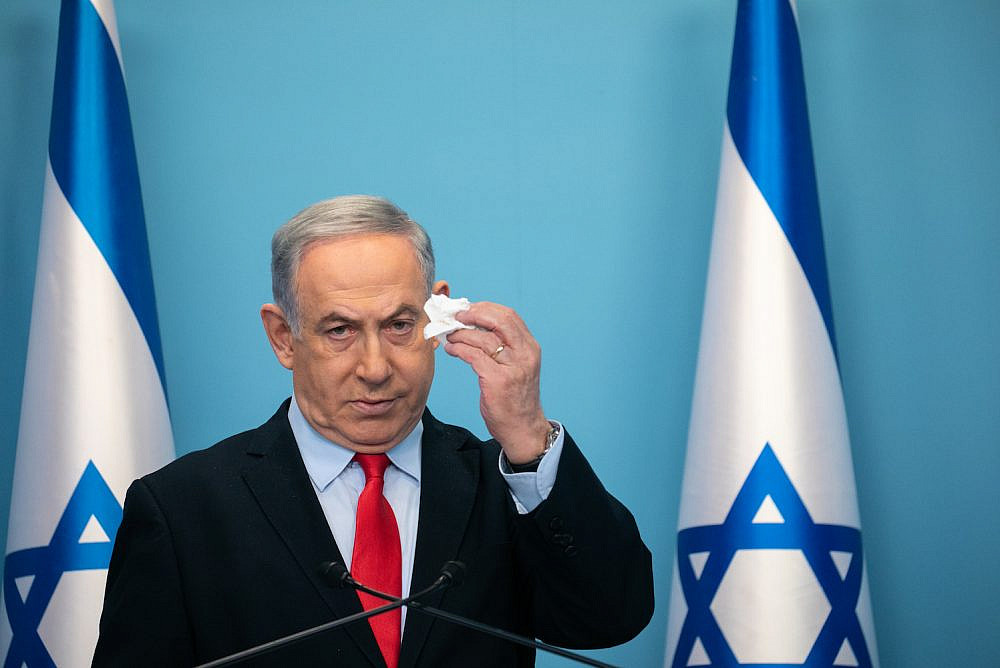
Netanyahu turns surveillance powers on Israelis

Israeli Prime Minister Benjamin Netanyahu announces emergency directives during a press conference at the Prime Ministers Office in Jerusalem, March 12, 2020. (Olivier Fitoussi/Flash90)
Israeli Prime Minister Benjamin Netanyahu announces emergency directives during a press conference at the Prime Ministers Office in Jerusalem, March 12, 2020. (photo: Olivier Fitoussi / Flash90)
As part of his ‘war’ on the outbreak, Netanyahu delays his long-awaited trial and announces the mass surveillance of Israelis infected by coronavirus.

By Edo Konrad | +972 Magazine |  Mar 15, 2020

From drones, to Facebook hacking, to biometric facial recognition, to blackmailing Palestinians with private information, to profiling potential Palestinian attackers using algorithms, surveillance is an essential component in the effort to turn Palestinians into obedient subjects of military dictatorship.

Standing at the podium in the Prime Minister’s Office in Jerusalem Saturday night, a grave-looking Benjamin Netanyahu declared Israel was in a state of emergency. The prime minister, who did not field questions from reporters, announced he would be ramming through a series of emergency directives, including the mass surveillance of Israeli citizens, as part of the fight against the coronavirus outbreak in the country.

Netanyahu stated that as part of the “war against an invisible enemy” — which has already infected over 200 Israeli citizens and nearly 40 Palestinians — he would be implementing “technological means” previously used in the “fight against terrorism” to monitor the movement of those who have tested positive for the virus, most likely by actively tracking citizens through geolocating their cellphones and credit cards.

Continue reading “Netanyahu turns surveillance powers on Israelis”

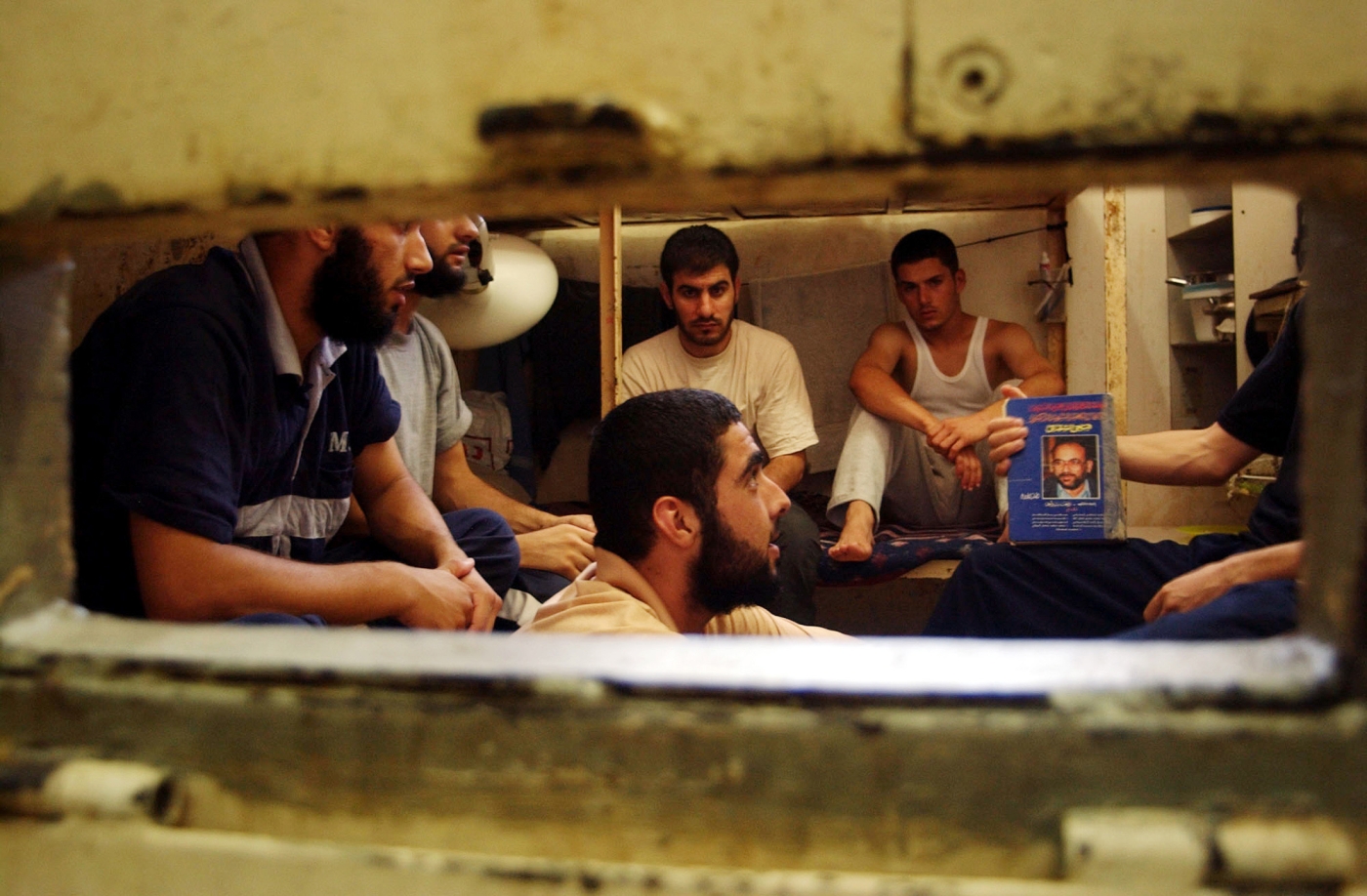
Coronavirus: Palestinian inmates fear for their lives in filthy and crowded Israeli jails

Palestinian prisoners sit in a prison cell in Ashkelon in 2004 (photo: Reuters)
Lack of hygiene products and packed cells leave prisoners fearing continued policy of ‘deliberate medical negligence’

By Akram Al-Waara | Middle East Eye | Mar 13, 2020

Palestinians… are concerned that the Israeli government and prison authorities are not taking the proper measures to prevent the spread of the virus and treat those who may become sick.

Fear and panic have characterised much of the past 10 days in the occupied West Bank, as the number of coronavirus cases continues to climb.

By Friday, the Palestinian Ministry of Health confirmed that the number of official cases had risen to 35, 34 of them in the southern West Bank city of Bethlehem.

But just as the measures taken by the government to stop the spread of the virus began to restore some sense of calm, Palestinians woke up to more dreadful news: the coronavirus had reached Israeli prisons, where thousands of Palestinian political prisoners are held.

Continue reading “Coronavirus: Palestinian inmates fear for their lives in filthy and crowded Israeli jails”

With 29 cases in Palestine, government steps up efforts to contain coronavirus

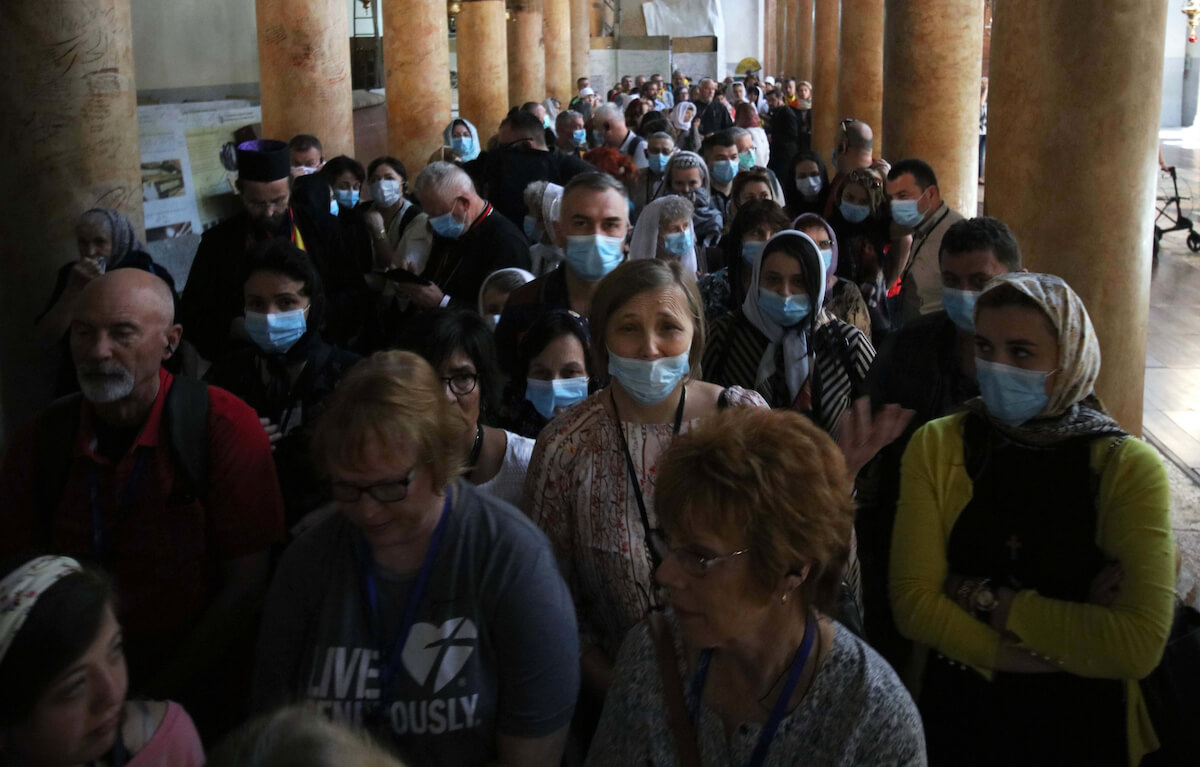
Foreign tourists wearing masks as a preventive measure against the coronavirus during a visit to the Church of the Nativity, in the West Bank city of Bethlehem on March 05, 2020. (Photo: Abedalrahman Hassan/APA Images)
Foreign tourists wearing masks as a preventive measure against the coronavirus during a visit to the Church of the Nativity, in the West Bank city of Bethlehem on March 05, 2020. (photo: Abedalrahman Hassan / APA Images)
Most tourists have been evacuated from Bethlehem and additional measures may be needed.

By Yumna Patel | Mondoweiss | Mar 10, 2020

Across the West Bank, East Jerusalem, and Gaza, 2,900 Palestinians were being held in self-quarantine — six of them in Jerusalem, and 605 people in Gaza who had recently returned from performing the Umrah pilgrimage in Saudi Arabia.

Palestinians are holding their breath as they wait to see if the Palestinian Authority’s desperate attempts to contain the spread of the novel coronavirus (COVID-19) to the city of Bethlehem is working.

Panic grew on Monday after the Palestinian Ministry of Health announced that there was one confirmed case of the virus in the northern occupied West Bank city of Tulkarem, the first case of the virus outside of Bethlehem.

Local media reported that an unidentified Palestinian man from Tulkarem contracted the virus while he was working in Israel, but that he was quarantined immediately along with his entire family — none of whom tested positive for the virus.

Continue reading “With 29 cases in Palestine, government steps up efforts to contain coronavirus”

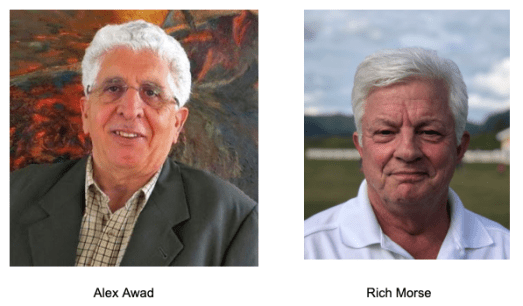
Canceled due to coronavirus precautions: Peace in the Holy Land, A Palestinian Christian perspective: A talk with Alex Awad and Rich Morse

Screen Shot 2020-03-04 at 10.47.54 AM

Please join our brothers and sisters at Bellevue Presbyterian Church to explore questions American evangelical Christians often have about the Israeli-Palestinian conflict this Saturday morning at Bellevue Presbyterian Church.
Date: Saturday, March 7, 2020
Time: 9:00 – 10:30 am
Location: Bellevue Presbyterian Church, Room S-140, 1717 Bellevue Way NE, Bellevue, WA 98004
Information: Event information here →
Tickets: Free
Event Details

Alex’s talk “Peace in the Holy Land, A Palestinian Christian Perspective,”  will address many of the questions evangelical Christians raise about the longstanding Israeli-Palestinian conflict. These questions include:

    • What prevents peace between Israel and Palestine?
    • What does the Bible say about the situation in the Holy Land today?
    • Who are the Palestinian Christians?
    • What are the challenges and opportunities for interfaith dialogue?

After his talk, Alex will be joined by Rich Morse, Regional Coordinator of Churches for Middle East Peace (CMEP) and both will take audience questions. Rich, who is CMEP’s Washington Regional Coordinator, will also talk about ways U.S. Christians can advocate for a just peace in the Holy Land.

More information here →

CANCELLED Event – due to coronavirus travel restrictions. Rev. Dr. Mitri Raheb Keynote: Culture as a Tool for Social Transformation: A Palestinian Christian Perspective

MR_5
Please join our brothers and sisters at Seattle Pacific University for an event sponsored by the Social Justice and Cultural Studies Dept and Churches for Middle East Peace.  Rev. Dr. Mitri Raheb will speak about the work of culture building and preservation in Palestinian society under the Israeli military occupation.
Date: Cancelled:  Wednesday, March 5, 2020
Time: 10:00 – 11:45 am
Location: Seattle Pacific University,
3307 3rd Ave W, Room: Beegle 201, Seattle, WA
Information: Event information here →
Tickets: Free, limited seating open to the public
Event Details

Come learn about the critical work of culture building and preservation in Palestinian society under the Israeli military occupation. Featuring keynote speaker Rev. Dr. Mitri Raheb, founder and president of Dar al-Kalima University College of Arts and Culture in Bethlehem, Palestine, and co-founder of U.S.-based fundraising and advocacy organization Bright Stars of Bethlehem. Rev. Dr. Raheb is the most widely published Palestinian Christian theologian to date.

In 2015 he received the Olof Palme Prize for his courageous and indefatigable fight against occupation and violence, and for a future Middle East characterized by peaceful coexistence and equality for all. In 2012 he was awarded the German Media Prize for his “tireless work in creating room for hope for his people, who are living under Israeli Occupation, through founding and building institutions of excellence in education, culture and health.”

Event information here →

No matter who wins elections, Israel’s victory image is clear

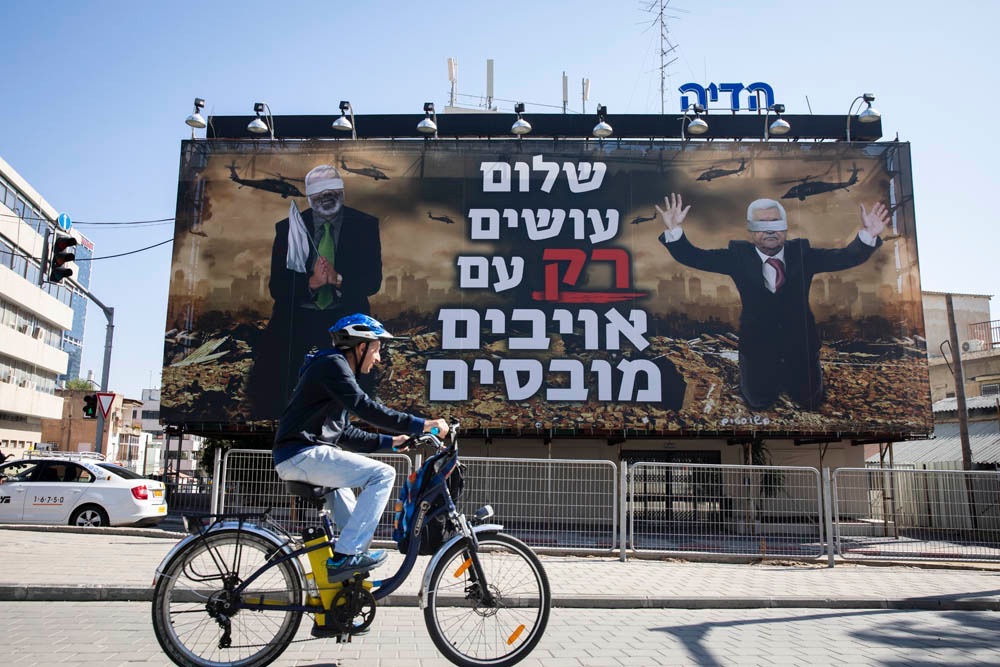
A billboard put up by the far-right Israel Victory Project in Tel Aviv shows blindfolded Palestinian leaders Ismail Haniyeh and Mahmoud Abbas. The caption reads: 'Peace is made with defeated enemies.' (Oren Ziv)
A billboard put up by the far-right Israel Victory Project in Tel Aviv shows blindfolded Palestinian leaders Ismail Haniyeh and Mahmoud Abbas. The caption reads: ‘Peace is made with defeated enemies.’ (photo: Oren Ziv)
A poster featuring Palestinian leaders defeated and humiliated is the epitome of Israel’s vision of absolute ‘victory’ over Palestinians.

By Hagai El-Ad  | +972 Magazine |  Mar 2, 2020

This victory image is the vulgar graphic representation of the political plan now being touted to fulfill the next phase of this very vision: U.S. President Donald Trump’s “peace” plan.

Both contenders for Israel’s premiership, Benjamin Netanyahu and Benny Gantz, are hoping to give the victory speech after today’s vote. Yet regardless of who – if any – emerges the winner, Israelis have already been presented with this election’s victory image: the humiliating poster featuring Palestinian leaders kneeling, blindfolded and defeated, against the backdrop of a destroyed city.

The campaign, advertised on billboards by the far-right group Israel Victory Project and quickly taken down by order of Tel Aviv’s mayor, is the epitome of Israel’s current phase of control over the Palestinians. Though they were in the public eye only for a short time, these billboards are already etched in the collective consciousness. After all, that is where the idea came from: the minds of a growing number of Jews in Israel who are publicly expressing their vision of absolute “victory” over the Palestinians — not only in the depths of their subconscious, but most openly and practically.

Continue reading “No matter who wins elections, Israel’s victory image is clear”

Trump’s ‘Deal of the Century’ is a flawed, ahistorical plan with major health consequences

Patients at the MSF clinic in Gaza. (photo: Doctors Without Borders / Médecins Sans Frontières)
The convergence of political repression and instability, public health needs, high unemployment, and a lack of resources is leading to a massive breakdown for Palestinians.

By Dr. Alice Rothchild | Mondoweiss | Feb 26, 2020

Refugee, as well as non-refugee patients in the occupied territories, face a mushrooming fragmentation of their health care “non-system” with care provided by UNRWA, the Ministry of Health, NGOs, and private clinicians with duplications, gaps, and chaos complicated by the priorities of international aid groups and donor agendas.

The Trump administration plan for Israel/Palestine, ironically titled “Peace to Prosperity: a vision to improve the lives of the Palestinian and Israeli people,” is a flawed, ahistorical document that is basically a gift to the Israeli government, affirming and giving international blessings to much of the status quo. The document is framed in classic Israeli hasbara: Israelis are peace loving, Palestinians are plagued by violence and terrorism. The struggle is described as intractable, a clash of religions and cultures, that can only be solved by ignoring history and international law and proposing technocratic solutions to political problems and issues of social justice.

The release of the plan coincided with snarky comments from its authors clearly involving attempts to belittle Palestinians – White House senior advisor Jared Kushner told CNN, if Palestinians reject the plan, “they’re going to screw up another opportunity like they’ve screwed up every other opportunity that they’ve ever had in their existence.” He also said on PBS, “Look, they played the victimhood card. Now, it’s like they want their rights. They want a state[…]Basically what we’re saying to the Palestinians is put up or shut up.”

Continue reading “Trump’s ‘Deal of the Century’ is a flawed, ahistorical plan with major health consequences”

Meet the foreign policy teams shaping the Democratic Party’s views on Israel

Sen. Bernie Sanders (Courtesy of J Street), Joe Biden (Gage Skidmore/CC BY-SA 2.0), and Sen. Elizabeth Warren (Matt Johnson/CC BY 2.0).
The advisers of the Democratic candidates offer a deeper look into what their policies on Israel-Palestine would be once they enter the White House.

By Alex Kane  | +972 Magazine | Feb 24, 2020

…there is a big difference between who is advising the progressives in the race — Sanders and Senator Elizabeth Warren — and who is advising the establishment candidates, former South Bend Mayor Pete Buttigieg and former Vice President Joe Biden.

U.S. Senator Bernie Sanders is doing something no American politician has done before: running as the Democratic front-runner for president while harshly criticizing Israel.

Just last Tuesday, Sanders slammed Israel’s “right-wing racist government” during a CNN town hall in Nevada, four days before he won a resounding victory in the state’s caucuses. On Sunday, he announced that he would not attend the annual conference of the American Israel Public Affairs Committee (AIPAC), stating he was “concerned about the platform AIPAC provides leaders who express bigotry and oppose basic Palestinian rights.”

When Sanders criticizes Israel in this way, he is not merely expressing his own personal beliefs. His remarks are also the outcome of the work of a foreign policy team that is helping to hone Sanders’ thinking on Israel – and which, in turn, is dramatically reshaping the national debate on what U.S. policy toward the Jewish state should be.

Continue reading “Meet the foreign policy teams shaping the Democratic Party’s views on Israel”

Reconciliation is a lifestyle, not a quick fix solution

Musalaha gathering. (photo: screenshot Musalaha)
A Musalaha intern reflects on recent women’s group gathering.

By Sophie Rice | Musalaha| Feb 20, 2020

In this honest, raw space, the group was encouraged that it’s okay and it’s important to hold different perspectives, and that it’s also okay to disagree, but the true beauty of reconciliation is found in our shared humanity.

The journey of reconciliation isn’t always easy. The conflict in Israel-Palestine runs deep through history, society, and personal lives, and given the current political climate you can find yourself asking, “Do my actions really make a difference for peace?” At times, positive change can feel like a small drop in a very large bucket. However, over the past two weekends, two groups of Musalaha women gathered together, one a newly formed reconciliation group and one an alumni group where some had been on the journey with Musalaha for 30 years. As they shared life, meals, honest stories, debate, and laughter, I was profoundly encouraged to see that through genuine friendships and deep love for each other, grassroots change is happening, and hope for a better future is possible.

Our new women’s group gathering was held in Beit Jala where for most of the Israeli women, it was their first time traveling to the West Bank outside of military service. As one woman shared, “Before I came to Beit Jala I was scared because I didn’t know if it was safe for me to drive here alone or not. Now that I’ve been here I know it’s safe.” At this early stage in the reconciliation process there are many new realities, like this, to be exposed to and new perspectives to hear and learn from.

Continue reading “Reconciliation is a lifestyle, not a quick fix solution”