Elderly Palestinian return to their villages for the first time in 80 years

283353672dbf41739bf73925dad4226d_18
Amena Sanqar was 17 when she and her family were forced to flee their village of Beit Nabala. (photo: Shatha Hammad / Al Jazeera)

To commemorate Land Day, group of Palestinian refugees returned to the villages from which they were expelled in 1948.

By Shatha Hammad | Al Jazeera | Mar 29, 2018


“We only took a few utensils to use for food preparation, we didn’t take many clothes, and we left our jewelry back at our home. We thought we would be back in a few days.”
— Hawwa told Al Jazeera.


In a rush, Hawwa al-Khawaja and her daughter Khawla stepped off a bus as it pulled over at the entrance of what was once the village they called home. The elder Khawaja stood there greeting others who had arrived on the buses that followed, just as she used to greet her village’s visitors as a young woman before 1948.

“Welcome, welcome to al-Thahiryeh,” the 90-year-old said. “We apologize for not having a home to welcome you in.”

Since 1948, there have been no homes or residents in the destroyed village of al-Thahiryeh, which lies southeast of the city of al-Lydd. That year, Zionist forces pushed out Palestinian families living in the village, before destroying every inch of it. Al-Thahiryeh was one of 500 villages that faced the same fate in what became known as the ethnic cleansing of at least 800,000 Palestinians.

On Wednesday, Hawwa al-Khawaja returned to al-Thahiryeh for the first time, but only for a few hours.

Continue reading “Elderly Palestinian return to their villages for the first time in 80 years”
Gazan Christian do not yet have permits to visit Jerusalem for Easter

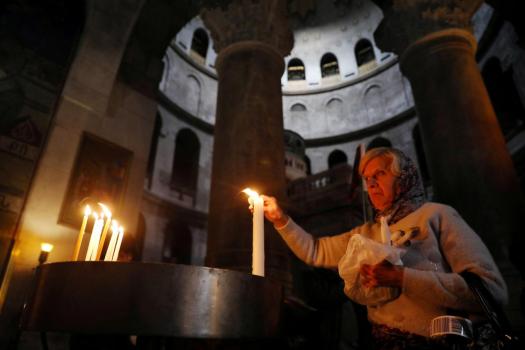
FILE PHOTO: A worshipper lights a candle as she visits the Church of the Holy Sepulchre in Jerusalem's Old City
A worshipper lights a candle in the Church of the Holy Sepulchre in Jerusalem’s Old City, Jan 22, 2018. (photo: Ammar Awad / Reuters)

Gaza has only 1,000 Christians among a population of 2 million in the narrow coastal strip.

By Stephen Farrell | Reuters | Mar 27, 2018


“Israel is a sovereign state and it has the right to decide who will enter its gates. No foreign residents have an inherent right to enter Israel, including Palestinian residents of the Gaza Strip.”
— Civil Administration (COGAT) spokesman


The Latin Patriarchate of Jerusalem said church authorities had applied for around 600 permits for Gazans to travel, but had not received any, three days before Good Friday.

Israel tightly restricts movements out of the Gaza Strip, territory controlled by Hamas, an Islamist group that it considers a terrorist organization.

The Israeli military-run authority that operates in the West Bank defended its policy to restrict access as many Palestinians had stayed on illegally in the past, and said it would only issue permits to people aged at least 55.

Continue reading “Gazan Christian do not yet have permits to visit Jerusalem for Easter”

Palestinian march along Israel’s border turns deadly on day one

lead_960_540
Israeli military vehicles are seen Friday next to the border on the Israeli side of the Israel-Gaza border, as Palestinians demonstrate in Gaza. (photo: Amir Cohen / Reuters)

At least 15 people have been killed at the outset of a massive protest expected to last another month and a half.

By Krishnadev Calamur | The Atlantic | May 30, 2018


If the demonstrations continue, and Israel responds the way it did today, there is a significant risk that the death count will rise, and an already complicated situation will get worse.


Israeli troops opened fire Friday at Palestinians near the Gaza Strip’s border with the Jewish state, killing at least 15 people and wounding many more. The numbers came from the Palestinian health ministry, which put the number of those injured at more than 1,000.

The Palestinian demonstration at the border, dubbed the Great March of Return, was billed as peaceful and nonviolent. Protesters pitched tents near the border with Israel and demanded that refugees be allowed to return to homes they left behind in 1948 during the creation of the state of Israel. Israel, which estimates that 17,000 Palestinians have gathered near the border at six locations, said its troops were enforcing “a closed military zone.” The Israeli army also said it opened fire toward the “main instigators” of what it called rioters who were “rolling burning tires and hurling stones at the security fence and at” Israeli troops. Israel had warned Gaza residents against protesting, and said Hamas, the militant group that governs Gaza, was “cynically” sending women and children “to the security fence and endangering their lives.”

The date the protest began, March 30, is the anniversary of Land Day, a 1976 event in which Israelis killed six Palestinians who were protesting the confiscation of their lands. The protests are expected to last until May 15, the anniversary of the creation of the state of Israel, which the Palestinians view as a “naqba” or “catastrophe” for their people.

Continue reading “Palestinian march along Israel’s border turns deadly on day one”

Easter in Jerusalem: Palestinians continue to live the suffering of Christ

ISRAEL-PALESTINIAN-CONFLICT-JERUSALEM
Right wing demonstrators wave Israeli flags as they pass through the Damascus Gate in Jerusalem’s Old City, May 24, 2017. (photo: AFP)

The ultimate goal of Israeli policy is to maintain a Jewish majority in Jerusalem and if possible end all Palestinian presence in it, particularly in the Old City.

By Khalil Fawadleh | Wafa | Mar 29, 2018


“Jerusalem should be open to all without any discrimination. We should have free access to Jerusalem, free access to our holy places.”
— Rev. Ibrahim Shomali, Chancellor of the Latin Patriarchate of Jerusalem


As the Holy Week during which Christians commemorate the crucifixion and resurrection of Jesus Christ draws nearer, Palestinians in general and the Christians in particular continue to experience the suffering of Jesus Christ more than 2,000 years ago, according to Palestinian Christian activists.

Noura Carmi, member of the Armenian Orthodox Church, said during a tour of Jerusalem’s Old City organized by the Palestine Liberation Organization’s (PLO) Negotiations Affairs Department on the occasion of Easter celebrations, and specifically through Via Dolorosa, which marks the 14 stations that Christian tradition identifies as the path which Jesus Christ took before his crucifixion, that Palestinians today were still living the suffering of the Christ, who walked that road more than 2,000 years ago, bloodied from wearing a crown of thorns on his head and carrying a heavy cross on his shoulder.

She pointed to buildings taken over by fanatic Jewish settler organizations, many of them were owned by Arab Christian residents of East Jerusalem, as part of a broad Israeli scheme to turn the Old City into a purely Jewish city.

Continue reading “Easter in Jerusalem: Palestinians continue to live the suffering of Christ”

Israel fast-tracks new US embassy in Jerusalem

merlin_134540252_d1feccad-2d96-47c7-8b34-188c09990c68-master768
US consulate in Jerusalem, Feb 24, 2018. (photo: Ammar Awad / Reuters)

The Finance Ministry will allow the Jerusalem municipality to waive the required permits.

By Staff | Reuters | Mar 27, 2018


“We will not allow needless bureaucracy to hold up the transfer of the American embassy to Jerusalem, Israel’s eternal capital.”
— Israeli Finance Minister Moshe Kahlon


Israel has expedited construction permits to enable temporary quarters for the US Embassy to open in Jerusalem as planned in May, the Finance Ministry said on Tuesday.

US President Donald Trump in December broke with other world powers by recognizing Jerusalem as Israel’s capital and announcing the US Embassy would be moved there from Tel Aviv.

Trump’s reversal of decades of US and broad international policy was welcomed by Israeli Prime Minister Benjamin Netanyahu as a “historic decision.” But it drew criticism from around the world and outraged Palestinians, who want a capital for their own future state in eastern parts of the city.

Israel has said the Embassy will be opened on May 14, the 70th anniversary of its founding. A US official said it would be located at a provisional site in Jerusalem that now houses a US consular section.

Building a permanent embassy could take several years.

Continue reading “Israel fast-tracks new US embassy in Jerusalem”

At 31, my first glimpse of life outside Gaza

abier-almasri
Abier Almasri (photo: Human Rights Watch / Reuters)

I try not to think about how, later this month, I will enter the Erez checkpoint from the Israeli side and cross back into Gaza, unsure when, if ever, I will be allowed to leave again.

By Abier Almasri | Reuters | Mar 16, 2018


Friends and family back home keep asking, “How’s life outside Gaza?” I can’t answer. How to tell people who live on four to six hours of electricity daily that high-rise buildings in New York leave their lights on 24 hours a day, simply because it looks nice? How it feels to live without generator noises, the deafening roar of Israeli military drones at night, or the constant fear of imminent conflict? Or that you can hop on a bus, train or plane on a whim, without needing a permit, and travel across the world?


I was born and grew up in Gaza. My father was a soccer coach for many years and his stories about his travels to other countries always made me want to travel too. But Israel imposed a land, air and sea blockade on Gaza in 2007 and has kept Gaza mostly closed ever since. So I never made it out until now, at age 31, I was allowed to leave — for just a little while.

I work for a global human rights organization and spent months seeking the exit permit from the Israeli government that would allow me to leave, to participate in security and research training sessions, to attend key organizational meetings, and to meet colleagues based just a short drive away in Jerusalem or Ramallah — to say nothing of those overseas. But I faced obstacles every step of the way to obtaining the documents and permissions I needed simply to get out of Gaza itself — until I got a phone call on January 28.

Continue reading “At 31, my first glimpse of life outside Gaza”

Palestinians hold day of mourning after 773 shot with live ammunition

5760
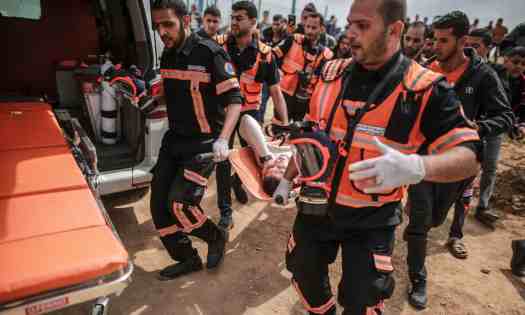
A wounded Palestinian is evacuated during the clashes between demonstrators and Israeli troops. (photo: Barcroft Images / Xinhua)

At least 15 killed when Israeli soldiers open fire during mass demonstrations in Gaza.

By Hazem Balousha and Oliver Holmes | The Guardian | Mar 31, 2018


“There is fear that the situation might deteriorate in the coming days.”
— Tayé-Brook Zerihoun, assistant UN secretary general for political affairs


Gaza hospitals, running low on blood and overstretched by the huge number of wounded, were reeling after one of the enclave’s bloodiest days outside of open war, in which Israeli soldiers shot 773 people with live ammunition, according to the ministry of health.

Fifteen of the wounded died, said the ministry spokesperson Dr Ashraf al-Qidra. “Most of the dead were aged between 17 and 35 years old,” he said. “The injuries were on the upper part of the body.” He added that the remainder of the wounded, some of whom were in a critical condition, had been “shot with live ammunition.”

The violence erupted on Friday after mass demonstrations took place demanding the right of return for Palestinian refugees and their descendants to land in Israel.

Continue reading “Palestinians hold day of mourning after 773 shot with live ammunition”

More Arabs than Jews live in Israel and Palestine, according to Israeli Army

1-5940740-2440408184
Palestinian women at the Qalandiyah checkpoint, 2016. (photo: AP)

The Israeli Army presented data to the Knesset showing 6.8 million Palestinians now living in Israel-Palestine, but only 6.5 million Jews.

By Yotam Berger | Haaretz | Mar 26, 2018


“Between the Jordan River and the Mediterranean there is an equal number of Palestinians and Jews, and that’s nothing new. That’s why the crossroads where we presently find ourselves is clear: either two states based on 1967, or one state that is an apartheid state, or one democratic state in which everyone has the right to vote. There is no other option, and at least this simple truth has to be stated clearly.”
— Knesset Member Ayman Odeh, head of the Joint List


The Israeli army presented data on Monday to a Knesset panel which show that more Arabs than Jews live between the Mediterranean and the Jordan River.

According to Civil Administration’s deputy commander Col. Haim Mendes, five million Palestinians live in the West Bank and the Gaza Strip. This figure does not include the hundreds of thousands of Palestinians living in East Jerusalem, or the 1.8 million Israeli Arabs. According to Israel’s Central Bureau of Statistics, as of September 2017 some 6.5 million Jews live in Israel. . . .

Continue reading “More Arabs than Jews live in Israel and Palestine, according to Israeli Army”

Film: In the Image (Fri, Apr 13)

amneh

Pushing for Change: Mideast Focus Ministry Film Series V

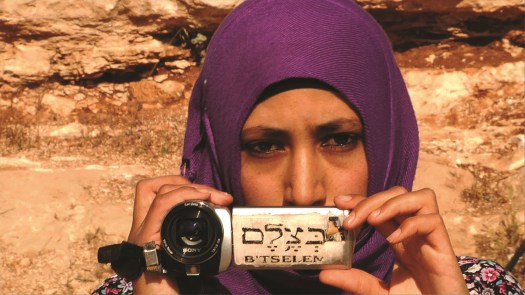
This film explores the daily lives of Palestinian women living in the West Bank. It portrays their stories in a novel and eye-opening manner through footage captured by the women themselves. Their courage is inspiring as they persist in working for change — and to pave the way for future peace in the region.

Date: Friday, Apr 13, 2018
Time: 7:00 – 9:00 pm
Location: Bloedel Hall
St. Mark’s Cathedral
1245 10th Ave E
Seattle, WA  98102
Information: Event website
Admission: Free

Event Details

Our concern is to help balance the limited and confusing media coverage of the Holy Land. We use compelling films as an entry point for reflection and discussion. As Christians, we respond to Christ’s call to seek justice and love the oppressed. As Americans, we ask: Can we reconcile this calling with our government’s massive financial support of Israeli military operations? We hope the time will come when Jews, Muslims and Christians will again come together in harmony in the Holy Land.

In this series, we see how people pushed to bring about a safe country for the Jewish people, and how today others are still push- ing for safety and change. Do our efforts for change lead to peace and justice . . . or not?

More information here →

Palestinians set to reject US peace plan

rts1miz1-870
A girl holds a Palestinian flag in front of Israeli troops during clashes in Ramallah, Mar 7, 2018. (photo: Mohamad Torokman / Reuters)

The peace plan contemplated by the Trump Administration will offer Palestinians limited sovereignty over limited territory.

By Uri Saver | Al-Monitor | Mar 25, 2018


The plan is much closer to the Israeli position than the Palestinian:

  • Two states
  • Palestine would comprise about half the West Bank
  • Gaza would be included if Hamas disarms
  • Israel would control West Bank security and border crossings
  • East Jerusalem would be part of Palestine, but not the Old City
  • No right of return

Despite growing tensions with the Palestinians, US President Donald Trump still intends to reveal a US peace plan for the Middle East. The plan will apparently be divulged right after the US Embassy moves to Jerusalem and after Trump’s meeting with North Korean leader Kim Jong Un.

According to a senior US diplomat in Tel Aviv, the fact that Palestinian President Mahmoud Abbas refuses any contact on the matter with US officials and that he had bad mouthed David Friedman, the US ambassador to Israel, has not altered Trump’s determination. Actually, messages on the evolving plans are conveyed nowadays to Ramallah by Egypt, Jordan and Saudi Arabia. More so, the March 20 meeting in Washington between Trump and Saudi Crown Prince Mohammed bin Salman was largely dedicated to two major topics: the common front against Iran in the region (including the Iran nuclear deal issue) and Israeli-Palestinian peace.

Continue reading “Palestinians set to reject US peace plan”