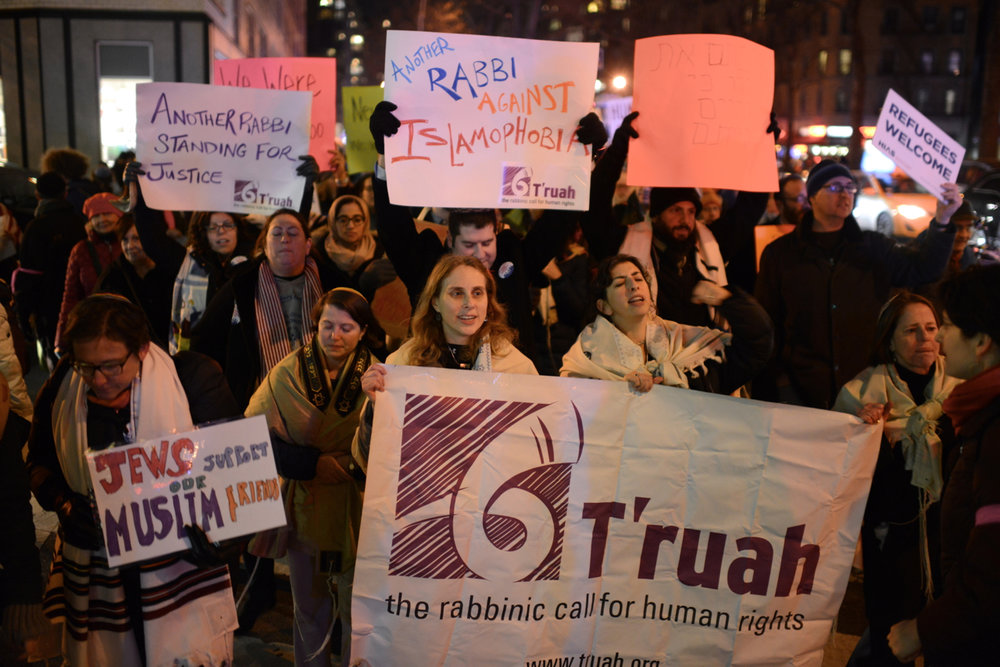
Unacceptable and inhumane: A response to Rabbi Jill Jacobs

(photo: giligetz.com)

What will it take for the world to see Gazans as real, living breathing human beings rather than either incorrigible terrorists or simple puppets of Hamas?

By Rabbi Brant Rosen | Shalom Rav | May 25, 2018


In truth, it has been difficult to avoid the abject dehumanization of Gazans by the Israeli government and Israel advocates these past few months. In statement after statement, Palestinians have all but been blamed for their own mass murder.


I continue to be troubled by Rabbi Jill Jacobs’ recent Washington Post op-ed, “How to tell when criticism of Israel is actually anti-Semitism,” and frankly disappointed to witness how warmly it has been received in progressive Jewish circles. In context and content, I find it to be anything but progressive.

Jacob’s article was written in response to the Israeli military’s killing of over 100 Palestinians in demonstrations in Gaza since March 30, including 14 children, and injured over 3,500 with live fire. Certainly, as the Executive Director of Tru’ah — an American rabbinical organization that seeks to “protect human rights in North America, Israel and the occupied Palestinian territories” — one might have expected her to follow the lead of other human rights organizations and protest (or even call into question) Israel’s excessive use of force.

On the very same day as Jacobs’ op-ed, for instance, Human Rights Watch called for an international inquiry “into this latest bloodshed,” adding that “these staggering casualty levels (were) neither the result of justifiable force nor of isolated abuses; but foreseeable results of senior Israeli officials’ orders on the use of force.” For its part, Amnesty International called Israel’s actions “an abhorrent violation of international law” and Doctors Without Borders termed them “unacceptable and inhuman.”

Continue reading “Unacceptable and inhumane: A response to Rabbi Jill Jacobs”
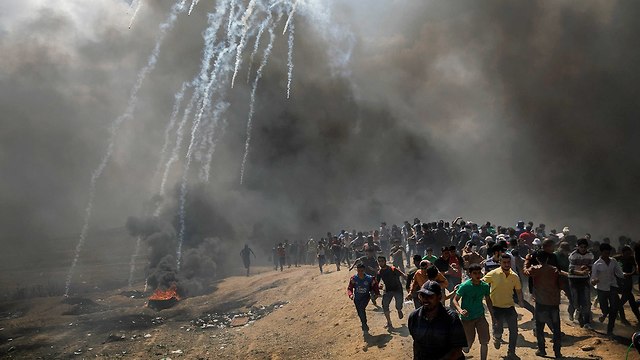
There is a way to solve the Gaza crisis

Riots on Gaza border, last week. (photo: MCT)

Analysis: An arrangement led by Egypt and supervised by UN and Arab League inspectors, leading to the creation of a joint PA-Hamas civil government, would serve all parties and gradually dismantle the explosive conflict — even without forcing Hamas to disarm.

By Ron Ben-Yishai | Ynetnews | May 21, 2018


The [Israeli] defense establishment is interested in . . . a quick implementation of a comprehensive plan for humanitarian and economic aid to the [Gaza] strip. This recommendation from the IDF — and recently from the Shin Bet as well — is based on a simple idea: Humanitarian welfare (water, sewage, health and electricity services) and economic development (reducing unemployment) will calm things down [and forestall further political deterioration and violence].


After 62 Palestinians were killed and thousands were wounded during recent Gaza border riots, and following the harsh criticism against Israel in the international arena, the Gaza affair is far from over. Although neither Israel nor Hamas are interested in war, there is still a high likelihood that the clashes will escalate and deteriorate to another bloody and destructive round of war.

This may be another battle which will end in the exact situation we have today or an even worse one. In such a situation, Hamas won’t be there and we’ll have to deal with a governmental anarchy in the strip that is bound to spill into our territory.

When that happens, we will have no other choice but to return as an occupying force that will have to take care of the needs of two million hostile Palestinians. Security officials in Israel share the opinion that we have no interest in toppling the Hamas rule at this time, as it would lead to the creation of a governmental void in the strip.

The defense establishment is interested in stopping the deterioration down this slippery slope through a quick implementation of a comprehensive plan for humanitarian and economic aid to the strip. . . . Continue reading “There is a way to solve the Gaza crisis”

Palestinians ask ICC to investigate alleged crimes by Israel

Palestinian Foreign Minister Riad Malki speaks during a press conference at the International Criminal Court on May 22, 2018. (photo: Mike Corder / Associated Press)

The Palestinian foreign minister asked the International Criminal Court to open an immediate investigation into alleged Israeli crimes committed against the Palestinian people.

By Mike Corder | The Washington Post | May 22, 2018


Although Israel is not an ICC member, its citizens can be charged by the court if they are suspected of committing grave crimes on the territory or against a national of a country that is a member. The ICC has recognized Palestine as a member.


Accusing Israel of systematic crimes, including apartheid in the occupied territories, Palestinians on Tuesday urged the International Criminal Court to open an investigation that could ultimately lead to charges against Israeli leaders.

Israel immediately slammed the Palestinian move as “legally invalid.”

The referral seeks an investigation into Israeli policies in the West Bank, east Jerusalem and Gaza Strip since Palestine accepted the ICC’s jurisdiction in 2014, Palestinian Foreign Minister Riad Malki told reporters in The Hague.

This includes Israeli settlement policies in the West Bank and east Jerusalem, as well as bloodshed in the Gaza Strip. Israel and Gaza’s ruling Hamas militant group fought a 50-day war in 2014, and in recent weeks, Israeli fire has killed over 100 Palestinians during mass protests along the Gaza border since March.

Continue reading “Palestinians ask ICC to investigate alleged crimes by Israel”

Israeli court halts immediate expulsion of Human Rights Watch head

Human Rights Watch’s Israel and Palestine director, Omar Shakir, in his office in the West Bank city of Ramallah on May 9. (photo: Abbas Momani / AFP / Getty Images)

The European Union and a consortium of 15 human rights organizations have petitioned the Israeli government on Shakir’s behalf.

By Ruth Eglash | The Washington Post | May 23, 2018


“Denying entry to or, worse, deporting people from a country because they are or were in their past critical of its governmental policies is a classic feature of authoritarian regimes. Israel contends to be a liberal democracy, but Omar’s case clearly shows that the government is persecuting people on political grounds.”
— Michael Sfard, Shakir’s attorney.


An Israeli court issued an interim injunction on Wednesday temporarily preventing Israel’s Interior Ministry from deporting Omar Shakir, the Israel and Palestine director at Human Rights Watch.

Shakir, a U.S. citizen, had his work permit revoked this month based on a recent amendment to the country’s immigration laws aimed at fighting supporters of the boycott, divestment and sanctions (BDS) movement.

This is the first time that Israel is applying the law against a person already inside the country; in previous instances, BDS activists seeking to enter the country have been blocked. If Shakir is expelled, critics say, it places Israel in a highly undesirable group of nations that have banned human rights activists.

Continue reading “Israeli court halts immediate expulsion of Human Rights Watch head”

Paraguay opens embassy in Jerusalem

Israeli Prime Minister Benjamin Netanyahu, right, speaks with Paraguay’s President Horacio Cartes during their meeting at the Prime Minister’s office in Jerusalem, May 21, 2018. (photo: Sebastian Scheiner / Associated Press)

Paraguay is the third country to move its embassy to Jerusalem after the US and Guatemala.

By Associated Press | The Washington Post | May 21, 2018


Eighty-three countries have embassies in Israel. Three are now in Jerusalem. The remaining 80 are in Tel Aviv or its suburbs.


Paraguay opened its new embassy in Jerusalem on Monday, following in the footsteps of the United States and Guatemala.

President Horacio Cartes dedicated the embassy, making Paraguay the third country to transfer its diplomatic mission in Israel from Tel Aviv to Jerusalem.

Romania, the Czech Republic and Honduras have said they are also considering doing the same.

Continue reading “Paraguay opens embassy in Jerusalem”

How do Israeli journalists report on a place they can’t reach?

Cameras belonging to news crews stationed at the Israeli side of the border with Gaza attempt to capture the clashes near the fence, May 15, 2018. (photo: Oren Ziv / Activestills.org)

For the past 11 years, Israeli journalists have been forbidden from entering Gaza. This has affected not only their reporting, but also the way fellow Israelis understand what is happening there.

By Oren Ziv | +972 Magazine | May 19, 2018


This was never Hamas’ decision; it was Israel’s.


The main obstacle that faces anyone who wants to report on what is happening at Gaza protests from the Israeli side of the border is that one can hear the gunfire, see the smoke, report on the army’s conduct, and estimate the number of protesters — and yet, you cannot get the full story. A journalist from East Jerusalem who often covers the goings on at the border summed it up perfectly: “We can hear the bullets, but we can’t see the blood.” Since Israel placed Gaza under siege 11 years ago, Israeli journalists have been forbidden from entering the Strip, both in times of conflict and calm. This was never Hamas’ decision; it was Israel’s.

Continue reading “How do Israeli journalists report on a place they can’t reach?”

Israel cannot fulfill its promise perpetuating apartheid

A Palestinian man falls to the ground after being shot by Israeli troops during a deadly protest at the Gaza Strip’s border with Israel on Monday. (photo: Khalil Hamra / The Associated Press)

As an American Jew, I feel compelled to speak the unspeakable: It is in Jewish best interests, morally and pragmatically, to rethink the notion of Israel as a Jewish state.

By Lauren Goldman Marshall | The Seattle Times | May 18, 2018


Imagine what a new Israel could be, an Israel for all peoples. If all the young lives, Jewish and Arab, cut short by this violence could instead be harnessed to irrigate the desert, desalinate the sea, create music and translate love poems into each other’s (very similar) languages! Now that would be an Israel to inspire the world.


Nineteen years ago, I rehearsed a play with Israeli and Palestinian teenagers at Seeds of Peace International Camp in Maine. Forging a script both sides could stand behind took perseverance. But at our cast party, Arabs and Jews leaned on each other and sang songs. It gave me a glimpse of what could be.

I contrast that hopeful moment with the appalling news coming out of Israel and Gaza. While Ivanka Trump, Jared Kushner and Benjamin Netanyahu celebrated the opening of the U.S. Embassy in Jerusalem, Israeli forces were firing on (mostly unarmed) Palestinian protesters gathered along the fence between Gaza and Israel, killing at least 60, and injuring more than 2,000.

Israel defends its response, claiming that the demonstrators were trying to breach the border. But the absence of any casualties on the Israeli side proves the response was grossly disproportionate. This is not an isolated incident, but an ongoing saga since 2007, when Israel imposed a blockade on Gaza following Hamas’ election victory. Nearly 2 million Gazans are squeezed into a virtual prison one-ninth the size of Rhode Island. Israel and Egypt control the borders and access to water, fuel, medical supplies and electricity. It doesn’t take a leap of logic to see that Gaza has become a concentration camp, and the demonstrations at the border are a desperate response to a humanitarian crisis.

Continue reading “Israel cannot fulfill its promise perpetuating apartheid”

Confessions of a Jewish dissident

Investigative journalist, I.F. Stone (1907–1989). (photo: AP)

How can wise solutions be reached, and the opportunity for peace rescued, when dissident voices are hardly heard above a whisper in what passes for debate on the Middle East?

By I.F. Stone | The New York Review of Books | Mar 9, 1978

[Ed. note: A timely piece reprinted from 1978.]


How can we talk of human rights and ignore them for the Palestinian Arabs? How can Israel talk of the Jewish right to a homeland and deny one to the Palestinians? How can there be peace without some measure of justice?


Abstractly speaking, I should be quite a popular person in the American-Jewish community. I am a dissident. I am also, at a time when the search is on for moderate voices on the Palestine question, a moderate. And I proved my devotion to displaced persons in and out of the Middle East years ago. I have a medal to prove it, from the Haganah — the illegal Jewish army that fought what Prime Minister Begin calls the Jewish war of liberation and established the state of Israel in 1948.

Yet despite all these credentials I find myself — like many fellow American intellectuals, Jewish and non-Jewish, ostracized whenever I try to speak up on the Middle East. It demonstrates what slight changes in time and space can do to familiar categories. Dissidents, Jewish and non-Jewish, in the Soviet Union are — deservedly — heroes. They may be forced to circulate their views in samizdat, they may be dependent for circulation in their homeland on the typewriter and carbon paper. But at least they make the front pages of the American and world press, and the correspondents in Moscow hang on their words. Here at least their books are bestsellers.

But it is only rarely that we dissidents on the Middle East can enjoy a fleeting voice in the American press. Finding an American publishing house willing to publish a book which departs from the standard Israeli line is about as easy as selling a thoughtful exposition of atheism to the Osservatore Romano in Vatican City.

Continue reading “Confessions of a Jewish dissident”

As Gaza sinks into despair, a new book makes the case against Israeli brutality

Palestinians inspect the Israeli-bombed Zeitun district of Gaza City on Jan 23, 2009.
 (photo: Olivier Laban-Mattei / AFP / Getty Images)

“This book is not about Gaza,” the author writes. “It is about what has been done to Gaza.”

By Charles Glass | The Intercept | May 13, 2018


Gaza is sinking, if not into the sea, into desperation. The Israeli embargo has rendered 65 percent of Gazans under the age of 30 unemployed. Health care suffers from lack of equipment and medicine. People cannot leave to find work outside, and children live with the trauma of never knowing when their homes will be bombed. When I was there in 2002, Dr. Eyad Sarraj of the Gaza Community Mental Health Program told me that almost half the children under 16 suffered bed-wetting due to constant fear. That was before the military invasions of the last 10 years.


Israel celebrates a double anniversary on May 15 this year, the founding of the state and the formal establishment of the Israeli Defense Forces, the name the state gave to its combined army, navy, and air force. Armed statehood fulfilled the political Zionists’ dream of gathering Jews from the ancient Diaspora under their own government in what they declared to be their “promised land.” During the battle over the land between 1947 and 1949, the IDF expelled three-quarters of the indigenous population. Of the 750,000 Palestinian Arabs who fled, 250,000 took shelter in Gaza, a tiny pocket of southwest Palestine then occupied by the Egyptian army. The destitute and traumatized refugees were three times more numerous than the 80,000 Gazans who took them in.

The United Nations passed but did not enforce annual resolutions calling for the refugees’ return. Israel invaded the territory in 1956, withdrew under American pressure in 1957, and invaded again in 1967. As its population grew to nearly 2 million souls packed into a pocket five miles wide and 40 miles long, Gaza has become a byword for misery. Former British Prime Minister David Cameron, no advocate of the Palestinian cause, called it “an open-air prison.”

Continue reading “As Gaza sinks into despair, a new book makes the case against Israeli brutality”

Israel’s use of fatal fire in Gaza

Israeli soldiers arrest two Palestinian protesters who tried to approach the fence at the de facto border with Gaza. (photo: Mohammed Saber / EPA-EFE / Shutterstock)

Excessive force or justified mob control?

By Loveday Morris and Ruth Eglash | The Washington Post | May 16, 2018


“Cutting or attacking the fence is an offense. It has to be countered, but countered with reasonable force. There is no meter that I know of that would put the safety of the border fence at the same importance of the life of a 14-year-old.”
— Michael Sfard, an Israeli human rights lawyer


Fourteen-year-old Wisal Sheikh Khalil had wire cutters out and was trying to break through Gaza’s boundary fence into Israel when she was shot dead by Israeli soldiers on Monday, according to her younger brother, who was with her at the time.

She was one of at least 60 Palestinians killed by Israeli troops during protests this week along the fence, according to local health officials.

Israel’s sharpshooters, looking down from their nests on mounds of earth on the other side of the fence, have been permitted to use lethal force against those “endangering” the barrier, Israeli military officials say. These officials also say that Israeli soldiers have been allowed to use live ammunition to shoot “instigators” among “rioters” on the de facto border.

In both cases, the orders are to aim for the legs, they say, though Khalil was shot in the head.

Continue reading “Israel’s use of fatal fire in Gaza”