Jared Kushner “annoyed” with Kuwait’s Palestine resolution at UN

Trump’s senior advisor and son-in-law, Jared Kushner, at the opening of the US Embassy in Jerusalem. (photo: Abir / Sultan / EPA-EFE)

Report says Kushner told Kuwait envoy initiative embarrassed him in front of American officials and allies.

By Al Jazeera | Jun 7, 2018


Last week, the US was alone in voting down the Kuwait-drafted UN Security Council resolution on protecting Palestinians from Israeli live fire. Ten countries, including Russia and France, voted in favor of the resolution.


Jared Kushner, US President Donald Trump’s son-in-law and White House senior adviser, met Kuwait’s ambassador to Washington and expressed his frustration with the Gulf nation’s position on Palestine at the United Nations Security Council (UNSC), according to Kuwait-based daily Al Rai.

Citing an unnamed US diplomatic source, the newspaper said on Wednesday that Kushner conveyed the Trump administration’s “annoyance” over a recently drafted Kuwaiti resolution that called for the protection of Palestinian civilians in the occupied West Bank and Gaza.

Kuwait drafted the resolution after dozens of Palestinian demonstrators were killed by Israeli forces last month in Gaza.

Continue reading “Jared Kushner “annoyed” with Kuwait’s Palestine resolution at UN”

They thought they were living in a Jerusalem suburb — but Actually, they’re settlers

The Jerusalem suburb of Mevasseret Zion. (photo: Emil Salman / Haaretz)

It turns out a street in an upscale Jerusalem suburb is actually outside the State of Israel.

By Nir Hasson | Haaretz | Jun 7, 2018


“I’d always known that the water tower is across the line, and suddenly the penny dropped — The street is, too.”
— Dror Etkes, spokesman for Kerem Navot, a non-profit organization that monitors Israeli land policy in the West Bank


Since the mid-1990’s, Mevasseret Zion, an upscale suburb of Jerusalem, with a population of some 25,000, has undergone significant expansion northward, in the form of the Rekhes Halilim neighborhood. It now turns out that in some parts of that neighborhood’s northern section, the homes are situated outside the town’s own municipal boundaries — and also outside the State of Israel. The major deviation is on Bareket Street, where more than 20 structures were built across the 1949 Green Line, in the West Bank. In four or five other cases, the Green Line, [which served as Israel’s border until the 1967 Six-Day War] runs right through the houses themselves.

A little to the west, a facility of Hagihon, the Jerusalem region water company, was also built across the Green Line. Not far from there, about two years ago, local residents placed two mobile homes which became a “pirate” synagogue that has functioned without interference ever since. On top of all this, the Israel Land Authority is promoting a new plan to build 300 residential units in the area. . . .

Continue reading “They thought they were living in a Jerusalem suburb — but Actually, they’re settlers”

Israeli army frames slain medic Razan al-Najjar as “Hamas human shield”

Palestinian paramedic, Razan al-Najjar, treating an injured man in Gaza. She was killed on Jun 1 by an Israeli sniper. (photo: Palestine Live)

The IDF describes Razan al-Najjar as an “Hamas human shield.” She describes herself as a “shield of safety” protecting the injured.

By Jonathan Ofir | Mondoweiss | Jun 7, 2018


“I am here on the front line acting as a human shield of safety to protect the injured . . . . No one encouraged me [to be] a paramedic, I encouraged myself. I wanted to take chances and help people.”
— slain Palestinian paramedic Razan al-Najjar


Just when you thought Israel couldn’t get any lower — the Israeli army has just released an incitement video, titled “Hamas’ use of human shields must stop,” in which it frames the slain medic Razan al-Najjar as a “Hamas human shield” — two days after it claimed she was killed by accident.

This is more than adding insult to injury. This is adding malice to crime.

The propaganda effort is based on twisting al-Najjar’s own words. I have consulted with three Arabic experts, who have looked at the original Arabic interview from which the IDF took the “human shield” text, and it is clear to them beyond a doubt that the IDF was knowingly and cynically manipulating Razan’s words to mean something other than what she said. . . .

Continue reading “Israeli army frames slain medic Razan al-Najjar as “Hamas human shield””

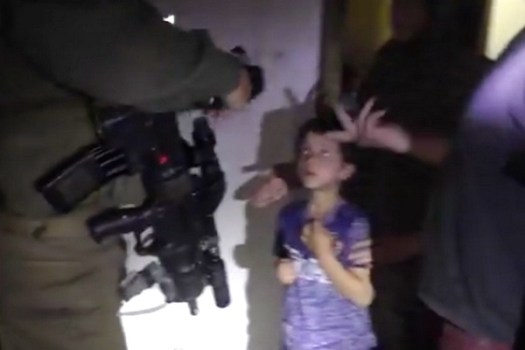
What would you do if soldiers dragged your son out of bed in the middle of the night?

hebronboy (1)
A screenshot from the B’Tselem video documenting the raid on the Da’na family’s home in Hebron. (photo: B’Tselem)

After more than half a century of occupation, most Israelis can no longer imagine themselves in the place of the Palestinians. But if we cannot imagine what it is like to live under occupation, we must at least confront its brutal reality.

By Orly Noy | +972 Magazine | Jun 8, 2018


Under an apartheid regime, it makes no sense to ask the white what he would do in the place of the black. To imagine the the tables turned has become impossible.


Twenty years ago, in March 1998, the head of the Labor Party Ehud Barak was asked by Haaretz journalist Gideon Levy what he would do were he a young Palestinian living under occupation. “If I were a Palestinian of the right age, I would, at some point, join one of the terrorist groups,” Barak answered.

Today, not only is it difficult to imagine a Jewish Israeli politician making a similar statement; the question itself sounds imaginary. Can we imagine ourselves as Palestinians? What a strange idea. If there is one thing 50 years of brutal military rule over another people has seared into the Israeli consciousness, it is that there is one law for us, and another for Palestinians — that our destinies as human beings were meant to be different.

When you consistently and systematically abuse the Other for decades, this separation of consciousness becomes a kind of survival mechanism. The fact that we cannot imagine ourselves in the place of those living in Gaza — for example, subject to a siege that forces one to live a life of suffering and extreme poverty — allows us to carry on without pangs of guilt.

Continue reading “What would you do if soldiers dragged your son out of bed in the middle of the night?”

The Palestine exception to free speech on campus

Entrance to the University of Chicago quad. (photo: University of Chicago)

University of Chicago’s commitment to protecting free speech doesn’t extend to students advocating for Palestine.

By University of Chicago Students for Justice in Palestine | The Chicago Maroon | Jun 8, 2018


Running contrary to much of current American political discourse and foreign policy, SJP’s position is exactly the type which needs the support of an institution devoted to free speech.


At about 12:00 pm on May 16, Students for Justice in Palestine (SJP) at the University of Chicago set up an installation on Bartlett quad to mark the 70th anniversary of the Nakba, the Palestinian Catastrophe, when over 700,000 Palestinians were forcibly removed from their land by Zionist forces in an act of brutal settler-colonial ethnic cleansing.

Our installation consisted of 70 flags, each with a fact about Palestine, Israel, and the Nakba. These facts were carefully researched and rendered in the installation. Though we are a political organization and make no claims to a mythical “neutral objectivity,” there were no falsehoods. Our goal was to educate, raise awareness, and foster discussion.

The installation was thoroughly scrutinized in advance by the University administration and approved of. By 3:00 pm the same day, the installation had been vandalized, 10 of the flags were missing, and a hastily-written note was left, accusing us of anti-Semitism. This accusation is patently false. As has always been the case, we vehemently oppose anti-Semitism, just as we oppose all forms of racism. By 1:00 am the following morning, all of the flags had been stolen.

Continue reading “The Palestine exception to free speech on campus”

The Palestinian letter behind the nixed Argentina-Israel soccer match

Argentinian forward Lionel Messi looks on as Jibril Rajoub speaks in Bethlehem, Aug 2013. (photo: Ahmad Gharabli / AFP)

Palestine Football Association chief Jibril Rajoub asked his Argentine counterpart to call off the game following “political pressure” by the Israeli government.

By Noa Landau and Jack Khoury | Haaretz | Jun 6, 2018


“The match itself is to take place in a stadium built on one of the at least 418 Palestinian villages destroyed by Israel 70 years ago, Al Malha.”
— Jibril Rajoub in his May 28th letter to the Argentian Football Association


The head of the Palestine Football Association appealed last month before his Argentine counterpart to cancel the match against Israel slated for Saturday in Jerusalem. On Tuesday night, the Argentine Football Association cancelled the game, which was to take place in Jerusalem.

In the letter, the Palestinian soccer official stressed what prompted his protest was the Israeli government’s decision to move the game from Haifa, where it was originally planned to take place, to Jerusalem.

“The original field of the match was Haifa,” said the letter penned by Jibril Rajoub. “However and after political pressure took place from the Israeli government, as it was openly said by Israel’s Minister of Culture and Sports Miri Regev, the match was moved to Jerusalem. This is a decision that, given the current context, the Palestine Football Association utterly rejects and condemns.”

Continue reading “The Palestinian letter behind the nixed Argentina-Israel soccer match”

Killing of Gaza nurse shows how cheap our blood is to Israel


Razan Al Najjar resuscitates a patient in a medical field tent in Gaza. (photo: Getty Images)

We are neither more nor less resilient and steadfast than any other human people in this world. We too feel pain and suffering. We too have a breaking point.

By Muhammad Shehada | Forward | Jun 4, 2018


We Gazans are caught between a rock and an unlivable, uninhabitable place, where the water we drink and the soil in which we plant are poisoning us and our children. Our air, land and sea are completely sealed off by Israel and Egypt’s military might. We Gazans endure humanitarian disaster, generation after generation, and are denied even the most basic right to escape a slow death. We are two million civilian prisoners, caged in a toxic slum from birth to death.


On June 1, 21-year-old volunteer paramedic Razan al-Najjar was shot dead at the Gaza protests while rescuing injured protestors near the separation fence.

Anyone with the smallest modicum of moral decency should be shattered, devastated and overwhelmed by her death, just as they should be devastated by the horrendous improvised projectile that hit a kindergarten in Israel. Both incidents deserve unequivocal condemnation, at the very least, though only one resulted in death (thank God, none of the children were hurt).

But al-Najjar’s murder shows us something else, something horrific that transcends the border shootings. For the systematic dehumanization of the Palestinian people, especially in Gaza, happens not only at the hands of the Israeli guns and policies but in the media afterwards, in the framing by Israel’s supporters.

Continue reading “Killing of Gaza nurse shows how cheap our blood is to Israel”

Who needs BDS? Israel scores Spectacular own goal in Argentina soccer fiasco

Culture and Sports Minister Miri Regev; Argentine soccer star Lionel Messi (photos: Emil Salman and Sergio Perez / Reuters)

The Argentines didn’t want to play an exhibition match in Israel in the first place, but would have come to Haifa. Then Culture and Sports Minister Miri Regev moved in.

By Uzi Dann | Haaretz | Jun 6, 2018


The move to Jerusalem and marking the game as part of Israel’s 70th-birthday celebrations gave legitimization to Israel’s opponents. They didn’t score a single goal but Regev did — an own goal, perhaps the most spectacular one in Israeli soccer history.


Argentine President Mauricio Macri is a friend of Israel, and of the large Jewish community in Buenos Aires. But even he, a former president of the Argentine soccer club Boca Juniors, knows that in any properly run country politicians don’t meddle with national soccer. (Not that Argentina is entirely a properly run country, but Israel is even less so.)

Such meddling would also break the rules of FIFA, the soccer world’s governing body. That’s why Macri politely declined Prime Minister Benjamin Netanyahu’s request to intervene in the decision to call off the exhibition match set for Jerusalem.

Culture and Sports Minister Miri Regev not only doesn’t get this, but she’s the main culprit for legitimizing Argentina’s decision not to come. If there’s one thing that Israeli governments have been scrupulous about over the years, it has been not to mix politics and sports.

Continue reading “Who needs BDS? Israel scores Spectacular own goal in Argentina soccer fiasco”

The Palestinians who never left

Displacement: with the 1948 expulsions most Palestinians became homeless refugees; some, as in Jaffa, stayed on. (photo: Bettmann / Getty)

While Gaza rages, a visitor to Jaffa discovers how many remained after the great expulsions of 1948, continuing to live and work in something like the diverse society they remembered.

By Stuart Braun | Le Monde Diplomatique | Jun 2018


As former citrus grove worker Ismail Abu Shehadeh reminded me, “you must wipe 1948 from your mind. Four thousand bombs were dropped on Jaffa — and it was a small place. Forgetting is a blessing from God.” Better for the old not to bring up the past, not to remember.


Sixty unarmed protestors were killed last month by Israeli military on the Gaza border, on the day that the US inaugurated its new embassy in Jerusalem, outraging the world; the Palestinians had been, in part, commemorating the Nakba, the catastrophe of the displacement of so many from the new state of Israel 70 years ago. The Great March of Return movement argues for the refugees’ right to come back to their ancestral lands. Yet some communities never left.

Staying in an Arab area south of Tel Aviv, I realized that Christian and Muslim Arabs and Jewish Israelis were, despite the divisive policies and rightward march of the Israeli government, still living together in a microcosm of what was once a very diverse part of the world. I’d been uneasy about travelling to Israel, and my pregnant wife and I were worried when, on our first afternoon, we heard that a Palestinian man had driven a truck into a crowd in Jerusalem and killed four young Israeli soldiers. We had found our apartment, which was in Ajami, a rundown district near the port of Jaffa, and our host, who lived next door with four generations of her Arab Christian family, welcomed us kindly with coffee in a sunny courtyard amid citrus trees in fruit. She was over 70, and had probably been a small child when her homeland ceased to exist. I had not expected to find anyone like her in modern Israel.

Continue reading “The Palestinians who never left”

US Ambassador Friedman slams American reporters for critical coverage of Gaza deaths

US Ambassador to Israel David Friedman speaks during a reception hosted by the Orthodox Union in Jerusalem, May 14, 2018 (photo: Ammar Awad / Reuters)

Friedman says criticism of recent Palestinian death toll in the Strip is aimed mainly at “my friends in the United States and one Israeli newspaper I’ve been known to criticize here” — a seeming reference to Haaretz.

By Judy Maltz | Haaretz | Jun 4, 2018


“I find it curious that an ambassador who repeatedly refuses requests to speak to the media is now criticizing the media. The international media is not a monolithic entity, and for him to generalize like this is simplistic, inaccurate and misinformed.”
— Joe Federman, chairman of the Foreign Press Association in Israel


US Ambassador to Israel David Friedman on Monday accused the media of major bias against Israel in its coverage of the recent violence on the Gaza border, telling reporters to “keep your mouths shut until you figure it out.”

Speaking in Jerusalem, Friedman said his criticism was aimed mainly at “my friends in the United States and one Israeli newspaper I’ve been known to criticize here” –—seemingly a reference to Haaretz, which the ambassador slammed in February after Gideon Levy published a piece criticizing him and his donation of an ambulance to a West Bank settlement.

Friedman claimed that most journalists covering the clashes in recent weeks had never bothered investigating whether Israel had other viable alternatives for defending its border besides using live fire. . . .

Continue reading “US Ambassador Friedman slams American reporters for critical coverage of Gaza deaths”