The events in Abu Dis came a day after a number of Israeli settlers from the illegal settlement of Pisgat Zeev protested in front of the house of Israeli Mayor of Jerusalem Nir Barakat over the “noise pollution” caused by the Muslim call to prayer.
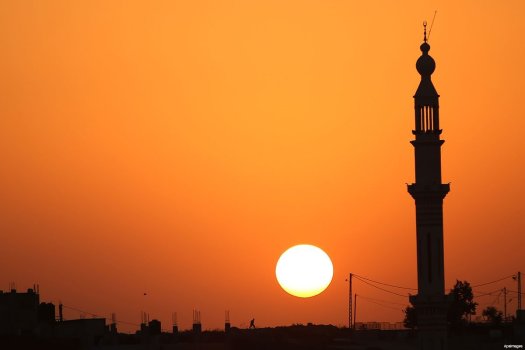
Israeli authorities reportedly banned the Muslim call to dawn prayer from being made from three mosques in the Jerusalem district town of Abu Dis today, according to local sources.
Lawyer Bassam Bahr, head of a local committee in Abu Dis, told Ma’an that Israeli forces raided the town just before the dawn prayer this morning.
According to Bahr, Israeli forces raided the Al-Rahman, Al-Taybeh and Al-Jamia mosques in the town, and informed the muezzins, the men responsible for the call to prayer — also known as the athan, which is broadcast five times a day from mosques — that the call for dawn prayer through the loudspeakers was banned.
Bahr added that the forces did not provide any reason for the ban, and also prevented locals living in the eastern part of the town from reaching the Salah Al-Din mosque for dawn prayers.
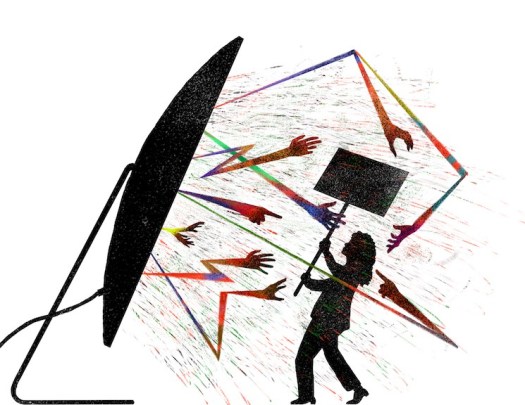
“The major way that McCarthyism worked was not because the government went in and punished people for the speech that they engaged in,” explains Corey Robin, a professor of political science at Brooklyn College and the CUNY Graduate Center whose name and photo are also featured on the site. “The bulk of it was precisely through these contacts amongst private employers and universities and non-state institutions that would sanction individuals for their speech.”
This past July, Thomas DeAngelis discovered that a bizarre website had placed his name and photo next to claims that he was “whitewashing terrorist violence and calling for more.” The site lists where he goes to school and what he’s studied, includes a lengthy description of his political activity, and even links to his Facebook page and Twitter handle.
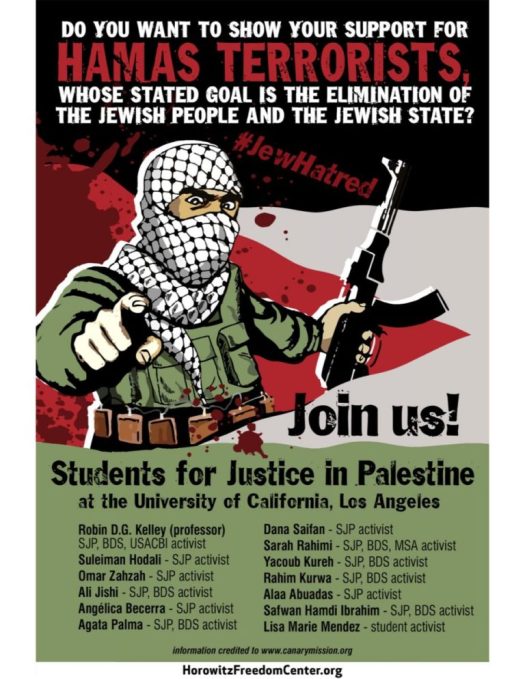
DeAngelis, 23, is a first year doctoral student in the Earth and Environmental Sciences program at the CUNY Graduate Center and a longtime activist with Students for Justice in Palestine (SJP). The profile on his political activities was posted to CanaryMission.org, a website that publishes the names, photographs, and biographical information of students engaged in Palestine activism across the United States.
The website, which was launched in May 2015, now contains profiles of over 600 individuals, most of them people of color. The site targets students and professors at universities across the U.S., in addition to a small number of people employed by Jewish Voice for Peace and other Palestine advocacy groups. [As of this writing, more than 1,000 US university faculty have signed a letter opposing CanaryMission.org here, AgainstCanaryMission.org.]
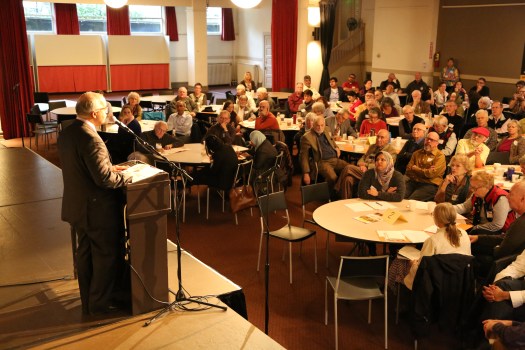
On Saturday, October 29, 2016, local area leaders and concerned citizens gathered at Town Hall Seattle for an event, Islam in the Public Square, to examine the dynamics that have led to the gap in understanding about Islam in America. We discussed the many issues clouding the image of Islam and Muslims in America, sought to build understanding and tolerance across ethnic and faith lines, and looked into ways all of us can confront and overcome the misunderstandings and fears that divide us. Together, as one Seattle community, we explored ways to work together for peace and justice.
Our humble thanks to the many people and organizations whose contributions of time, effort, and resources made this event such a success.
Below are the events, with links to transcripts, video, and photos.
These essays are presented here for the general reader. Each author takes full responsibility for what has been written. The material has been thoughtfully researched, and is offered in the spirit of seeking peace through understanding.
“For me, the source of coexistence for Islamic and Christian religions is the Church of the Holy Sepulchre.”
— Adeeb Joudeh, the current keeper of the key
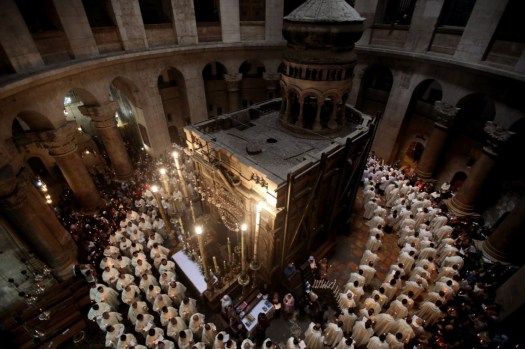
The Church of the Holy Sepulchre in Jerusalem’s Old City is Christianity’s most hallowed shrine. It’s believed that the rock-cut tomb at the heart of the church was where the body of Jesus Christ was once laid.
Over the past week, for the first time in centuries, a team of conservationists and researchers removed a marble slab that lay in a rotunda, known as the Edicule, at the center of the complex. It’s the spot, as my colleague William Booth put it earlier this year, when the renovation project first began, “where millions of pilgrims have knelt and prayed, where the salt of tears and the wet of sweat have smoothed and worried the hardest stone.”
“I’m absolutely amazed. My knees are shaking a little bit because I wasn’t expecting this,” Fredrik Hiebert, National Geographic’s archaeologist-in-residence, is quoted by the publication’s website. “We can’t say 100 percent, but it appears to be visible proof that the location of the tomb has not shifted through time, something that scientists and historians have wondered for decades.”
“Two states are not achievable in the foreseeable future,” the former Palestinian prime minister, Salam Fayyad, told me. “It has become a process about a process, and not real.”
There is agreement on very little in the fractious Holy Land, but on one issue there is near unanimity these days: A two-state resolution of the Israeli-Palestinian conflict is more distant than ever, so unimaginable that it appears little more than an illusion sustained by lazy thinking, interest in the status quo or plain exhaustion.
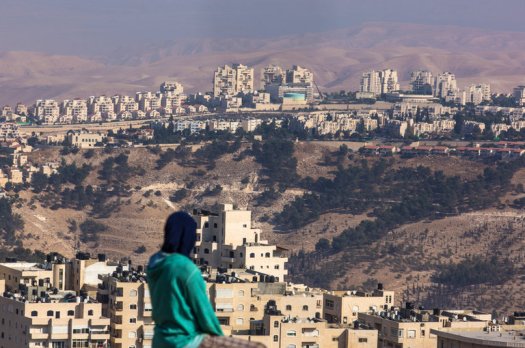
From Tel Aviv to Ramallah in the West Bank, from the largely Arab city of Nazareth to Jerusalem, I found virtually nobody on either side prepared to offer anything but a negative assessment of the two-state idea. Diagnoses ranged from moribund to clinically dead. Next year it will be a half-century since the Israeli occupation of the West Bank began. More than 370,000 settlers now live there, excluding in East Jerusalem, up from about 249,000 in 2005. The incorporation of all the biblical Land of Israel has advanced too far, for too long, to be reversed now.
Greater Israel is what Israelis know; the smaller Israel west of the Green Line that emerged from the 1947-49 war of independence is a fading memory. The right-wing government of Prime Minister Benjamin Netanyahu, with its contempt for Palestinians and dissenting voices in general, prefers things that way, as the steady expansion of settlements demonstrates. The Palestinian Authority in the West Bank, headed by President Mahmoud Abbas, has lost the legitimacy, the cohesion and the will to do much about it. The cancellation of municipal elections in the West Bank and Gaza that had been set for this month was another sign of paralyzing Palestinian infighting. . . .
Within Israel, where Netanyahu has now amassed more than a decade in power, the political and cultural drift is toward ever more assertive and intolerant nationalism. Criticism is increasingly equated with treason. Groups like B’Tselem, which focuses on allegations of human rights violations against Palestinians in Israeli-occupied territories, are under withering attack. The Messianic religious Zionism that holds all the West Bank to be Israel’s by biblical decree is ascendant. The left is in feeble disarray.
“And the army sees everything but does nothing,” Jibrin says. “A settler can ride a quad bike through a grazing flock and no one cares.” Jibrin still challenges intruders, though. “Why are you here?” he asked one settler who was walking on his land. “I am here for the Israeli Government,” the settler replied. “But you are poor people. You are here for nobody.”
Jibrin sits with quiet dignity and explains the effects of the occupation, “Life has become as small as a ring,” he says.
ibrin was born in Qawawis, a community of shepherds in the South Hebron Hills. His family had fields of wheat and barley, sheep and olive trees. Then, in the mid-1980s, the Susya settlement, illegal under international law, was established by the Israeli government on Palestinian land just across the road. Things started to change. The settlers let their animals into the Palestinian fields and damaged the crops. They threw stones at the shepherds. Jibrin’s family moved nearer to the village for protection.
But the harassment didn’t stop: it got worse. The settlers carried guns. The last twenty years have seen fatalities and serious injuries among the shepherds. Two died after stepping on an improvised explosive device placed on a shepherding path. Jibrin’s neighbour has a plastic stomach as a result of being shot by a settler. Another has a damaged voice box after being shot in the neck and speaks with difficulty.
How Israel is privatizing its occupation of Palestine — enriching the security industry and allowing the country to evade accountability for human-rights violations
“Earlier this year, Human Rights Watch (HRW) released a report, ‘Occupation Inc.,’ that detailed how ‘Israeli and international businesses have helped to build, finance, service, and market settlement communities.’ It added, ‘In many cases, businesses are “settlers” themselves.’”
It is 4:30 a.m. with the moon still high in the sky, but Palestinians from across the West Bank are already disembarking from buses outside the Qalandia checkpoint near Jerusalem. They’re about to begin a day’s work on the other side of the separation wall, in Israel.
Qalandia is one of the busiest checkpoints through which Palestinians with the required work documents can travel from the occupied Palestinian territories to Israel. With unemployment around 26 percent in the West Bank (in Gaza, it’s far worse — among the highest in the world, according to the United Nations), it’s always extremely busy at this early hour, because Palestinians need work, which is more readily available in Israel, especially in construction, manufacturing, and agriculture. . . .
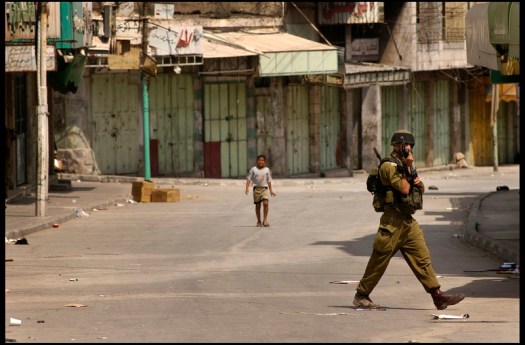
The warehouse-like checkpoint looks like a cattle pen on the inside: Metal bars on either side and above form a narrow chute, enclosing and herding the workers—many of whom have traveled from villages more than an hour away—toward the point where their documents will be checked by Israeli officials. They then wait on the Israeli side for transport from their employers.
For years, these checkpoints were manned by personnel from the Israel Defense Forces (IDF) and the Israeli Border Police. But starting in January 2006, gun-toting private security guards joined the soldiers and police. Today, there are 12 checkpoints in the West Bank and two on the Gaza border that use such guards. Israel is slowly privatizing its occupation.
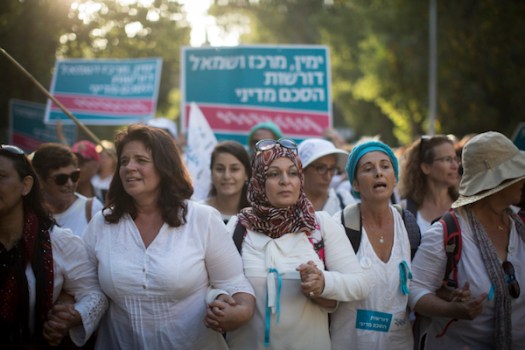
“The thousands of Palestinian and Israeli women who marched in Jerusalem and Jericho this month are not only demanding peace from their societies, they are reaching through stereotypes and artificial boundaries to find true partners.”
Less than a year ago a group of Palestinian and Israeli women spent a weekend in Tantur, situated between Jerusalem and Bethlehem, brainstorming what we could possibly do to break the cycle of violence and political stagnation. Everyone had their own personal reason for being there, whether it was the Israeli mothers who had to send their children to war or the Palestinian women who were exhausted by the daily incursions of the Israeli army, checkpoints, and the inability to live freely and imagine a hopeful future for their children. Personally, I felt torn apart having seen Jerusalem split into a hundred pieces, a place that should be the inspiration for coexistence instead oozing with the blood of Palestinians and Israelis on a near daily basis. . . .
“We need to think outside of our surroundings,” Lily kept saying, and together we visualized the March of Hope, a march of togetherness — a cry to the whole world, coming from a mother’s womb, to stop the violence. We resolved not to stop, even in the midst of most terrible acts of violence. We met and shouted out, “ Enough! Enough!” in Arabic, Hebrew and English. We resolved to propose a shared language of hope, of humanity, of an unshakable commitment to peace, and we rejected the language of separation.
“Consider a post-peace Israel where refugee claims have been settled, where the everyday brutality of occupation no longer precludes normalcy, and where the work of truth and reconciliation has begun. While still remaining alert to outside threats, Israel would be able to relax its disproportionate focus on security. After all, war and occupation take a toll on creative expression, while massive defense spending diverts focus from cultural investment.”
We watched with admiration as Hagai El-Ad of B’Tselem and Lara Friedman of Americans for Peace Now appeared recently before the U.N. Security Council to urge action against the Israeli occupation. The session was framed as a discussion of settlements in the context of “peace” and a “two-state solution.” But behind the occupation lurks an even more vexing issue: that of the “right of return” for Palestinian refugees. We feel we need to unpack this issue — and the assumptions about demographics that animate it — if we’re going to make real headway on countering the occupation.
The vast majority of Israelis, even most on the Israeli left, argue that admitting the Palestinian refugees would lead Israel to lose its “Jewish character.” For them, a Jewish-majority state provides the Jewish people with a degree of security and justice. Yet many Palestinians and their increasingly numerous and vocal supporters in North America and Europe see no justice in Israel’s exclusionary policies allowing all Jews, but no Palestinians, to “return” to the country.
Israelis’ anxious focus on ethnic demographics inflicts harm on those within the state as well. An array of discriminatory laws and practices currently marginalize the 20% of Israeli citizens who are Palestinian. These laws and practices not only make it difficult for Palestinian citizens to embrace the state as their own, they also preclude justice, equality and peace.




 HolyLandJustice.org
You must be logged in to post a comment.