Half of Americans Support Sanctions on Israel

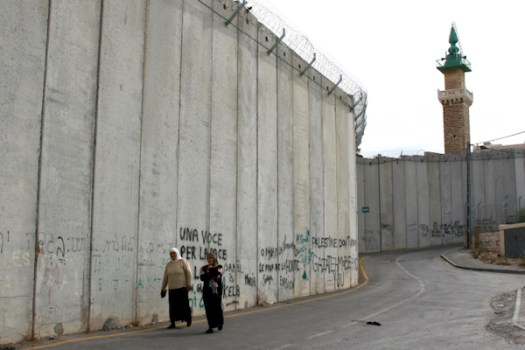
SEPARATION WALL
Palestinian women walk along Israel’s separation wall in the West Bank village of Abu Dis. (photo: Anna Kaplan / Flash900)

The Clinton campaign diverged from the party’s base on Israel-Palestine.

By Michael Schaeffer Omer-Man / +972 Magazine
December 3, 2016


Perhaps demonstrating how out of touch decision makers are with the electorate on the matter of Palestine and Palestinian rights, momentum in American government — local and national — seems to be toward limiting the tools Americans have to leverage their own economic and political power to end the occupation. At least 22 U.S. states have legislation that punishes companies for answering the Palestinian call for boycott, divestment and sanctions against Israel.


The number of Americans who support imposing sanctions on Israel over its defiant settlement policies has shot up to 46 percent, the same percentage of Americans who voted for Donald Trump in the presidential election.

That number has shot up nearly 10 percentage points over the past year, according to a national poll published by the Brookings Institute on Friday, on the sidelines of this week’s Saban Forum, “an annual dialogue between American and Israeli leaders.”

Among Democrats, a 60-percent majority “supported imposing some economic sanctions or taking more serious action” in response to Israeli settlements, the poll found. A much smaller number of Republican respondents (31 percent) support sanctions.

The United States, like most countries in the world, opposes the existence and expansion of Israeli settlements — both in the occupied West Bank (including East Jerusalem) and Golan Heights. Despite that opposition, however, Washington has rarely set any consequences for Israel’s settlement policies or actions.

Continue reading “Half of Americans Support Sanctions on Israel”
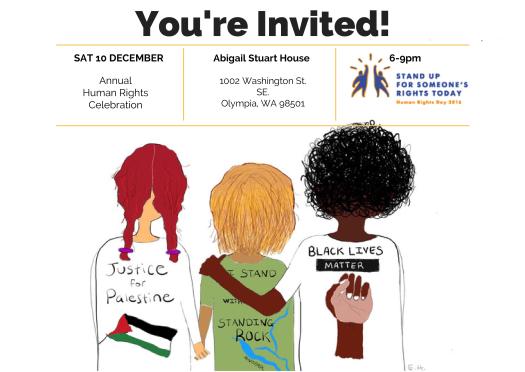
Don’t Forget: Human Rights Day Celebration!

page11
Artwork by Ethar Hamid

Please join our brothers and sisters at the Rachel Corrie Foundation for this important event.

Date: Saturday, December 10, 2016
Time: 6:00 – 9:00 p.m.
(dinner and drinks)
Location: Abigail Stuart House
1002 Washington St SE
Olympia, WA  98501
Cost: $35.00 (includes dinner and two drinks) (register here)
Information: Event website
Questions: 360-754-3998
Contact the Foundation

Join the Rachel Corrie Foundation for the 2016 Annual Human Rights Day Celebration for an evening of food and knowledge. Gather together for an evening with friends and enjoy delicious food prepared by local Olympia chefs, wine and locally-brewed beer donated by Three Magnets Brewing Co., a musical performance by Benjamin SittingBull, a Plains Indian singer, flutist and drummer, and a discussion on environmental and political activism.

[Continue reading here . . . ]


Now is the time to talk about . . .

adichie-nowisthetimetotalkaboutwhatweareactuallytalkingabout-1200
Photo: Livio Mancini / Redux

. . . What we are actually talking about.

By Chimamanda Ngozi Adichie / The New Yorker
December 2, 2016


Now is the time to resist the slightest extension in the boundaries of what is right and just. Now is the time to speak up and to wear as a badge of honor the opprobrium of bigots.


America has always been aspirational to me. Even when I chafed at its hypocrisies, it somehow always seemed sure, a nation that knew what it was doing, refreshingly free of that anything-can-happen existential uncertainty so familiar to developing nations. But no longer. The election of Donald Trump has flattened the poetry in America’s founding philosophy: the country born from an idea of freedom is to be governed by an unstable, stubbornly uninformed, authoritarian demagogue. And in response to this there are people living in visceral fear, people anxiously trying to discern policy from bluster, and people kowtowing as though to a new king. Things that were recently pushed to the corners of America’s political space — overt racism, glaring misogyny, anti-intellectualism — are once again creeping to the center.

Now is the time to resist the slightest extension in the boundaries of what is right and just. Now is the time to speak up and to wear as a badge of honor the opprobrium of bigots. Now is the time to confront the weak core at the heart of America’s addiction to optimism; it allows too little room for resilience, and too much for fragility. Hazy visions of “healing” and “not becoming the hate we hate” sound dangerously like appeasement. The responsibility to forge unity belongs not to the denigrated but to the denigrators. The premise for empathy has to be equal humanity; it is an injustice to demand that the maligned identify with those who question their humanity.

Continue reading “Now is the time to talk about . . .”

Stand with your Muslim neighbors

9d78c0e2-b805-11e6-9939-06ebf03f73d6-1560x1170
Photo: Jordan Goldwarg

If you have never visited a mosque, now is the time to do it.

By Jordan Goldwarg / The Seattle Times
December 1, 2016

[Jordan Goldwarg is the Northwest regional director for Kids4Peace International, a global movement of youth and families, dedicated to ending conflict and inspiring hope in divided societies around the world.]


In my work as the director of an interfaith-youth movement, I have had the privilege of visiting numerous mosques in Seattle and forming close friendships and professional relationships with many Muslims. Through these contacts, I have come to see Islam as a religion that espouses peace, compassion and tolerance.


On a recent night, I received a disturbing email informing me of vandalism that had damaged the main sign at the Muslim Association of Puget Sound (MAPS), the largest mosque in the region.

The following day, I received a phone call from a Muslim friend telling me that if a national Muslim registry is created, she will fear for her children and move her family back to East Africa.

These two incidents dramatically illustrate the anxiety that American Muslims are feeling, driven in no small part by a 67 percent increase in hate crimes last year over 2014, according to the FBI.

The vandalized sign underscores the critical importance of non-Muslim allies to stand against Islamophobia and support our Muslim friends and neighbors.

We need to defend Muslims for two reasons. First, as friends, we can speak out against bigotry and lend our voices in opposition to those who say that Muslims who speak in their own defense are simply trying to protect their own interests.

Second, we have the ability to make members of a targeted group feel valued and accepted as members of our community. So many of my Muslim colleagues have told me that community support is what makes this time of fear and anxiety more bearable. Continue reading “Stand with your Muslim neighbors”

“Make this my dream as well”

jonathan-kuttab-pic
Photo: King’s University College

In historic appearance, Palestinian offers one-state vision to a N.Y. temple.

By Phillip Weiss / Mondoweiss
November 30, 2016


Our two tribes not only have separate and different narratives, but we also have separate and conflicting ideologies. . . . We cannot find a way to live together if we continue to hang on to the two ideologies that we started with. We must find a new idea that is worth working towards, and change our ideologies in such a way that acknowledges the other as part of us, as who we want to be. . . . It’s a tall order, I know. But you really must move away from what I call the false view of democracy, which says that if I have 51 percent of the population, I can totally destroy negate crush delegitimize disenfranchise the other. That’s not democracy. The tyranny of 51 percent simply does not work.


I can’t remember the last time I’ve cried in a synagogue, but last night was truly extraordinary: a suburban New York temple hosted a Palestinian leader making the argument for one democratic state between the river and the sea. And the Jewish audience did not contest his description of human rights atrocities. And his Jewish hosts thanked him for opening their eyes to new ideas.

If there is a glimmer of hope that the American Jewish community can be redeemed from a tragic course, and that the peoples of Israel and Palestine can be freed from a blind alleyway of history, there it was last night, at Temple Israel in New Rochelle.  Continue reading ““Make this my dream as well””

Interfaith Leaders Turn Conflict Into Trust

29fixesweb-master768
Photo: Daniel Acker / The New York Times

By David Bornstein / The New York Times
November 29, 2016


Democracy is not just a place where you elect representatives; it’s a society where you can make personal convictions public. And diversity isn’t just the things we like. Diversity is also the things you don’t like. . . . What are ways in which I can understand my fellow citizens? What qualities do they possess that I would admire? And what are fundamental things that we can work on together?


This month, the F.B.I. reported that hate crimes against Muslims in 2015 reached their highest level since 2001. In New York City this year, hate crimes are tracking one-third higher than last year; against Muslims they have more than doubled.

The election of Donald J. Trump has highlighted religious tensions in America, particularly with Trump’s proposals to bar Muslims from entering the country and to create a registry of Muslims living in the United States. But these tensions did not begin with Trump. In America, virtually every form of faith or belief has at some point suffered unfavorable reception by others; the victims include Roman Catholics, Mormons, evangelical Christians, Jews and atheists, alongside Muslims.

Four years ago, I reported on the Interfaith Youth Core, which trains leaders to build relationships and respect between diverse faith communities. The work has expanded considerably. The organization now has more than 350 active campuses in its network, and more than 1,000 colleges have used its resources. This year its founder, Eboo Patel, explained in a book, Interfaith Leadership, what this type of leadership entails and why he considers it vital in today’s world. Patel, who is Muslim, recently spoke with me about democracy, the responsibilities of citizens, and his fears and hopes after this year’s election.

[Continue reading here . . . ]

Dark Clouds Over Palestine

OLYMPUS DIGITAL CAMERA

Deep divisions among the Palestinians are as damaging to their cause as the U.S.’s nauseating pandering to Israel

By Ramzy Baroud / Morning Star
November 24, 2016


Over his two terms, during which time thousands of innocent people — the vast majority of whom were Palestinians — were killed in Gaza and the West Bank, Obama purportedly worked to build a “middle ground.” However, the outcome of these policies were quite devastating — he sold Palestinians false hope while granting Israel most of its needs of military funding and technology and at the same time shielding it from international censure.


Fear and trepidation are slowly building up, as US president-elect Donald Trump is fortifying his transitional team with people capable of bringing about a nightmare scenario, not only for the US but for the rest of the world as well.

For Palestinians, however, the signs are even more ominous. From former New York mayor Rudy Giuliani to Republican leader Newt Gingrich the Trump team is filling up with dishonorable men who have made careers out of pandering to Israeli interests while discounting Palestinian rights.

In 2011 Gingrich had claimed that Palestinians are “invented” people, while Giuliani — according to the Jewish News Service — “is fondly remembered in the Jewish community for expelling Yasser Arafat, leader of the Palestine Liberation Organization (PLO) from a UN concert at the Lincoln Centre in 1995.”

Considering statements made by Trump last May, that the expansion of illegal Jewish settlements in the occupied West Bank “should keep moving forward,” to more recent comments by Trump’s spokesperson in Israel, Jason Greenblatt, that the illegal land occupations are “not an obstacle to peace,” it is fairly certain that the Trump administration will be decidedly anti-Palestinian and anti-peace.

[Continue reading here . . . ]

Dichotomy of American and Israeli Jews

pew

Twin Portraits From Pew Research Center Surveys

By Pew Research Center
September 27, 2016


“In many respects, Israel is a red state, and American Jews are a blue country.”


If you are Jewish, odds are that you live in Israel or the United States. Four out of every five Jews in the world live in these two countries, with approximately 6 million Jews in each.

Pew Research Center has surveyed Jewish adults in both places, and has found deep bonds between them. Nevertheless, their experiences and perspectives are very different. For instance, we asked Jews in Israel to describe, in their own words, the biggest long-term problem facing their country. They were as likely to cite economic concerns (such as Israel’s high cost of living, or a shortage of affordable housing in Tel Aviv and other cities) as they were to mention military or national security issues (such as terror attacks or Iran’s nuclear program).

Yet when American Jews were asked to name Israel’s biggest long-term problem, fully two-thirds cited a military or security issue, and hardly any (1%) mentioned economic difficulties — which suggests that many Jews in the United States either don’t know much about Israelis’ day-to-day economic challenges or don’t worry much about them.

[Continue reading here . . . ]

Jimmy Carter: America Must Recognize Palestine

29carter-master768-v2
Image: Vahram Muradyan / The New York Times

By Jimmy Carter / The New York Times
November 28, 2016


The Security Council should pass a resolution laying out the parameters for resolving the conflict. It should reaffirm the illegality of all Israeli settlements beyond the 1967 borders, while leaving open the possibility that the parties could negotiate modifications. Security guarantees for both Israel and Palestine are imperative, and the resolution must acknowledge the right of both the states of Israel and Palestine to live in peace and security. Further measures should include the demilitarization of the Palestinian state, and a possible peacekeeping force under the auspices of the United Nations.


We do not yet know the policy of the next administration toward Israel and Palestine, but we do know the policy of this administration. It has been President Obama’s aim to support a negotiated end to the conflict based on two states, living side by side in peace.

That prospect is now in grave doubt. I am convinced that the United States can still shape the future of the Israeli-Palestinian conflict before a change in presidents, but time is very short. The simple but vital step this administration must take before its term expires on Jan. 20 is to grant American diplomatic recognition to the state of Palestine, as 137 countries have already done, and help it achieve full United Nations membership. . . .

The primary foreign policy goal of my life has been to help bring peace to Israel and its neighbors. That September in 1978, I was proud to say to a joint session of Congress, “Blessed are the peacemakers, for they shall be called the children of God.” As Mr. Begin and Mr. Sadat sat in the balcony above us, the members of Congress stood and applauded the two heroic peacemakers.

I fear for the spirit of Camp David. We must not squander this chance.

[Continue reading here . . . ]

Israel to build 500 new settler homes in East Jerusalem

44f22246134e48ff99130bcab38f6c48_18
Photo: Al Jazeera

Palestinian leaders say Israel’s settlement movement is emboldened by the election of Donald Trump in the US.

By Al Jazeera News
November 24, 2016


“The real policy of the Israeli government is to destroy the very last opportunity to build a Palestinian state and kill the so-called two state solution.”


Israel has announced plans to move forward with the construction of 500 homes for Jewish settlers in occupied East Jerusalem, the first such move since the US presidential election.

“This morning, the local planning and building committee made the decision to advance [plans]… for 500 units in Ramat Shlomo,” the Ir Amim anti-settlement NGO said, referring to an ultra-Orthodox Jewish settlement near the Palestinian neighborhood of Shuafat.

More than 200,000 Israeli settlers now live in communities in East Jerusalem, which Israel has occupied along with the rest of the West Bank, the Gaza Strip and parts of Egypt and Syria since the 1967 war. More than half-a-million Israelis live in Jewish-only settlements throughout the West Bank, including East Jerusalem. They are considered illegal by international law.

[Continue reading here . . . ]