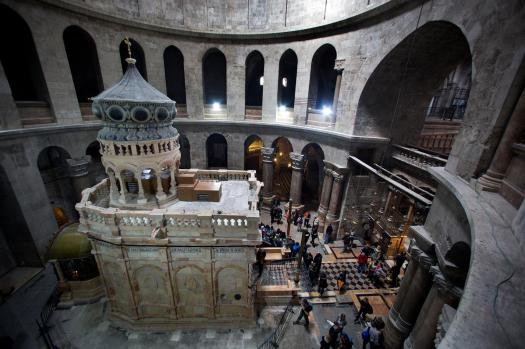
The Edicule inside the Church of the Holy Sepulchre in Jerusalem. (photo: Oded Balilty / AP for National Geographic)
Newly restored, but new problems discovered.
March 27, 2017
After a $4 million restoration, the Edicule, enclosing what is believed to be the tomb of Jesus Christ inside the Church of the Holy Sepulchre in Jerusalem, was reopened to the public. (The Guardian, The New York Times)
“For the first time in over two centuries, this sacred edicule has been restored. This is not only a gift to our holy land, but to the whole world.” — Theophilos III, Greek Orthodox Patriarch of Jerusalem
However, the scientific team from National Technical University of Athens (NTUA) that completed the restoration is warning of a newly-discovered risk of the Edicule’s collapse.
“When it fails, the failure will not be a slow process, but catastrophic.” — Antonia Moropoulou, NTUA’s chief scientific supervisor
Ground-penetrating radar and robotic cameras reveal that the Edicle and the rotunda that protects it are built on an unstable foundation of the crumbled remains of earlier structures, honeycombed with tunnels. (National Geographic) Continue reading “Tomb of Jesus at Risk of Collapse”
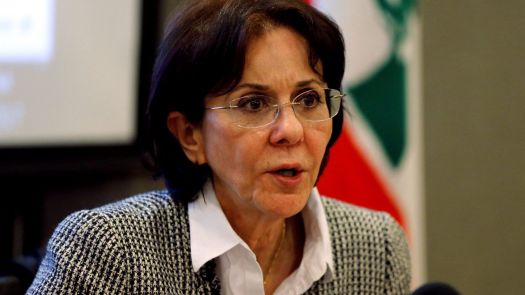
U.N. Under-Secretary General and ESCWA Executive Secretary Rima Khalaf was fired after refusing to withdraw a report declaring Israel an “apartheid state.” (photo: Mohamed Azakir / Reuters)
This report concludes that Israel has established an apartheid regime that dominates the Palestinian people as a whole. Aware of the seriousness of this allegation, the authors of the report conclude that available evidence establishes beyond a reasonable doubt that Israel is guilty of policies and practices that constitute the crime of apartheid as legally defined in instruments of international law.
Israel and its allies condemned the report and its authors. (Independent)
“The attempt to smear and falsely label the only true democracy in the Middle East by creating a false analogy is despicable and constitutes a blatant lie.” —Danny Danon, Israeli Ambassador to the U.N.
“The United Nations secretariat was right to distance itself from this report, but it must go further and withdraw the report altogether.” — Nikki Haley, U.S. Ambassador to the U.N.
Newly-installed U.N. Secretary General Antonió Guterres demanded the retraction of the report, which U.N. Undersecretary General Rima Khalaf, Executive Secretary of the UN-ESCWA, refused. She was subsequently dismissed, and the report was withdrawn. Read her resignation letter here. (New York Times, Haaretz)
After giving the matter due consideration, I realized that I too have little choice. I cannot withdraw yet another well-researched, well-documented U.N. work on grave violations of human rights, yet I know that clear instructions by the Secretary-General will have to be implemented promptly. A dilemma that can only be resolved by my stepping down to allow someone else to deliver what I am unable to deliver in good conscience.
Richard Falk, one of the authors of the report, Princeton University professor and former U.N. Special Rapporteur on human rights in Palestine, describes the thorough process behind the report in an editorial. (The Nation)
Our report concludes that Israel has deliberately fragmented the Palestinian people . . . relying on systematic discrimination . . . to maintain its control, while continuing to expand territorially at the expense of the Palestinian people. On the basis of these findings — backed up by detailed presentations of empirical data, including reliance on Israeli official sources — we conclude that the allegation of apartheid as applied to the Palestinian people is well founded.
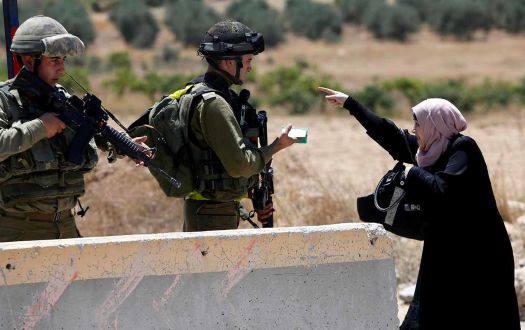
A Palestinian woman argues with Israeli soldiers at a West Bank checkpoint south of Hebron on Aug 16, 2016. (photo: Mussa Qawasma / Reuters)
Dubai carrier Emirates is one of 10 airlines from predominantly Muslim countries affected by the new computer ban. (photo: Marwan Naamani / AFP)
“A Muslim ban by a thousand cuts.”
March 21, 2017
In a scathing opinion written by Judge Derrick K. Watson, the U.S. District Court in Honolulu blocked the Administration’s second travel ban targeting Muslim-majority countries. (New York Times)
“The illogic of the Government’s contentions is palpable. The notion that one can demonstrate animus toward any group of people only by targeting all of them at once is fundamentally flawed. . . . It would therefore be no paradigmatic leap to conclude that targeting these countries likewise targets Islam.”
Now, the Administration is prohibiting passengers from eight Muslim-majority countries from carrying computers, tablets, and cameras onboard U.S.-bound flights. (The Washington Post, Independent)
“Secretary of Homeland Security John Kelly and Transportation Security Administration acting administrator Huban Gowadia have determined it is necessary to enhance security procedures for passengers at certain last-point-of-departure airports to the United States.”
This despite the U.K. having tried and abandoned a similar ban in 2006, and the utility of such an approach being seriously questioned being raised by security experts. (Independent, The Guardian)
“From a technological perspective, nothing has changed between the last dozen years and today. That is, there are no new technological breakthroughs that make this threat any more serious today. And there is certainly nothing technological that would limit this newfound threat to a handful of Middle Eastern airlines.”
“What appears to be new is this latest overreaction — it appears to be a Muslim ban by a thousand cuts.”
My question: Do your own donations to support education in the Israeli settlement of Beit El and President Trump’s trust in you put you in a unique position to stop Israel’s demolition of Palestinian communities?
David Friedman, esq.
Nominee for U.S. Ambassador to Israel
Dear Mr. Friedman,
I am writing with urgency. I have asked my Senators Feinstein and Harris to forward my questions to you and request your reply. I am bringing these questions forward because although many speculate about what shape peace between Israelis and Palestinians will take in the future, I am most concerned with how you will assure a future for Palestinians who are being forced from their land right now.
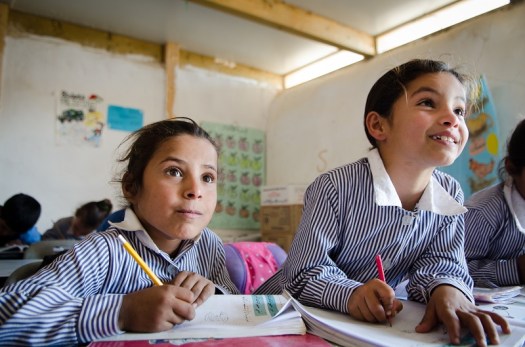
The stakes were always high, but since January 2017, this situation is critical. These past two weeks, I have once again been urging everyone I know to write to their Senators and Representatives to urgently request that they call the Israeli Embassy and the U.S. State Department to prevent the imminent demolition of a West Bank Palestinian school and village, this time the village of Khan al Ahmar. Simultaneously we await word of the State of Israel’s position re the appeal by the Palestinian village of Susiya, calls are arriving from the village of Umm al Kheir about the Israeli Army’s demolition of water catchment cisterns in their area, and more.
Join Kids4Peace Seattle supporters, volunteers, youth, families, and staff for our fourth annual spring celebration! Help us recognize the many successes of the past year as we also look forward with excitement to this summer’s programs. Hear directly from youth involved in the program and also get updates on our work in Jerusalem and the US.
Tickets are $50 per person; there will be an opportunity to make an additional pledge of support at the event. The ticket price is fully tax-deductible, and all donations go directly to support the work of Kids4Peace as we heal divided societies in both the United States and Jerusalem.
Registration and reception from 7:00 – 7:30
Program and dessert buffet from 7:30 – 8:30
Wine and coffee will be served, along with a delicious dessert buffet.
For more information, please contact Jordan Goldwarg, Kids4Peace Northwest Regional Director, at jordan@k4p.org or 617-335-7603. Can’t attend but would still like to support our work? Donate online anytime.
Jeremy Ben Ami speaks at a J Street conference. (photo: J Street)
The election of Donald Trump has emboldened fears that the two-state solution will officially be tossed into the dustbin of history. But J Street President Jeremy Ben Ami is undeterred.
The most important value for J Street that is an issue for the Palestinian community is our Zionism. J Street’s raison d’etre in the Jewish community is to say that — for those American Jews who care about there being a nation-state for the Jewish people — things are going in the wrong direction.
Under the dark cloud of Israeli and American leaders who appear united in their disinterest in a two-state solution, and the growing refrain in policy circles that the “window” is gone, J Street, the organization whose signature policy goal is a two-state resolution to the Israeli-Palestinian conflict — might have found itself foundering. What new ideas can be found when all avenues to the goal have been exhausted? What role does it have left to play in such a bleak context?
The annual J Street Conference that ended Monday in Washington, D.C., raised all these questions — minus the despair. Organizers said that over 3,500 people had turned out, panel rooms were packed to standing-only. The abundant cheering and whooping sometimes felt spontaneous and emotional, at others seemed tinged with effort to be enthusiastic.
One person whose enthusiasm seems effortless is Jeremy Ben Ami, the founder and president of the liberal Zionist organization. Despite all signs pointing to perdition, Ben Ami is indomitable, ticking off a long list of vital roles J Street has to play in the changed landscape of both America and Israel, and insisting on the singular viability of two-state solution. I spoke to Ben Ami as the conference neared its end on the role J Street must play in influencing U.S. government policy, among other things.
Palestinian workers stand in line next to a portion of the separation wall, waiting to cross through the checkpoint from Bethlehem into Israel. (Miriam Alster / Flash90)
The reality in the West Bank is one that resembles a prison, where Israel controls the law, the security, who can leave, and now who can visit.
There is no peace process, nor is there a real discussion over one state or two states. Even discussions on whether Israel is an apartheid state have become intellectual fodder for Jews and leftists. The reality is one that resembles a prison, and the prisoners will continue to be held by force . . . .
The Knesset passed a law Monday night denying entry visas or residency rights to foreign nationals who call for boycotts against Israel or the settlements. The law won’t have much of an effect on entry into Israel proper, but rather will mostly affect those trying to enter the West Bank — a solid reminder that the ban is yet another example of the way Israel holds Palestinians prisoners. After all, one can assume that most people who enter the Palestinian territories oppose the settlements or support some version of the boycott.
Because Israel controls every point of entry into areas under Palestinian control in the West Bank, Palestinians cannot leave (without a permit) or come back (without a permit). With the passage of the law, they are no longer allowed to have visitors. In other words: they are prisoners, and these restrictions are just the tip of the iceberg.
Fordham University has a real problem with political speech. In the name of avoiding controversy, they suck the air out of political life on campus and then act surprised that so few are able to take a deep breath. The fear of political polarization or controversy . . . often stifles meaningful dialogue on campus and deprives students of the opportunity to engage in the marketplace of ideas.
I am a proud Jew and a proud American. However, I cannot defend the actions of my school — Fordham University — which has recently blocked the formation of a Students for Justice in Palestine (SJP) chapter on campus.
On November 17th, the United Student Government stated that SJP “fulfills a need for open discussion and demonstrates that Fordham is a place that exemplifies diversity of thought.”
However, Dean of Students Keith Eldredge would go on to deny SJP official recognition. He stated that Fordham “cannot support an organization whose sole purpose is advocating political goals of a specific group, and against a specific country.” Seemingly unaware of the irony, he went on to argue that “the Israeli-Palestinian conflict . . . often leads to polarization rather than dialogue.”
In spite of our different views, we stand in strong opposition to the new law. It will be bad for Israel, bad for the cause of democracy at this fragile moment, and bad for the principles of free speech and thought on which our scholarship is based.
We, the undersigned scholars of Jewish studies, write to express our dismay over the bill passed on March 6 by the Israeli Knesset that would bar entry to any foreigner who supports the BDS movement or supports boycotting settlements or goods produced in the occupied territories. We are researchers with a wide range of professional, social, and personal ties to Israel and a diverse array of ideological positions. But we are unified in our belief that this law represents a further blow to the democratic foundations of Israel, continuing the process of erosion wrought by a recent series of bills including the Regulation Law, the Suspension of MKs Law, and the NGO Law, as well as the earlier Boycott Law. This is unacceptable. Continue reading “172 Scholars Decry Israel’s Travel Ban”
Daniela Vargas, 22, was released Friday from U.S. Immigration and Customs Enforcement custody. She had been detained after speaking out at a news conference in Jackson, Mississippi. (photo: Elijah Baylis / The Clarion-Ledger)
Daniela Vargas talks about her life before being detained by ICE agents, what life what like in detention and what her hopes are for the future.
“We’re all here for the same reason, even Americans.America is the land of the free. Who wouldn’t want to be here?” — Daniela Vargas
For 10 days, Daniela Vargas existed in a world closed off from the rest of society.
She didn’t eat, didn’t sleep. She cried for the first 48 hours.
She was alive but she wasn’t living. Her new reality was a far cry from the life she knew. The life she knew before immigration agents took her into custody.
But Vargas did what she has been doing since she was a 7-year-old immigrant who didn’t speak the same language as the other first-graders. She adapted.







You must be logged in to post a comment.