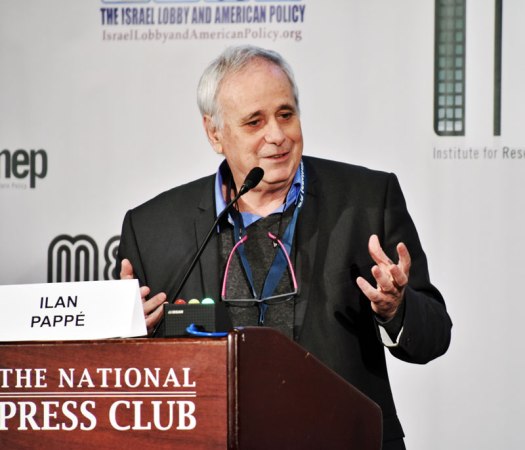
Ilan Pappé: Zionism as Settler-Colonialism

pappeex2gestureportlock
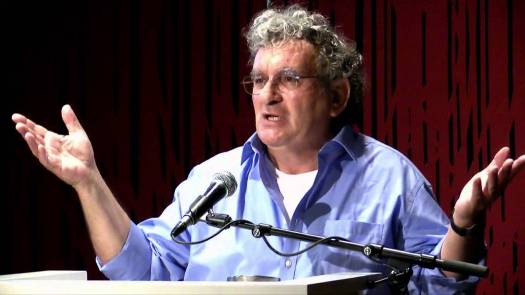
Ilan Pappé speaking at the conference The Israel Lobby and American Policy in Washington, DC, on March 24, 2017. (photo: Phil Portlock)

Keynote address: “The Value of Viewing Israel-Palestine Through the Lens of Settler-Colonialism.”

By Ilan Pappé / Washington Report on Middle East Affairs
March 24, 2017


Zionism is not an event. It is a structure, and it’s a setter colonialist structure.


. . . What I’m going to argue today, this afternoon, is that as much as the lobbies are important in affecting and influencing American policy, there is a basic and fundamental misunderstanding of what the conflict in Palestine is all about, including among those American diplomats, pundits, politicians who see themselves champions of Palestinian rights.

The level of — I wouldn’t call it ignorance, because these are very educated well-read people, so ignorance would not be a fair concept here — the level of blindness, or the level of ignorance in the sense of ignoring certain chapters rather than not being able to understand reality, this level is so high that it really makes it impossible, even when you have a period in which the lobbies are not strong or even when you have a president who is more pro-Palestinian than anyone before him. The level, the depths, of that ignorance is so significant that it would not allow the two other factors, even if they are diminished or weakened, to influence fundamentally the American policy and, in association, the reality on the ground.

Now, what is missing? And this is what I would like to point out. What is missing is an understanding of the nature of Zionism, the nature of the Zionist project in Palestine — not as a nostalgic journey into the past, but as a current analysis. The late and amazing scholar of settler colonialism, Patrick Wolfe, said famously that settler colonialism is not an event. It’s a structure. Zionism is not an event. It’s a structure, and it’s a settler colonialist structure. It was a settler colonialist structure in 1882, and it is a settler colonialist structure in 2017.

You don’t appease a settler colonialist project by dividing Palestine into two states. That will never appease the settler colonialist project. The only way to challenge a settler colonialist project is to decolonize the settler colonialist project. This challenge has not been digested by American policymakers, including those who regard themselves as open-minded, balanced — if you want — objective above the situation.

Continue reading “Ilan PappĂ©: Zionism as Settler-Colonialism”
Event Reminder: Kids4Peace Jet City to Jerusalem

https3a2f2fcdn-evbuc-com2fimages2f289034232f896348876352f12foriginal

Please join our brothers and sisters at Kids4Peace Seattle for their 4th Annual Spring Celebration and Fundraiser.

Date: Thursday, May 18, 2017
Time: 7:00 – 8:30 p.m.
Location: Temple De Hirsch Sinai
1441 16th Avenue
Seattle, WA 98122
Information: Facebook event
Event website
Tickets: $50

Event Details

Join Kids4Peace Seattle supporters, volunteers, youth, families, and staff for our fourth annual spring celebration! Help us recognize the many successes of the past year as we also look forward with excitement to this summer’s programs. Hear directly from youth involved in the program and also get updates on our work in Jerusalem and the US.

Tickets are $50 per person; there will be an opportunity to make an additional pledge of support at the event. The ticket price is fully tax-deductible, and all donations go directly to support the work of Kids4Peace as we heal divided societies in both the United States and Jerusalem.

Registration and reception from 7:00 – 7:30
Program and dessert buffet from 7:30 – 8:30

Wine and coffee will be served, along with a delicious dessert buffet.

For more information, please contact Jordan Goldwarg, Kids4Peace Northwest Regional Director, at jordan@k4p.org or 617-335-7603. Can’t attend but would still like to support our work? Donate online anytime.

Is Trump Visiting Israel to Praise Bibi — Or To Bury Him?

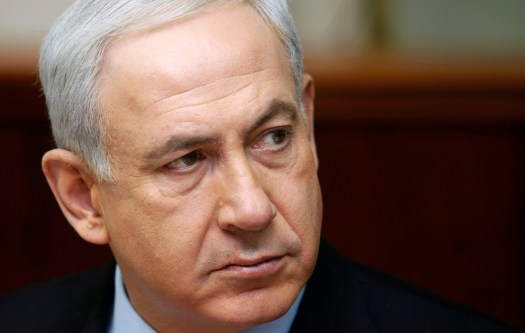
Israel's Prime Minister Netanyahu attends the weekly cabinet meeting in Jerusalem
(photo: PBS)

Trump has much to gain and little to lose; the reverse is true of Netanyahu.

By J. J. Goldberg / Forward
May 2, 2017


Israelis with ties to the Trump administration are reporting, according to political correspondent Tal Shalev of the widely read Walla news site, that the president wants to convene a “regional summit” of Middle East leaders this summer in Washington. Participants would include Egypt, Jordan and Saudi Arabia, along with Israel and the Palestinian Authority. The agenda would be based on the Saudi-led Arab Peace Initiative.


When Donald Trump visits Israel later this month, as he reportedly will do, he faces much to potentially gain and little to lose. The reverse is true of his host, Israel’s prime minister, Benjamin Netanyahu.

For Trump, it’s an opportunity to show some statesmanship and gravitas — qualities he’s not widely associated with — in a friendly environment. It’s an opportunity to solidify his shaky relationship with the ardently pro-Israel Republicans in Congress, who’ve been repeatedly undermined or plain flummoxed by Trump’s unpredictable antics. And — who knows? — he just might make some progress where so many have failed: getting the Israeli-Palestinian deadlock unstuck. Strange things happen when Trump’s around.

Besides, if he tries and fails, it will simply end up being another implausible promise he’s made and then airily dismissed. We’re used to it.

Continue reading “Is Trump Visiting Israel to Praise Bibi — Or To Bury Him?”

Pence: Israel Embassy Move Under “Serious Consideration”

20jerusalem-master768
The United States Embassy in Tel Aviv, where all other countries have their embassies. (photo: Jack Guez / Agence France-Presse via Getty Images)

By The Associated Press / The New York Times
May 2, 2017


“The president of the United States, as we speak, is giving serious consideration into moving the American embassy in Tel Aviv to Jerusalem. . . . To be clear, the president has also personally committed to resolving the Israeli and Palestinian conflict.”
— Vice President Mike Pence


President Donald Trump is giving “serious consideration” to moving the U.S. Embassy to Jerusalem from Tel Aviv, Vice President Mike Pence said Tuesday, the day before a scheduled White House visit by Palestinian President Mahmoud Abbas.

Trump is also “personally committed” to becoming the U.S. president who finally ends the long-running Israeli-Palestinian conflict, Pence said.

Moving the U.S. Embassy to Jerusalem is a politically charged act that would anger Palestinians who want east Jerusalem, which was captured in 1967, as a future capital and part of their sovereign territory. Such a move would also distance the U.S. from most of the international community, including its closest allies in Western Europe and the Arab world.

[Editor’s note: There are 82 foreign embassies in Israel, none of which are in Jerusalem.]

Continue reading “Pence: Israel Embassy Move Under “Serious Consideration””

In Palestinian Power Struggle, Hamas Moderates Talk on Israel

02hamas-master768
Members of the Qassam Brigades, the armed wing of the Hamas movement, in the Gaza Strip last year. (photo; Said Khatib / AFP / Getty Images)

Hamas presents new charter accepting a Palestine based on 1967 borders.

By Ian Fisher / The New York Times
May 1, 2017


“Whether it’s a coincidence or it’s connected, I have one thing to say: The Palestinian leadership is afraid of this Hamas moderation. Because the [Palestinian Authority] and Fatah are afraid that by this moderation, Hamas presents itself as the true representation of the Palestinian people.”
— Mkhaimar Abusada, political scientist at Al-Azhar University-Gaza

Hamas, the militant group built around violent resistance to Israel, sought on Monday to present a more moderate public face, taking its next shot in an intensifying struggle for leadership of the Palestinian cause and international recognition.

Released by Hamas just days before its chief rival, the Palestinian Authority leader Mahmoud Abbas, was to meet President Trump, a new document of principles for the group calls for closer ties to Egypt, waters down the anti-Semitic language from its charter, and accepts at least a provisional Palestinian state — though it still does not formally recognize Israel.

With its statement, Hamas is trying to offer a more mainstream-friendly version of its vision for the Palestinian cause, and to gain ground against Mr. Abbas, whose influence is growing more tenuous.

Continue reading “In Palestinian Power Struggle, Hamas Moderates Talk on Israel”

German Foreign Minister Calls Netanyahu’s Bluff

3175
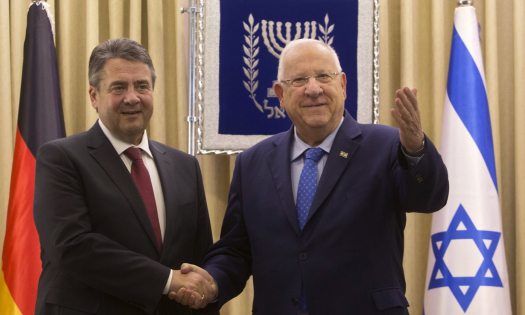
German foreign minister Sigmar Gabriel (left) with Israeli president, Reuven Rivlin, in Jerusalem on April 25, 2017. (photo: Sebastian Scheiner / AP)

German Foreign Minister Sigmar Gabriel will learn far more from his meetings with B’Tselem and Breaking the Silence than from meeting with Netanyahu.

By Dahlia Scheindlin / +972 Magazine
April 25, 2017


“You never get the full picture of any state in the world if you just meet with figures in government ministries.”


Given an ultimatum of meeting with Breaking the Silence and B’Tselem or meeting Israeli Prime Minister Netanyahu, German Foreign Minister Sigmar Gabriel very simply made the right choice to forego Netanyahu. And not in order to “defy” Netanyahu, as per a breathless Bloomberg headline, or to give any message at all.

He was right simply because what would he have actually learned from Netanyahu? Those organizations will give Gabriel concrete information: B’Tselem will update him on developments regarding the 50-year-old occupation and its most current manifestations, in the form of data, documentation and analysis. Breaking the Silence will give him human experiences of occupation, and tell the truth about growing attempts to intimidate and suppress the group for daring to oppose Israeli policies. Continue reading “German Foreign Minister Calls Netanyahu’s Bluff”

The Longest-Serving Palestinian Prisoner in Israel

1474847845
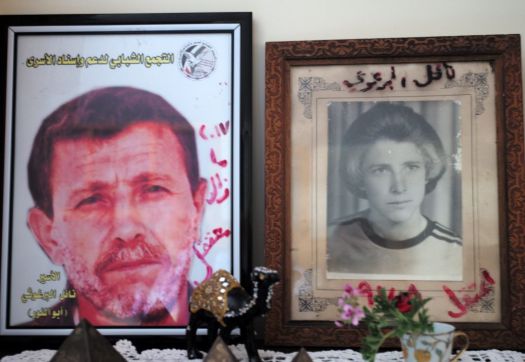
Nael Barghouti as a prisoner in 1993 (right) and as a long-haired youth in 1978. (photo: Alex Levac / Haaretz)

He was released in a prisoner swap after serving 33 years, then sent back in on a technicality.

By Gideon Levy / Haaretz
April 29, 2017


[After being returned to prison,] Nael was sentenced to 30 months in prison for violating the conditions of his release. But when that term ended, he was not set free. Then, two months ago came the astounding news that he would have to complete his life-plus-18-years sentence, originally meted out in 1978.


The three photographs on the chest of drawers at the entrance to the living room tell the whole unbelievable story. The first shot, from 1978, shows a long-haired youth. The second, taken 15 years later, is a portrait of a prisoner between his two aged parents, both of whom lean on canes. It was taken the last time they met. The third is of an elderly man, at the time of his release from prison.

Thirty-nine years separate the first and third images, and Nael Barghouti, the man in all of the photos, spent most of that time incarcerated in an Israeli prison for murdering Mordechai Yakoel, a bus driver, in 1978. There is no longer-serving prisoner than Barghouti, and no crueler arbitrary treatment by the authorities than that demonstrated in his case. Continue reading “The Longest-Serving Palestinian Prisoner in Israel”

The “Idea of Israel” and “My Promised Land”

the-separation-wall-on-th-011
The separation wall on the West Bank that divides Palestinians and Israelis. (photo: Pedro Ugarte/AFP/Getty)

The moral consequences of the triumph of Zionism: Ilan PappĂ© and Ari Shavit view Israel from different vantage points, but they agree the status quo between Israel and the Palestinians can’t be sustained.

By Avi Shlaim / The Guardian
May 14, 2014

[Ed. note: In anticipation of Ilan Pappé’s visit to Seattle next month, we are touching on some of the Israeli “new historians.” This 2014 piece from The Guardian reviews Pappé’s book, The Idea of Israel: A History of Power and Knowledge, and Ari Sahvit’s, My Promised Land: The Triumph and Tragedy of Israel.]


Chaim Weizmann, the first president of the state of Israel, famously said that it is by its treatment of the Palestinians that his country will be judged. Yet, when judged by this criterion, Zionism is not just an unqualified failure but a tragedy of historic proportions. Zionism did achieve its central goal but at a terrible price: the displacement and dispossession of the Palestinians — what the Arabs call the Nakba, the catastrophe.


Zionism achieved its greatest triumph with the establishment of the state of Israel in 1948. The Zionist idea and its principal political progeny are the subject of deeply divergent interpretations, not least inside the Jewish state itself. No other aspect of Zionism, however, is more controversial than its attitude towards the indigenous population of the land of its dreams. Chaim Weizmann, the first president of the state of Israel, famously said that it is by its treatment of the Palestinians that his country will be judged. Yet, when judged by this criterion, Zionism is not just an unqualified failure but a tragedy of historic proportions. Zionism did achieve its central goal but at a terrible price: the displacement and dispossession of the Palestinians — what the Arabs call the Nakba, the catastrophe.

The authors of these two books are both Israelis, but they approach their subject from radically different ideological vantage points. Ilan Pappé is a scholar and a pro-Palestinian political activist. He is one of the most prominent Israeli political dissidents living in exile, having moved from the University of Haifa to the University of Exeter. He is also one of the few Israeli students of the conflict who write about the Palestinian side with real knowledge and empathy.

Continue reading “The “Idea of Israel” and “My Promised Land””

Blood and Sand

maxresdefault
Benny Morris, professor of history at Ben-Gurion University of the Negev, speaking in Oslo, Oct 6, 2014. (photo: Med Israel for fred)

A revisionist Israeli historian revisits his country’s origins.

By David Remnick / The New Yorker
May 5, 2008

[Ed. note: In anticipation of Ilan Pappé’s visit to Seattle next month, we are touching on some of the Israeli “new historians.” This 2008 piece from the New Yorker reviews Benny Morris’s book, 1948: A History of the First Arab-Israeli War, which provides an in-depth analysis of the origins of Israel. Morris’s early work, Righteous Victims: A History of the Zionist-Arab Conflict, 1881-2001, was the seminal work among the “new historians,” and is arguably one of the best histories of the Israeli-Palestinian conflict.]


In “1948,” the assembled compendium of aspiration, folly, aggression, hypocrisy, deception, bigotry, violence, suffering, and achievement is so comprehensive and multilayered that no reader can emerge without a feeling of unease — which is to say, a sense of the moral and historical intricacy of the conflict.


For thirteen centuries, between 1200 B.C. and the second century A.D., the Jews lived in, and often ruled, the land of Israel. The population was clustered mainly in Judaea, Samaria, and Galilee. The Jews’ dominion was long but not eternal. The Romans invaded and, after suppressing revolts in A.D. 66-73 and 132-135, killed or expelled much of the Jewish population and renamed the land Palaestina, for the Philistines who had lived along the southern seacoast. After the conquest, some Jews stayed behind, and the faith of the Hebrews remained a religio licita, a tolerated religion, throughout the Roman Empire.

By the nineteenth century, Palestine had been ruled by Romans, Persians, Byzantines, Arabs, Christian Crusaders, and Ottoman Turks. When Mark Twain visited in 1867, his imagination soaked with the Biblical imagery of milk and honey, he discovered to his surprise “a hopeless, dreary, heartbroken land . . . desolate and unlovely.” Jericho was “accursed,” Jerusalem “a pauper village.” Twain’s passages on Palestine in “The Innocents Abroad” have, over the decades, been exploited by propagandists to echo Lord Shaftesbury’s notion that, before the return of the Jews to Zion, Palestine was a land without a people for a people without a land. Twain and Shaftesbury, as it turned out, were hardly alone in failing to recognize a substantial Arab population in the Judaean hills and beyond.

Continue reading “Blood and Sand”

Event Reminder: Kids4Peace Jet City to Jerusalem

https3a2f2fcdn-evbuc-com2fimages2f289034232f896348876352f12foriginal

Please join our brothers and sisters at Kids4Peace Seattle for their 4th Annual Spring Celebration and Fundraiser.

Date: Thursday, May 18, 2017
Time: 7:00 – 8:30 p.m.
Location: Temple De Hirsch Sinai
1441 16th Avenue
Seattle, WA 98122
Information: Facebook event
Event website
Tickets: $50

Event Details

Join Kids4Peace Seattle supporters, volunteers, youth, families, and staff for our fourth annual spring celebration! Help us recognize the many successes of the past year as we also look forward with excitement to this summer’s programs. Hear directly from youth involved in the program and also get updates on our work in Jerusalem and the US.

Tickets are $50 per person; there will be an opportunity to make an additional pledge of support at the event. The ticket price is fully tax-deductible, and all donations go directly to support the work of Kids4Peace as we heal divided societies in both the United States and Jerusalem.

Registration and reception from 7:00 – 7:30
Program and dessert buffet from 7:30 – 8:30

Wine and coffee will be served, along with a delicious dessert buffet.

For more information, please contact Jordan Goldwarg, Kids4Peace Northwest Regional Director, at jordan@k4p.org or 617-335-7603. Can’t attend but would still like to support our work? Donate online anytime.