Palestine in 1923

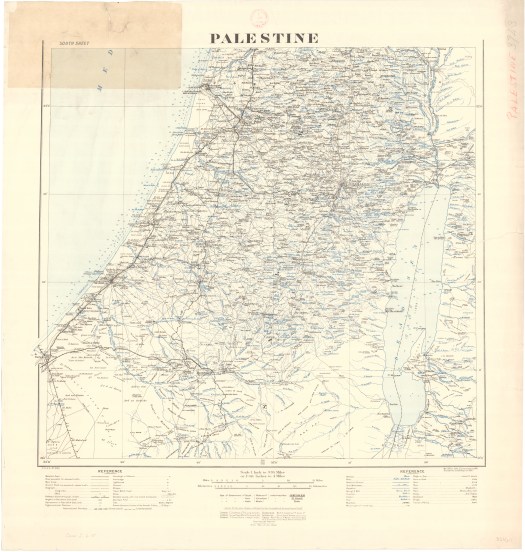
Palestine_south_1924
Map of Palestine, 1924. (map: British War Office / National Library of Scotland)

How a 1923 college textbook describes the nascent conflict in Palestine.

[Ed. note: I recently came across my father’s college textbook, Europe Since 1815.* I was curious to see how it described the then-recent events in Palestine. Here is the complete entry on Palestine.]


It is quite obvious that the vague term “a national home” does not mean, and cannot safely be made to mean “a Jewish State.” For Palestine as a Jewish State with supreme authority in the hands of the Jews would mean a clear and flagrant defiance of the principle of self-determination. . . . [The Arabs] consider Palestine their country, as it is, if majorities have any rights which the world is bound to respect.


. . . Great Britain has also been given by the League of Nations a mandate for Palestine. Embodied in the mandate is a provision for the establishment of a “National Home” for the Jewish People according to the principle laid down in the Balfour Declaration of November 2, 1917, which reads as follows: “His Majesty’s Government view with favor the establishment in Palestine of a National Home for the Jewish people and will use their best endeavors to facilitate the achievement of that object, it being clearly understood that nothing shall be done which may prejudice the civil and religious rights of existing non-Jewish communities in Palestine, or the rights and political status enjoyed by Jews in any other country.”

What this may mean remains to be seen, the term and conception of a “national home” being new to political science and of uncertain scope and significance. It represents the presented status of the Jewish nationalist aspiration expressed in recent times in the movement called Zionism. Great Britain as the mandatory power is responsible for the carrying out of this purpose. It has not yet indicated what its interpretation of the Balfour Declaration will actually be. It is quite obvious that the vague term “a national home” does not mean, and cannot safely be made to mean “a Jewish State.” For Palestine as a Jewish State with supreme authority in the hands of the Jews would mean a clear and flagrant defiance of the principle of self-determination accepted as the underlying basis of the system of mandates created by the Conference of Paris.

Palestine has a population of somewhat less than 800,000, of whom only about 80,000, or one in ten, are Jews, most of the rest being Arabs. The Arabs are absolutely opposed to the aims of Zionism. They consider Palestine their country, as it is, if majorities have any rights which the world is bound to respect. They regard the Balfour Declaration as the work of British politicians who have an eye to the advantage of British commerce and imperial expansion and who are sensitive to the influence of Jewish world finance. They see no reason why the should themselves be sacrificed to such considerations. There is an Arabic nationalist aspiration as there is a Jewish nationalism and a British imperialism. Whether the three can live together in harmony within the restricted area of Palestine remains to be seen. There are materials sufficient for a serious conflict. It should be noted, further, that there are nearly as many Christians as Jews in Palestine, 73,000 of the former, 83,000 of the latter. . . .


*Hazen, Charles Downer. Europe Since 1815. Henry Holt and Company, 1923. Excerpts from pages 999–1000.

Israel’s Irrational Rationality

Israeli policemen removing a protester during the eviction of Jewish settlers from the illegal settlement of Amona in the occupied West Bank, February 2017
Israeli policemen removing a protester during the eviction of Jewish settlers from the illegal settlement of Amona in the occupied West Bank, February 2017. (photo: Corinna Kern / NurPhoto / Getty Images)

By David Shulman / The New York Review of Books
June 22, 2017


No amount of coddling and reassuring, no increased bribes in the form of more money or military aid, will have any effect on Israeli policy for the simple reason that Israel considers any sacrifice that would be necessary for peace far worse than maintaining the current situation . . . . The assumption that Israel genuinely wants a peace agreement is simply wrong; the costs of such an agreement are tangible, immediate, and perhaps overwhelming, involving the loss of territory, an end to colonization, and potential political collapse, whereas the costs of maintaining the status quo are for many Israelis, if at times unpleasant, eminently bearable.


This June, Israel is marking the fiftieth anniversary of the Six-Day War. Some Israelis, including most members of the present government, are celebrating the country’s swift victory over Egypt, Jordan, and Syria as the beginning of the permanent annexation of the entire Palestinian West Bank; others, like me, mourn it as the start of a seemingly inexorable process of moral corruption and decline, the result of the continuing occupation of the West Bank, along with Israel’s now indirect but still-crippling control of Gaza. As it happens, my own life in Israel coincides exactly with the occupation. I arrived from the US in 1967, not as an ideological Zionist but as a young student who had fallen madly in love with the Hebrew language. Sometimes I think it is my passion for the language that has kept me here for five decades, although I would now want to add the strong feeling that it is my fate and my good fortune to be able to fight the good fight.

The country I came to live in fifty years ago was utterly unlike the one I live in today. It was no utopia, but its society was broadly moderate and humane, a mildly Mediterranean version of a modern European social democracy. Despite what some would say, it was not a colonial settlers’ society. There was widespread fear and even hatred of Arabs, including Arab citizens of Israel, but it was nothing like the rampant racism one now hears every day on the radio or TV. Shame, sincere or not, had not yet disappeared from public life.

In those early years, most Israelis regarded the occupied territories — which included the Golan Heights and the Sinai Peninsula as well as the West Bank and the Gaza Strip — not as providing an opportunity for enlarging the boundaries of the state through colonization but as bargaining chips in an eventual and hoped-for peace settlement with the Arabs. There were as yet no Israeli settlements in the territories and hence no fanatical, messianic settlers; the Israeli army could still claim, with some justice, to be an army of defense, not a police force sent to ensure that the project of seizing Palestinian land take place without too much resistance from the local population.

Continue reading “Israel’s Irrational Rationality”

Jerusalem Police: Jewish Peace Activists Are Human “Garbage”

1246260096
Protesters at the Flag March on Jerusalem Day, May 24, 2017. (photo: Olivier Fitoussi)

When the police officer wrenched back my arm I couldn’t tell if it was breaking. Now I am more sure than ever of the need for more direct action for equality between Jews and Palestinians.

By Ori Weisberg / Haaretz
May 31, 2017


“At the fall of your enemy, do not rejoice; at his stumbling, do not gladden your heart” (Prov. 24:17)


No day of the year demonstrates the division of Jerusalem like Jerusalem Day, which was marked last week. Most Israelis see it as marking the city’s “liberation” and “unification,” but Palestinians, who make up a third of the population, and a minority of Israelis, see it as the beginning of its occupation.

The Jerusalem municipality annually authorizes a march through the Old City’s Muslim Quarter, shutting it down for the protection of its residents. These Jerusalemites are forced to sacrifice a half day’s revenue, which many of them sorely need, while marchers punctuate their songs with chants like “Death to Arabs!”, “Mohammed was a pig!”, “Burn the villages!”, and “Burn the mosques!” Residents are locked into or out of their homes for the duration while marchers bang on the metal shutters of their closed storefronts, often causing damage that they must repair at their own cost. Even if such a march proceeds peacefully, it would be still be experienced by Palestinians as a form of violence.

Continue reading “Jerusalem Police: Jewish Peace Activists Are Human “Garbage””

The Dovekeeper and the Children’s Intifada

brooks-the-dovekeeper-1200
Ahmed Manasra being escorted into a courtroom in Jerusalem, in October, 2015. (photo: Ahmad Gharabli / AFP / Getty)

How a thirteen-year-old boy in Jerusalem became a Rorschach blot for the Israeli-Palestinian conflict.

By Geraldine Brooks / The New Yorker
May 27, 2017


“Our children don’t have normal childhoods. From the minute they open their eyes they wake into a reality of checkpoints, soldiers, settlers insulting their mom. They see the news from Gaza, children like them, bombed and homeless. They hear about a boy their age, burned alive by Israelis. They are sad and afraid. It’s not a healthy environment.”


Their plans were quite precise: they wouldn’t attack women, or the elderly, or children like themselves. Their targets, they agreed, would be men in their late teens and early twenties — young men of military age. All this was settled between them before they left the house. Hassan Manasra, fifteen, took a carving knife from his mother’s kitchen, but his cousin Ahmed, thirteen, couldn’t find the long, daggerlike knife he’d intended to use for his weapon. It took him a while, but finally he located it, concealed in a cupboard, where his father had hidden it for safekeeping.

The Manasras live in a compound of multifamily homes occupying almost an entire block in the Jerusalem hillside neighborhood of Beit Hanina. In the shared courtyard, half a dozen bicycles of various sizes are propped against a tree or lie in the dirt by the tall entry gate. Ten brothers and their families share the compound, and the children move fluidly through each other’s apartments, which are furnished rather formally: prints of alpine landscapes, velvet-covered sofas, lacy tablecloths. They’re the homes of a modestly prosperous clan whose breadwinners owned a grocery store, or work in trades or in transportation. Until October 12, 2015, Hassan and Ahmed followed the same schedule as all the school-age cousins in the household: go to class, come home, eat, change clothes, and then go play in an area that their uncles had cleared for them on the unused land beneath the highway overpass that separates Beit Hanina from the adjacent neighborhood of Pisgat Ze’ev. Sometimes the cousins played soccer, but Hassan and Ahmed particularly enjoyed training for parkour; the concrete pylons and grassy embankments under the highway were ideal for practicing vaults and tumbles.

The highway divides two East Jerusalem neighborhoods — the House of Hanina and the Peak of Ze’ev — that face each other across a shallow valley. Both are long-settled places. Beit Hanina was home to a few farming families as early as Canaanite times; in Pisgat Ze’ev, excavations have uncovered ritual baths from the Second Temple period. Both neighborhoods have seen tremendous population growth since 1967, when Israel captured this territory from Jordan in the Six-Day War. Now the busy highway is all that marks the division between the Palestinian neighborhood and the Jewish one. Pisgat Ze’ev is the last stop on the Jerusalem tramline, Beit Hanina the second-to-last. Residents of the two neighborhoods live cheek by jowl, yet they inhabit two different worlds.

Continue reading “The Dovekeeper and the Children’s Intifada”

The Ultimate Deal: One State or Two?

20170520_srp070_0
(photo: The Economist)

Israel’s dangerous drift to chauvinism may make a solution ever harder to find.

Special Report: Six Days of War, 50 Years of Occupation / The Economist
May 20, 2017


Israel cannot at the same time have all of the “Land of Israel,” a predominantly Jewish state and full democracy. Most Israelis (and many Palestinians) cannot conceive of a one-state model with equal rights for all Arabs and Jews. In reality, a one-state model means that some or all of the Palestinians would be disenfranchised. So, in the end, two states still looks like the least bad option to most Israelis and Palestinians.


IN A COUNTRY of larger-than-life leaders—founding fathers, warriors and peacemakers  — it is easy to forget how long Binyamin Netanyahu has been around for. Having served as prime minister for 11 years—three years in the 1990s and eight years in his current stint — he is Israel’s second-longest holder of that office after David Ben-Gurion. He is on first-name terms with the world’s leaders. But what has he achieved?

On the big questions of war and peace, not much. He has won no big battles and secured no big peace agreements. Instead he has managed the conflict and avoided big disasters, which is no small feat. He has waged two wars against Hamas in Gaza, fending off calls for a full reinvasion. In the West Bank, the Palestinian Authority co-operates on security. Hizbullah, the Lebanese Shia militia, is too busy in Syria to risk a second front with Israel, and its paymaster, Iran, is some years away from being able to make a nuclear bomb.

Continue reading “The Ultimate Deal: One State or Two?”

A Sorry State: The Half-Life on an Occupied Palestine

20170520_srp073_0
(photo: The Economist)

There is no end in sight to the occupation.

Special Report: Six Days of War, 50 Years of Occupation / The Economist
May 20, 2017


Arij, a student, picks her way past the fetid rubbish by the wall as she returns to East Jerusalem from Birzeit University, a commute of two-and-a-half hours each way. She does not speak Hebrew, so could not go to an Israeli university. “I don’t know any Jews. I am not ready to make friends with them,” she says. Most Israelis are not interested either. The Arabic that they are usually taught is a pidgin designed for places like Kalandia, with phrases in the imperative: “Jib al-hawiya” (give me your ID).


ISRAEL, THE PALESTINIAN AUTHORITY and Hamas may be bitter rivals, but they all agree on one thing: the Erez border crossing between Gaza and Israel, for the lucky few allowed to use it, is a prime opportunity to recruit spies. At the Israeli terminal a poster showing a handshake offers the “Chance of Your Lifetime” to Palestinians willing to provide information on militants. Beyond a buffer zone, at the PA and Hamas posts, murals warn Palestinians against betraying the homeland.

Erez marks one of the world’s strangest frontiers, separating the lush fields of Israeli kibbutzim from the free-fire zones, rubble and chaos of Gaza — a territory that is neither a state, nor an autonomous domain of the PA, nor even a fully occupied territory after Israel pulled out in 2005. Instead it is a large detention camp, guarded from without by Israeli forces (and by Egyptian troops), and from within by Hamas, the strongest of the armed gangs, which pushed out the PA in 2007. The PA’s border post provides a convenient buffer between Israel and Hamas.

The façade of the Israeli terminal masks a surreal automated facility. No Israeli is in sight as Palestinians emerging from Gaza make their way through remote-controlled gates and scanners. Commands are barked through distorted tannoys, or made with obscure hand signals from behind the blast-proof window of a control room high above.

Continue reading “A Sorry State: The Half-Life on an Occupied Palestine”

Maria Cantwell, Please Reconsider Your Support of Anti-BDS Legislation

The following is an open letter from The Right Reverend Cabell Tennis, retired Bishop of the Episcopal Diocese of Delaware, in response to Maria Cantwell’s sponsorship of Senate bills S.170 and S.720.*

The Rt. Reverend Cabell Tennis

May 22, 2017

Senator Maria Cantwell
915 Second Ave
Seattle, WA 98174

Dear Senator Cantwell,

This letter comes from a Seattle resident who greatly respects and appreciates your work as a United States senator for Washington. I am a retired Episcopal Bishop, a lifelong Democrat and progressive.

I especially salute you and your colleagues in the Washington State delegation for your steadfast alertness to the sometimes threatening proposals from the Trump administration and the Republican majority.

There is, however, one matter that seems to me to be outside of progressive and fair-minded legislation. I am referring to the present move to constrain the use of boycott, divestment, and sanction (BDS). From my perspective, and I would urge you to join me, BDS is a nonviolent, peaceful means for people to support the oppressed and take a stand against violations of international law when they are occurring and our government does not act.

In this case, I am referring to the Palestinian people who have been under military occupation for more than 60 years while we have consistently supported the State of Israel by financial contributions and vetoes in the United Nations. The pattern is clearly that of apartheid as it was practiced by South Africa during the long night of oppression there.

I urge and encourage you to not support legislation that seeks to limit or suppress BDS. It is a fundamental right of the people of this country to petition their government through peaceful and nonviolent means including acts of protest.

Sincerely,

Cabell Tennis


* Senate bill S.170, the “Combating BDS Act of 2017,” prohibits “measures by State and local governments to divest from entities that engage in commerce-related or investment-related boycott, divestment, or sanctions activities targeting Israel.”
Senate bill S.720, the “Anti-Israel Boycott Act,” prohibits “boycotts fostered by international governmental organizations against Israel.” 

Startup Nation or Left-Behind Nation? Israel’s Economy is a Study in Contrasts

20170520_srp075_1
(photo: The Economist)

Dazzling high-tech firms divert attention from a serious productivity problem.

Special Report: Six Days of War, 50 Years of Occupation / The Economist
May 20, 2017


The economic disparities are striking. With GDP per person at $35,700 a year in 2015, Israel’s standard of living is much the same as France’s. For the West Bank the figure stands at $3,700, akin to Egypt’s; for Gaza it is about $1,700, similar to Congo-Brazzaville’s. In real terms, Gazans are about 25% poorer today than they were at the time of the Oslo accords.

Israel’s security barrier is, to a large extent, also a one-way protectionist barrier. The Palestinian market is fully exposed to Israeli goods, but Palestinian products struggle to get out. Strawberry farmers in Gaza, working less than a kilometer from the border fence, say they cannot export to Israel and only rarely to the West Bank. In the main, Palestinians are treated as a source of cheap, and disposable, labor.


IN A PATCH of desert until recently frequented only by passing camels, workers in a computer lab examine new “smart” appliances: a slow cooker on one bench, a security camera on another, a smoke detector on a third. Millions of devices that incorporate mini-computers are being connected to the internet. But as well as convenience, the “internet of things” offers cyber-criminals many new vulnerabilities to exploit. “If I were an attacker, I would never hide in your PC,” says Oleg Brodt, director of research and development at Cyber@BGU, the cyber-security research centre run by Ben Gurion University in Beersheva. “I would try to hide in your smoke detector or door alarm, because nobody bothers to protect them.”

The centre has shown how wearable devices can be used to eavesdrop on corporate networks. It has also demonstrated the multitude of ways in which even supposedly ultra-secure computer systems not connected to the internet can be hacked. These include exploiting FM radio waves emitted by video cards, the blinking of LED lights or even the pattern of heat signatures.

Continue reading “Startup Nation or Left-Behind Nation? Israel’s Economy is a Study in Contrasts”

Trump Chases His “Ultimate Deal”

trump-chases-his-ultimate-deal-1200
(photo: Evan Vucci)

What is the basis of optimism In Israel about Donald Trump? For many, it seems to be his apparent endorsement of an “outside-in” peace process.

By Nathan Thrall / The New Yorker
May 22, 2017


The outside-in approach is merely the latest in a series of failed tactics aimed at creating new incentives to make peace, rather than pursuing strategies — withholding financial assistance, to begin with — that steer the parties away from the status quo. Trump frightens Israeli leaders precisely because he is one of the only American politicians they could imagine even considering the latter approach.


Not so long ago, President Donald Trump had backers of the Israeli-Palestinian peace process worried and Israeli settlers and annexationists elated. Many were convinced that a change in U.S. policy toward Israel was imminent, not least because the President’s three main advisers on Israel were modern Orthodox Jews with ties to West Bank settlements. Mr. Trump’s chief negotiator, Jason Greenblatt, is a former West Bank yeshiva student. The new U.S. Ambassador to Israel, David Friedman, until recently headed a settler fund-raising group. And the family of Jared Kushner, Trump’s son-in-law, has donated to the institutions of a settlement northeast of Ramallah.

For months after Trump’s election, Palestinians couldn’t manage to arrange so much as a phone call with his senior advisers. And, at a White House press conference in February with Prime Minister Benjamin Netanyahu, Trump himself expressed ambivalence about Palestinian statehood. Few doubted Naftali Bennett, the head of the pro-settler Jewish Home Party, when he declared that “the era of a Palestinian state is over.”

Today, however, Palestinians leaders are roundly praising Trump — not just Mahmoud Abbas, the head of the Palestinian Authority, but also Khaled Meshal, the former leader of Hamas. In Trump, they see the rare possibility of an American President who appears capable of challenging the decades-long bipartisan consensus to underwrite Israel’s occupation while making empty promises to end it. The fact that Mr. Trump is a Republican and surrounds himself with lifelong Zionists makes him seem even better positioned to twist Israel’s arm. Palestinians took note when, during the Republican primaries, Trump vowed to be a neutral mediator, refused to blame only one side for the Israeli-Palestinian conflict, and declined to back down when attacked, even though he had many electoral and financial incentives to do otherwise.

Continue reading “Trump Chases His “Ultimate Deal””

The Army’s New Elite: Israel’s Army is Recruiting Ever More Ultra-Orthodox Officers

20170520_srp072_1
(photo: Magnum)

Religious soldiers are replacing kibbutzniks. Does it matter?

Special Report: Six Days of War, 50 Years of Occupation / The Economist
May 20, 2017


Is the IDF the most moral army in the world, as many claim? There must be doubts. Breaking the Silence, a group of reservists who bear witness to what they have seen and had to do while in uniform, tell many disturbing stories, from the petty humiliation of Palestinians to actions that might count as war crimes.


ARMY INDUCTION DAY feels like a graduation party. Family and friends gather. The kids leave home to become the defenders of the Jewish state. The gun is passed from father to son. On the day the paratroopers are being signed up at Bakum, the main recruitment centre of the Israel Defence Forces (IDF), young men dance in a circle to the beat of a drum, singing “Don’t be afraid, Israel.” All in the cheerful band wear the knitted skullcaps of the national-religious movement, having studied at a religious military academy in the settlement of Eli.

Religious Zionists have largely taken over the ideological fire of the secular kibbutz movement, which built socialist collective farms in the early years of the state. Now it is the boys from the yeshivas (Jewish seminaries) who seek to settle the land and become army officers. If the army is a microcosm of Israeli society, then its top units may be the harbingers of Israel’s future elite. The paratroopers form a sort of military aristocracy. Eight of the 15 IDF chiefs of staff since 1967 have worn the red beret and boots, and several became prominent politicians.

Continue reading “The Army’s New Elite: Israel’s Army is Recruiting Ever More Ultra-Orthodox Officers”