US role as Mideast peace broker may be over

3883
Mike Pence, an evangelical Christian, has visited Israel four times before and pushed for Trump’s inflammatory policies in the Middle East. (photo: Alex Brandon / AP)

Under Trump, relations between the Palestinian leadership and Washington have soured – and Pence’s trip is expected to confirm the enmity.

By Oliver Holmes | The Guardian | Jan 20, 2018


Trump has said he wants to revitalize long-stalled peace talks in pursuit of what he has described as the “ultimate deal.” Yet when Pence touches down in Tel Aviv on Sunday evening, the US’s role as mediator in the conflict may be over for good.


It’s not the trip to the Holy Land that Mike Pence might have imagined. For a start, the US vice-president — an evangelical Christian — is no longer welcome in Jesus’s birthplace of Bethlehem.

Donald Trump doomed Pence’s chances of a visit to the West Bank when he reversed decades of US policy last month by recognising Jerusalem as Israel’s capital. This broke a longstanding international consensus that the issue would be negotiated in peace talks with the Palestinians, who also claim parts of the city.

While Trump did not rule out a future division of Jerusalem, the Palestinian president, Mahmoud Abbas, swiftly rescinded Pence’s invitation to meet him and visit Bethlehem, while senior Christian clerics in Egypt — where Pence arrives on Saturday at the start of his four-day trip ­— also cancelled planned events.

Continue reading “US role as Mideast peace broker may be over”

ACTION: Call on Congress on to oppose UNRWA cuts

JORDAN-PALESTINIAN-REFUGEE-UNRWA-DEMO
UNRWA provides a lifeline to 5 million Palestinian refugees. (photo: AFP)

Take action today, and urge Congress to reject any cuts to vital aid for Palestinians and to oppose the administration’s decision to recognize Jerusalem as Israel’s capital.

By American Friends Service Committee | Jan 20, 2018


“Never forget that justice is what love looks like in public.”
— Cornel West


Last month, President Trump announced his administration’s reckless, one-sided decision to recognize Jerusalem as the capital of Israel and eventually move the US embassy there. Now the administration is threatening to cut off US aid to the Palestinians — a move that would have disastrous consequences for the Palestinian refugees who depend on it.

Please click on this link to send and email to your congressional representatives →

Volunteer opportunities at the Tent of Nations

OLYMPUS DIGITAL CAMERA
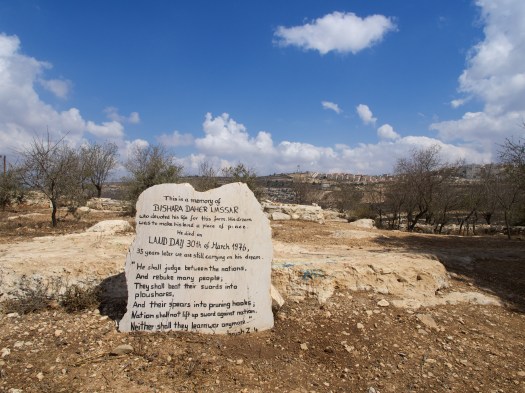
A memorial for Bishara Daher Nassar at the Tent of Nations near Bethlehem, with a settlement visible in the background. (photo: HolyLandJustice.org)

If you’re interested in spending some time in the West Bank, please consider volunteering with our friends at Tent of Nations.

By Glenna Kay Plitt (via email) | FOTANNA | Jan 18, 2017


  • Mar 19–30, 2018 — Camp 1: Tree Planting Camp
  • Jun 4–14, 2018 — Camp 2: Cave Renovation Camp
  • Jun 25–Jul 7, 2018 — Camp 3: Children’s  Summer Camp
  • Jul 30–Aug 9, 2018 — Camp 4: Almond Harvest Camp
  • Aug 27–Sep 7, 2018 — Camp 5: Fig and Grape Harvest Camp
  • Oct 22–Nov 2, 2018 — Camp 6: Olive Harvest Camp

High school students look for gap-year experiences, retired people look for short-term volunteer projects, college students look for international travel experiences for credit or for internships, people between jobs look for something new and different to add to their résumés — many people are searching for meaningful ways to make a difference in a world that feels very topsy-turvy right now. FOTONNA is here to help you make that difference.

We are offering any and all of you an opportunity to participate in a small but meaningful way through volunteering on the Nassar family farm (Daher’s Vineyard, outside Bethlehem) or enabling someone you know to go in your stead. I know that you are all familiar with the Tent of Nations Peace Project, and Daoud Nassar is in need of volunteers to help in both small and big ways. With the current unrest in the area (which is an understatement), there is an even greater need today to have an international presence on the farm at all times. You can find out more by visiting Daoud’s website — www.tentofnations.org — and clicking on the Volunteer tab. Continue reading “Volunteer opportunities at the Tent of Nations”

Female IDF soldiers move from the front lines to the headlines

4336464487_b9a23886d6_b-640x400
Female soldiers in the IDF take a water break during an exercise on Nov 19, 2007. (photo: Israel Defense Forces / Flickr)

Debate over mixed-gender IDF units rages in the Hebrew-language press.

By Adiv Sterman | The Times of Israel | Jan 18, 2018


“It is too bad that too many ultra-religious Zionists — both rabbis and MKs — are stoking the flames, stirring up unnecessary controversy, and provoking hatred.”
— Yossi Yehoshua, writing in Yedioth Ahronoth


The frustration felt by many citizens of the Jewish state over the growing chasm between religious-conservative and secular-liberal values in Israel is reflected in today’s Hebrew-language newspapers, as pundits and analysts pretty much across the board denounce calls for draft evasion issued by prominent right-wing rabbis, including Rabbi Shmuel Eliyahu, who went as far as saying that the IDF’s chief of staff should be fired for promoting women’s service in combat roles.

“Woman combat soldiers: The secret to the IDF’s success,” writes Israel Hayom’s Maayan Adam, who is an officer in the army reserves herself. “The comments against women’s service no longer manage to anger me; they even lead me to feel pity. It is easy to notice that behind the patriarchal discourse stands a distress call from a handful of scared men,” Adam says, adding that there can be no turning back now that women have been introduced into the army’s various combat units.

Continue reading “Female IDF soldiers move from the front lines to the headlines”

Belgium pledges $23m to UNRWA after US cuts aid

149f9ee6998046c4836706459dbb525a_18
UNRWA supports about 5 million Palestinians. (photo: Ibraheem Abu Mustafa / Reuters)

Belgium is the first to step up after refugee agency pleas for additional donors.

By Al Jazeera News | Jan 18, 2018


“For a lot of Palestinian refugees the UNRWA is the last life buoy. With the help of UNRWA half a million of Palestine children are able to go to school. This prevents them from falling prey to radicalization and extreme violence.”
—Alexander De Croo, Belgian Deputy Prime Minister


Belgium has pledged to donate 19m euro ($23m) to UNRWA, the UN’s aid organization for Palestinian refugees, after the US government announced it would slash its funding to the agency by half.

Deputy Prime Minister Alexander De Croo said in a statement on Wednesday that Brussels would allocate the funds over three years.

The first annual payment is being disbursed immediately “considering the financial difficulties that UNRWA currently faces,” the statement said.

Washington announced on Tuesday it is withholding $65m out of the $125m aid package earmarked for the United Nations Relief and Works Agency for Palestinian Refugees, or UNRWA.

Continue reading “Belgium pledges $23m to UNRWA after US cuts aid”

UN seeks donations for refugees after US cuts aid

palestinian-refugee-feature
Palestinians hold signs during a protest against aid cut, outside United Nations’ offices in Gaza City. (photo: Reuters)

UNRWA issues a broad appeal in the wake of the Trump administration’s aid cut.

By Reuters via New York Post | Jan 17, 2018


“At stake is the dignity and human security of millions of Palestine refugees, in need of emergency food assistance and other support in Jordan, Lebanon, Syria, and the West Bank and Gaza Strip. The reduced contribution also impacts regional security at a time when the Middle East faces multiple risks and threats, notably that of further radicalization.”
— Pierre Krähenbühl, UNRWA Commissioner-General


The head of the UN agency that provides aid to Palestinian refugees appealed on Wednesday for world donations after the United States withheld about half its planned funding for the organization, a move he said risks instability in the region.

Washington said on Tuesday it would provide $60 million to the UN Relief and Welfare Agency while keeping back a further $65 million for now. The US State Department said UNRWA needed to make unspecified reforms.

Palestinians, already angered by US President Donald Trump’s Dec 6 recognition of Jerusalem as Israel’s capital, denounced the decision, which could deepen hardship in the Gaza Strip where UNRWA helps much of its population of 2 million.

Continue reading “UN seeks donations for refugees after US cuts aid”

US cuts to refugee agency a “death sentence”

afp_ww37l
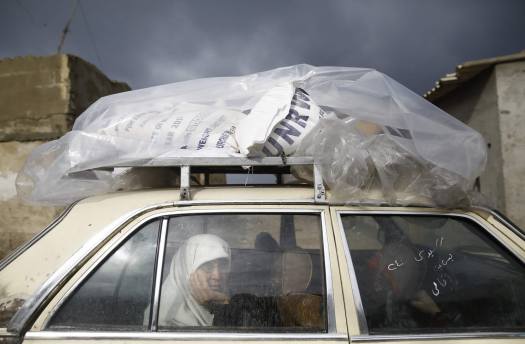
A Palestinian woman rides in a car after collecting aid provided by UNRWA in Gaza City on Wednesday. (photo: Mohammed Abed / AFP / Getty Images)

Trump’s decision to cut aid to Palestinian refugees threatens the well-being of millions.

By Hazem Balousha and Ruth Eglash | The Washington Post | Jan 17, 2018


“We are extremely worried. We support 1 million people with food. . . . [We] just hope we have enough time to persuade them to change their mind and/or to find another donor.”
— Matthias Schmale, UNRWA Gaza Director


The UN Relief and Works Agency, the main body providing aid to millions of Palestinian refugees and their descendants across the Middle East, made an urgent appeal for international support Wednesday, one day after the State Department announced that it will slash its annual funding.

“After decades of generous support, dramatic reduction of US funding to @UNRWA results in most critical financial situation in history of Agency,” the agency’s commissioner general, Pierre Krähenbühl, wrote on Twitter. “I call on member states of the United Nations to take a stand & demonstrate to Palestine Refugees that their rights & future matter.”

In a more detailed statement to the media, Krähenbühl said the U.S. contribution of $60 million, less than half of a planned $125 million installment, is “dramatically below past levels” and jeopardizes the “dignity and human security of millions of Palestine refugees, in need of emergency food assistance and other support.”

Continue reading “US cuts to refugee agency a “death sentence””

Jerusalem: It’s tense, crowded and can feel like a jail

10jerusalem4-superjumbo
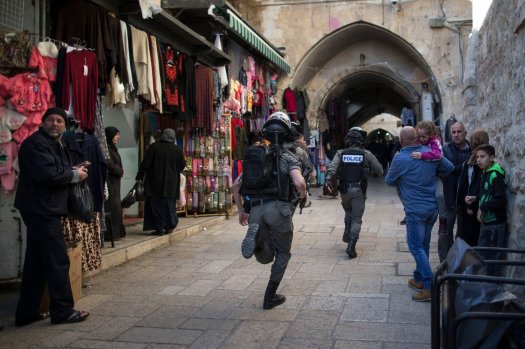
Israeli border police officers responding to a disturbance in the Muslim Quarter after Friday prayers. (photo: Uriel Sinai / The New York Times)

This is a tense city on a good day.

By David Halbfinger | The New York Times | Dec 9, 2017


“There’s a big religion problem in Jerusalem. It’s a city of racism. Once there’s a little bit of balagan [chaos] between Jews and Arabs, Jews won’t go in my taxi, and Arabs won’t go to the mall. And if I go into a religious neighborhood and they find out I’m Arab, they’ll stone my car. . . . There will never be peace here. If they take all the Arabs away, the Jews would eat each other. And the same thing with us.”
— Jerusalem taxi driver Muhammad Ziada


You feel it behind the wheel: The traffic signals turn red and yellow to alert a coming green. Hesitate a half-second before accelerating? A honking horn. Schoolgirls gesture at motorists as they step into a crosswalk, fingertips bunched and faces scowling: Will you wait, or what?

You see it in the crowding: Overstuffed apartments spilling onto one another, in teeming Palestinian neighborhoods, and in ghetto-like ultra-Orthodox enclaves, a few blocks apart on either side of the Green Line, the pre-1967 boundary with the West Bank.

You hear it in the way people talk — “The Arabs,” “The Jews” — about people with whom they have been sentenced to share a tiny patch of soil atop a ridge with no strategic value, over which the world has been battling for thousands of years, and negotiating on and off for decades, with no end in sight.

Continue reading “Jerusalem: It’s tense, crowded and can feel like a jail”

Let the two-state solution die a natural death

AlineBatarseh
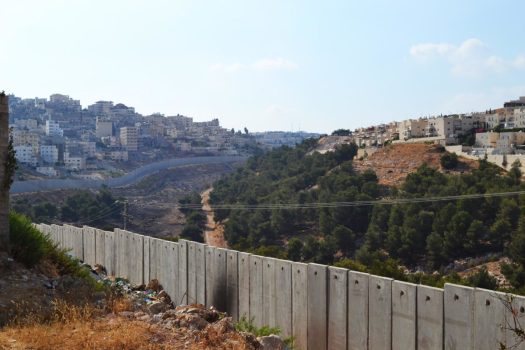
An Israeli settlement sits to the right of Israel’s separation wall in East Jerusalem, diving the Palestinian neighborhood to the left, from other Palestinian neighborhoods in the area. (photo: Eoghan Rice)

The primary political and ethical question is how to create political traction for a secular state shared equally by Israelis and Palestinians.

By Richard Falk | Mondoweiss | Jan 8, 2018


All in all, it seems time to recognize three related conclusions:

  1. The leadership of Israel has rejected the Two-State Solution as the path to conflict resolution;
  2. Israel has created conditions, almost impossible to reverse, that make it totally unrealistic to expect the establishment of an independent Palestinian state;
  3. Trump even more than prior presidents has weighted American diplomacy heavily and visibly in favor of whatever Israel’s leaders seek as the endgame for this struggle of decades between these two peoples.

Despite all appearances to the contrary, those in the West who do not want to join the premature and ill-considered Israeli victory party, are clinging firmly to the Two-State Solution amid calls to renew direct diplomatic negotiations between the parties so as to reach, in the extravagant language of Donald Trump, “the ultimate deal.”

Israel has increasingly indicated by deeds and words, including those of Netanyahu, an unconditional opposition to the establishment of a genuinely independent and sovereign Palestine. The settlement expansion project is accelerating with pledges made by a range of Israel political figures that no settler would ever be ejected from a settlement even if the unlawful dwelling units inhabited by Jews were not located in a settlement bloc that have been conceded as annexable by Israel in the event that agreement is reached on other issues.

Continue reading “Let the two-state solution die a natural death”

Jewish voices for peace have long been banned — by Jews

spinoza1
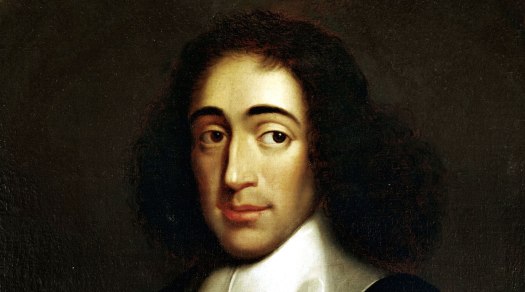
Baruch, later Benedict, Spinoza

From Spinoza to Vilkomerson, exclusion from the Jewish community based on beliefs has a long history.

By Jonathan Ofir | Mondoweiss | Jan 10, 2018


“But the formality of this step — banning outright leaders and key members of a Jewish organization — is yet further concrete evidence of what has been apparent for some time: that even as the Israeli government makes crystal-clear its commitment to having as few non-Jews as possible within its borders, it is also becoming increasingly blatant about possessing criteria for the types of Jews it considers kosher.”
— Natasha Roth


The big news concerning Israel’s fight against the movement for Boycott, Divestments and Sanctions this week is the publication of an Israeli government blacklist of 20 organizations. Notable on the list is the American Jewish group, Jewish Voice for Peace.

Rebecca Vilkomerson, the head of the organization, wrote Monday that “now, contrary to any democratic norm, there’s to be a political litmus test for entering the country.”

It may come as a surprise to some that Jews are actually being banned in an organized and institutional manner — from entering Israel — the Jewish state. But scrutiny of Jewish history reveals how logical this is. They are simply considered “the wrong kind of Jews,” as Zionist leader Chaim Weizmann told Lord Balfour. And the “wrong kind of Jews” can be banned. The Jewish tradition of such societal expulsion of Jews is known in Hebrew as “herem,” the term also applied for “boycott.”

Continue reading “Jewish voices for peace have long been banned — by Jews”