Sanders and Feinstein call anti-BDS bill “threat to free speech”

Two of the most prominent Jewish members of the Senate warn that the Israel Anti-Boycott Act will harm free speech in the US.

By Amir Tibon | Haaretz | Dec 19, 2018

While we do not support the Boycott, Divestment and Sanctions (BDS) Movement, we remain resolved to our constitutional oath to defend the right of every American to express their views peacefully without fear of actual punishment by the government.
— Sens. Bernie Sanders and Diane Feinstein in a letter to Senate leaders

Senators Bernie Sanders and Dianne Feinstein sent a letter on Thursday to Senate leaders urging them not to promote a controversial piece of legislation that will penalize boycotts against Israel and Israeli settlements in the West Bank.

Sanders and Feinstein, two of the most prominent Jewish members of the Senate, warned that the proposed legislation, called the Israel Anti-Boycott Act, will harm free speech in the US. . . .

Both Schumer and McConell support the anti-boycott bill, which is being promoted by the pro-Israeli lobby group AIPAC.

The legislation has been met with opposition from leading civil rights groups, including the American Civil Liberties Union, over concerns that it will limit American citizens’ freedom of speech.

Continue reading “Sanders and Feinstein call anti-BDS bill “threat to free speech””

If America’s “core values” mean anything at all, then anti-BDS laws must be repealed

Activists attend a pro BDS rally (photo: Stephen Melkisethian / Flickr)
Since 2015, 26 states have passed anti-BDS legislation.

By Ray Hanania | Middle East Monitor | Dec 13, 2018

Arab Americans have everything on their side: the US Constitution; the rule of law; and the fight against racism enshrined in its domestic laws by the state of Israel which defines the settlements in the occupied West Bank. However, it takes more than all of that to do the right thing. It takes courage.

Last month, Airbnb, an American company that allows homeowners to list their properties for rental to visiting tourists, announced that it will prohibit listings of properties in Israel’s illegal settlements in the occupied West Bank. The company’s decision was morally and legally correct, not least because of the illegal nature of the settlements and the racism that underpins them.

That the Israeli settlements are built for “Jews only” isn’t the real problem, though. The real problem is that they are built on land and property stolen by Israel’s government from Palestinian Christians and Muslims in violation of the Fourth Geneva Convention.

This week, however, the Illinois Investment Policy Board (IIPB), which manages nearly $14 billion in financial investments for the state’s pensioners, declared that Airbnb is no longer in compliance with the state’s anti-BDS (Boycott, Divestment and Sanctions) laws which prohibit boycotts of Israel. Illinois has the dubious distinction of being the first state to propose an anti-BDS law and the third state to pass such a law. Anti-BDS laws are intended to punish US citizens and businesses who exercise their Constitutional right to free speech and decide to boycott Israel’s illegal settlements.

Continue reading “If America’s “core values” mean anything at all, then anti-BDS laws must be repealed”

The conservative case for Palestine

Palestinians inspect the damages caused by the destruction of the Yaziji building, bombed the previous night during a round of multiple Israeli airstrikes, Gaza City, Nov 13, 2018. (photo: Mohammed Zaanoun / Activestills.org)
Lost in all the coverage of George H. W. Bush was one of his major accomplishments — a willingness to play hardball with Israel. It’s long past time to get back to that sort of conservatism.

By Maj. Danny Sjursen | AntiWar.com | Dec 18, 2018

Here are the inconvenient facts: so long as Israel maintains two sets of political and civil rights for Jews and Muslims in the occupied Palestinian territories (those seized after the 1967 Six Day War), denies Palestinian national sovereignty, continues to build illegal Jewish-only settlements in the West Bank, and maintains a crippling blockade of the Gaza Strip, well, then, there will continue to be regular protests, an ongoing insurgency, and countless Palestinian deaths. Such asymmetrical killings — especially of civilians — will only feed the beast of conflict in a vicious cycle that is now entering its eighth decade.

This article being about the Israel/Palestine crisis — a veritable “third-rail” in American political discourse — it’s necessary to start with a few disclaimers. This author is not anti-Semitic and believes the Israeli state has a right to exist. Now that that’s out of the way, let’s address the controversial caveat: Palestinians, for moral and strategic reasons, also deserve state sovereignty and equivalent civil rights. And, believe it or not, that should be the stated position of all real (small “c”) conservatives.

The reasons are simple — the United States’ one-sided, pro-Israel stance, along with its massive funding of the Israeli military, continue to sully America’s reputation in the Muslim and Arab world. This (accurate) perception of inequity and hypocrisy on the part of the U.S. breeds more “terrorists” than America’s military can kill and directly endangers the homeland. Furthermore, the inextricable linkage between this administration as well as a variety of US military and intelligence agencies with the far right-wing leaders of the current Israeli government risks allowing Prime Minister Netanyahu to drag Washington into more regional wars America neither needs nor can win. It is, to be frank, the ultimate “wag-the-dog” scenario — and the two culprits are Israel and their cynical friend Saudi Arabia.

Continue reading “The conservative case for Palestine”

Curbing free speech in the name of helping Israel

Israel-edt-superJumbo.jpg
(image: Niv Bavarsky / The New York Times)
A Senate bill aims to punish those who boycott Israel over its settlement policy. There are better solutions.

By Editorial Board | The New York Times | Dec 18, 2018

Many devoted supporters of Israel, including many American Jews, oppose the occupation of the West Bank and refuse to buy products of the settlements in occupied territories. Their right to protest in this way must be vigorously defended. The same is true of Palestinians. They are criticized when they resort to violence, and rightly so. Should they be deprived of nonviolent economic protest as well?

One of the more contentious issues involving Israel in recent years is now before Congress, testing America’s bedrock principles of freedom of speech and political dissent.

It is a legislative proposal that would impose civil and criminal penalties on American companies and organizations that participate in boycotts supporting Palestinian rights and opposing Israel’s occupation of the West Bank.

The aim is to cripple the boycott, divestment and sanctions movement known as B.D.S., which has gathered steam in recent years despite bitter opposition from the Israeli government and its supporters around the world.

Continue reading “Curbing free speech in the name of helping Israel”

A new moral imagination on immigration

New US citizens hold American flags during a naturalization ceremony at Liberty State Park, Jersey City, NJ, Oct 2, 2018. (photo: Drew Angerer / Getty Images)
In our country’s history, immigration has never been just about policy. It has always been about who we are and what we are willing to stand up for.

By Pramila Jayapal | The New York Review of Books | Dec 3, 2018

Now it’s more important than ever that Democrats — and any remaining willing Republicans — recapture America’s moral imagination on immigration. Our job is to tell the truth about immigration instead of cowering before falsehoods.

When my parents used all their savings to send me across the oceans from India at the age of sixteen, they made the ultimate sacrifice of separating from their child without knowing if we would ever live on the same continent again. They did so because they believed America was where I would get the best education and have the most opportunity. It took me seventeen years — involving an alphabet soup of visas and the abiding fear that I might not be able to stay in my new home — to get my US citizenship, in 2000. That was a teary and complex moment. Surrounded by people from all over the world, with hands over our hearts, we pledged allegiance to our new country. We knew we were the lucky ones and we were grateful, even as we felt our loss in saying good-bye to the families and countries we had left behind.

Just a year later, in the wake of September 11, I went on to found and lead what became the largest immigrant advocacy organization in Washington state. We organized tens of thousands of immigrants, faith leaders, labor unions, and businesses, engaging in a national conversation on immigration, identity, and the need to reform our outdated laws. Today, more than three decades since I arrived in America, I have the privilege of serving as the first South Asian-American woman in the House of Representatives, and I am one of only twelve members of the 115th Congress who are proud naturalized citizens.

Continue reading “A new moral imagination on immigration”

300 meters in Gaza: Snipers, burning tires and a fence

drone-image-1200
A protest in Khan Younis on Mar 30. The photographer, Yasser Murtaja, was killed by an Israeli sniper in the same location the following week. (photo: Yasser Murtaja, Ain Media)

A fence that divides Israel and Gaza has become the latest flashpoint in the decades-old conflict.

By David Halbfinger, Iyad Abuheweila and Jugal Patel | The New York Times | Apr 13, 2018


Most Gazans are Palestinian refugees or their descendants, and marching on the fence highlights their desire to reclaim the lands and homes from which they were displaced 70 years ago in the war surrounding Israel’s creation.


A fence that divides Israel and Gaza has become the latest flashpoint in the decades-old conflict, with Israeli soldiers unleashing lethal force against mostly unarmed Arab protesters who have been demonstrating every Friday for the past several weeks.

The image above shows how each side is arrayed in Khan Younis, one of five demonstration sites where 34 Palestinians have been killed since the protests began nearly three weeks ago.

The protests resumed on Friday, and the Palestinians plan to keep the weekly protests going with large turnouts until May 15, when many plan to try to cross the fence en masse. The Gazans are protesting Israel’s blockade, which has been choking off the impoverished coastal strip for more than 10 years. They also want to reassert the rights of refugees and their descendants to reclaim their ancestral lands in Israel, 70 years after hundreds of thousands of Palestinians were displaced.

Continue reading “300 meters in Gaza: Snipers, burning tires and a fence”

Announcing the launch of One State Foundation

one state foundation

A new Palestinian-Israeli initiative to grow debate and support for a one state solution.

By Jonathan Ofir | Mondoweiss | Mar 1, 2018


“Can we make people see, emotionally feel and rationally understand that a shared future in equality is in the end beneficial for all? That is the challenge we are taking on.”
— Angélique Eijpe, co-founder and board member of One State Foundation


We are still in times where speaking about a single democratic and secular state in Israel-Palestine is considered contentious. Just look how former Knesset Speaker Avraham Burg was received at a liberal synagogue in NY, when he spoke about this concept — Rabbi Matalon called him a “troublemaker,” and rabbi Cohen said he “pushed all the buttons.”

But today, a new foundation is officially launching — the One State Foundation, which boldly and clearly promotes this concept and goal.

Continue reading “Announcing the launch of One State Foundation”

ACLU says revised anti-BDS bill remains unconstitutional

2014_8_2-bds-rally-in-washington14636453448_3610804d55_o
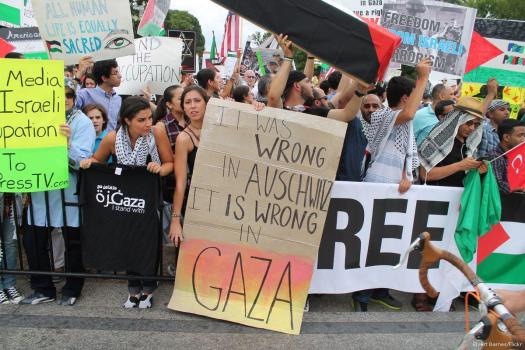
BDS rally in Washington, DC. (photo: Elvert Barnes / Flickr)

The opinion is a blow to pro-Israel groups who had hoped revisions would soften the constitutional issues.

By Middle East Monitor | Mar 7, 2018


“This bill is unconstitutional because it seeks to impose the government’s political views on Americans who choose to express themselves through boycotts.”
— Ben Wizner, director of the ACLU Speech, Privacy, and Technology Project


The American Civil Liberties Union (ACLU) has criticized a revised version of draft legislation intended to target the growing Boycott, Divestment, Sanctions (BDS) campaign, saying that the latest version of the bill remains unconstitutional.

The ACLU had voiced objections to the original bill in Jul 2017 on First Amendment grounds, and in response to such criticisms, Senators Ben Cardin (D-MD) and Rob Portman (R-OH) released a revised version over the weekend.

But in a Mar 6 press release, the ACLU revealed that it had written to senators informing them of the veteran civil liberties group’s opposition to the revised bill, in what is a blow to pro-Israel groups who are hoping that the bill will become law. [The letter can be viewed here.]

Continue reading “ACLU says revised anti-BDS bill remains unconstitutional”

Israel approves law to criminalize criticism of the Israeli Army

migr_1718483346
An Israeli soldier fires on Palestinian demonstrators during a protest against Jewish settlement near Tubas, in the occupied West Bank. (photo: Reuters)

“The only way to stop us is to end the occupation,” said the group being targeted, Breaking the Silence.

By Telesur | Feb 27, 2018


The bill is just one among many recently passed by the Israeli Knesset to crush dissent. In November, lawmakers introduced a bill to criminalize those that support the Boycott, Divestment and Sanctions (BDS) movement.


The Israeli Knesset approved the first reading of a bill that would prohibit organizations from being critical of the Israeli Army Monday.

The bill, which passed by 35-23 votes, was proposed by Education Minister Naftali Bennett. Bennett is the chairman of the right-wing Jewish Home party, a party seeking to criminalize any criticisms of the Israeli occupation.

The principal target of the bill is the group Breaking the Silence, an organization of veteran Israelis who expose the brutal nature of the occupation.

Continue reading “Israel approves law to criminalize criticism of the Israeli Army”

Evangelicals deeply concerned about US recognition of Jerusalem as capital of Israel

3b9d4f989d737741220c0589afd62601
The Old City of Jerusalem. (photo: G Adventures)

Multiple Christian organizations express their opposition to recognizing Jerusalem as the capital of Israel.

Press Release|Religion News Service | Feb 22, 2018


Given the rich heritage of this city and its spiritual significance to the Jews, Christians, and Muslims of the Holy Land, we hope that Jerusalem will be able to serve as the capital for both Israel and Palestine.


As followers of Christ, we share a hope that the Holy Land — the birthplace of our Lord and Savior and the Promised Land of the Israelite Patriarchs — will be a land of peace where divine justice, as expressed through the Jewish prophets, can reign. We recognize the historical significance of this land to the Jewish people, who after generations in exile looked to return to the land to secure their physical safety and spiritual redemption. We also affirm the presence of an indigenous Arabic speaking community in the land that has been present since the time of Pentecost (Acts 2:11).

It is therefore with the deepest concern that we are witnessing unprecedented actions by the United States government that — while supported by many good-meaning people within the Church — may inadvertently jeopardize the lives and future security of the peoples of the Holy Land. We therefore cannot support President Trump’s decision to recognize Jerusalem as the capital of Israel absent a comprehensive peace agreement between the Israelis and Palestinians.

Continue reading “Evangelicals deeply concerned about US recognition of Jerusalem as capital of Israel”