A compelling, ground-level immersion into the greatest humanitarian crisis of our time, Sky & Ground accompanies the Nabi clan, a large, extended Syrian-Kurdish family, as they painstakingly make their way from their home in Aleppo, bombed out by the war, to the Idomeni refugee camp on the border of Greece and Macedonia. Their goal is Berlin, where they will reunite with family members and seek asylum but first they must make the arduous and dangerous journey through Serbia, Hungary and Austria.
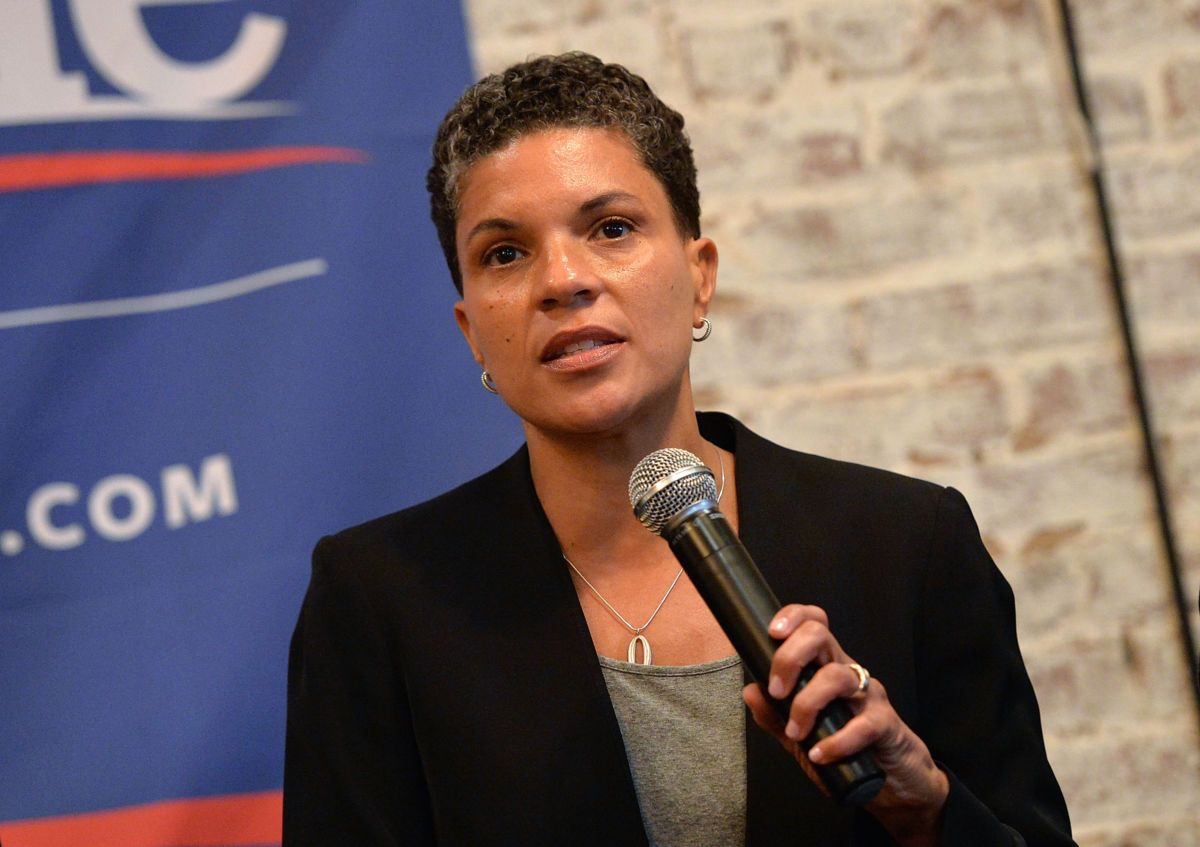
Author and civil rights lawyer Michelle Alexander attends the Harlem Women’s Round-Table Conversation at Row House on Apr 1, 2016, in New York City. (photo: Slaven Vlasic / Getty Images)
There is a false equivalency between criticizing Israel and being anti-Semitic.
By Marjorie Cohn | Truthout | Jan 25, 2019
[We need] to honor our deepest values in times of crisis, even when silence would better serve our personal interests or the communities and causes we hold most dear. It’s what I think about when I go over the excuses and rationalizations that have kept me largely silent on one of the great moral challenges of our time: the crisis in Israel-Palestine. — Michelle Alexander
As a progressive Jew, I find that many of my family members and friends are still what we call “PEP” — progressive except Palestine. Amid ever-worsening injustices created by the Israeli system of apartheid and Israel’s illegal occupation of Palestinian lands, it is past time for this to change.
I am hopeful that the firestorm sparked by Michelle Alexander’s recent New York Times column, “Time to Break the Silence on Palestine,” will finally generate the heat necessary to force more people and groups on the left to overcome the fundamental hypocrisy of the “progressive except Palestine” approach.
I was deeply inspired by Alexander’s column and her decision to speak so honestly about the difficulty of overcoming the fear of backlash over taking a public stand against the Israeli occupation of Palestine.
Striking a comparison between the risk taken by prominent critics of Israel and the risk Dr. Martin Luther King Jr. took by publicly criticizing the Vietnam War, Alexander observes, “Those who speak publicly in support of the liberation of the Palestinian people still risk condemnation and backlash.”
An MSF surgeon at Al-Awda Hospital examines X-rays from a patient shot by the Israeli army during protests in Gaza in Jul 2018. (photo: Jacob Burns / MSF)
For the most serious cases, the necessary treatment is very difficult to obtain in the Gaza Strip, which is isolated by a blockade.
By Staff | MSF Doctors Without Borders | Jan 25, 2019
MSF has increased its capacity in the Gaza Strip, performing 302 surgeries in December 2018 and caring for about 900 wounded patients. The needs of wounded patients, however, are overwhelming both MSF and other health care actors, and much more remains to be done to ensure adequate treatment of these serious and complex injuries.
Doctors Without Borders/Médecins Sans Frontières (MSF) medical teams in the Gaza Strip have the arduous task of treating bone injuries in patients who were shot by the Israeli military during protests. Limited resources make it impossible to provide adequate treatment in many cases, making it necessary to refer patients to hospitals outside the Gaza Strip. However, legal obstacles complicate referrals outside of the territory, and MSF was only able to make its first referral this month.
Treating gunshot wounds is complicated. At al-Awda hospital in Jabalia, northern Gaza, MSF surgeons operating on the shin of Yousri [name changed] who was shot in July 2018, found that the bullet had left a large gap in the bone just below his knee. They took bone from Yousri’s hip to fill the gap and help him walk again. “It will take at least two or three months for the bone to fuse, and could be longer,” said MSF surgeon Hiroko Murakami. “After that time we will see if everything is OK, and, if it is, then we can remove the external fixator and the patient can start physiotherapy. So it’s still going to take him a long time to recover.”
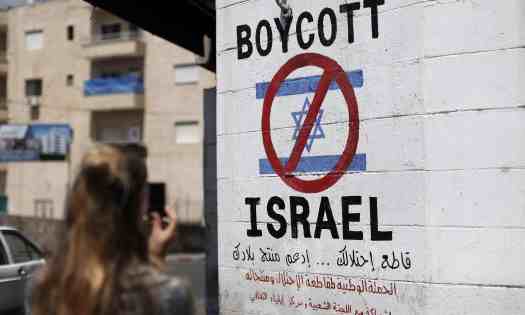
Bethlehem, Jun 2015. (photo: Thomas Coex / AFP / Getty Images)
In contrast, other courts have held boycotts to be protected speech.
By Staff | i24 News | Jan 24, 2019
‘[The Times] may even call upon others to boycott Israel, write in support of such boycotts, and engage in picketing and pamphleteering to that effect. This does not mean, however, that its decision to refuse to deal, or to refrain from purchasing certain goods, is protected by the First Amendment.’ — US District Judge Brian Miller in his opinion
A US federal judge on Wednesday upheld legislation in the state of Arkansas forbidding state employees and contractors from participating in boycotts of Israel, such as the Boycott Divestment and Sanctions (BDS) movement.
US District Judge Brian Miller dismissed a lawsuit brought forth by the Arkansas Times newspaper challenging the 2017 law — which requires state contractors to pledge not to boycott Israel — ruling that such a boycott is not protected by the First Amendment. The Arkansas Times is not engaged in a boycott against Israel, but filed the lawsuit after the University of Arkansas Pulaski Technical College refused to contract the paper because it declined to signed the anti-boycott pledge.
Miller wrote in his ruling that commercial boycotts, unlike actions such as writing in support of such boycotts, are not a protected form of speech and are therefore not protected by the First Amendment. . . .
A demonstrator holds a Palestinian flag during a protest at the Israel-Gaza border fence on Jan 18. (photo: Ibraheem Abu Mustafa / Reuters)
America has a long and proud history of boycotts being used to advocate for human rights and social justice.
By Yousef Munayyer | The Washington Post | Jan 19, 2019
When elected officials say they oppose BDS, what they are really saying is they oppose these tactics — and would even outlaw constitutionally protected freedom of expression — only because the targets are institutions complicit in Israel’s denial of Palestinian rights. This amounts to holding Israel to a different standard and enabling its horrific policies.
As Congress returned for a new session at a moment of political crisis and government shutdown, the Senate chose an odd priority for its legislative agenda. Senate bill 1, or S1, authorizes billions in weapons to Israel and includes an unconstitutional law aiming to silence the movement for Palestinian rights.
Boycott, divestments and sanctions, or BDS, are tactics Palestinian civil society has asked people around the world to utilize to hold Israel accountable for policies that deny them human rights. While these tactics have gained traction, many US lawmakers have chosen to introduce repressive legislation targeting BDS tactics when implemented in support of Palestinian rights.
These so-called “anti-BDS” laws, adopted at both the state and federal level, have caused great controversy. Opposition to such bills has overwhelmingly come from Democrats on the grounds that economic protest is protected under the First Amendment right to free speech; Republicans have almost entirely supported these laws as a caucus. But the debate over the “Combating BDS Act,” recently packaged into S1, led to a revealing exchange. Sen. Marco Rubio (R-Fla.), who sponsored the act, claimed some Senate Democrats secretly support BDS. Sen. Chris Murphy (D-Conn.) quickly shot back that such a claim was untrue.
Please join our brothers and sisters at the Mideast Focus Ministry for their First Friday Film series. There will be a light reception prepared by local Syrian refugees beginning at 6:15 pm.
Date:
Friday, Feb 1, 2019
Time:
7:00 – 8:30 pm
Location:
St. Mark’s Cathedral
Bloedel Hall 1245 10th Ave E
Seattle, WA 98102
Soufra follows the unlikely and wildly inspirational story of intrepid social entrepreneur, Mariam Shaar — a generational refugee who has spent her entire life in the Burj El Barajneh refugee camp just south of Beirut, Lebanon. The film follows Mariam as she sets out against all odds to change her fate by launching a successful catering company, “Soufra,” and then expand it into a food truck business with a diverse team of fellow refugee woman who now share this camp as their home.
Together, they heal the wounds of war through the unifying power of food while taking their future into their own hands through an unrelenting belief in Mariam, and in each other. In the process, Mariam is breaking barriers, pulling together Syrian, Iraqi, Palestinian and Lebanese women to work side by side and form beautiful friendships while running this thriving business. Continue reading “Film: Soufra (Friday)”
Palestinian schoolchildren at a school run by UNRWA in the Shuafat refugee camp in occupied East Jerusalem. (photo: Ammar Awad / Reuters)
The United Nations refugee agency for Palestinians said Israeli authorities did not inform the group of a plan to shut down UNRWA-run schools in occupied East Jerusalem.
By Staff | Al Jazeera | Jan 20, 2019
‘UNRWA’s existence in Jerusalem is not a gift from Israel. There are bilateral agreements binding on Israel to respect the agency’s installations, jurisdiction and immunity in Jerusalem. In addition, Israel is a party to the 1946 Refugee Convention, and such attempts are in violation of this Convention.’ — Sami Meshasha, spokesperson for UNRWA
Israeli media reported that the state’s National Security Council will revoke permits allowing UNRWA schools to operate starting next school year. The schools will be replaced by schools run by the Jerusalem municipality, supported by Israel’s education ministry.
UNRWA runs seven schools in two refugee camps in occupied East Jerusalem, serving a total of 3,000 students.
The Israeli plan is the latest blow to the agency, after the United States’s decision last year to halt its funding.
Hanan Ashrawi, a member of the Palestinian Liberation Organization executive committee, said the Israeli decision is “a direct insult to the international community and disregard for its laws and decisions and institutions.” . . .
Palestinians say it is an attempt to literally pull their hopes for a future capital in East Jerusalem from under their feet.
By Ruth Eglash and Loveday Morris | The Washington Post | Jan 25, 2019
If you are Israeli or Jewish then you feel very excited by what is shown here. But the history of Jerusalem does not only belong to the Israelis. — Yonathan Mizrachi, an Israeli archaeologist and executive director of Emek Shaveh, an Israeli cultural heritage group
The main road winding through the densely built Arab neighborhood of Wadi Hilweh is like many others in Jerusalem, lined with convenience stores and often crammed with traffic. There’s little clue to what is happening just yards below the pavement and under the floors of surrounding houses and apartment blocks.
For five years, Israeli archaeologists, supported by a nationalist Jewish organization, have been digging a tunnel here. Their aim is to uncover what they say was once an important thoroughfare used by worshipers some 2,000 years ago to reach the Jewish holy temple.
Developers envisage an archaeological attraction that would lure millions of visitors keen to walk the same stones as ancient pilgrims, or perhaps even Jesus. Private donors have contributed $75 million for the Pilgrim’s Road project, and the government has put up $13 million more.
Please join our brothers and sisters at the Mideast Focus Ministry for their First Friday Film series. There will be a light reception prepared by local Syrian refugees beginning at 6:15 pm.
Date:
Friday, Feb 1, 2019
Time:
7:00 – 8:30 pm
Location:
St. Mark’s Cathedral
Bloedel Hall 1245 10th Ave E
Seattle, WA 98102
Soufra follows the unlikely and wildly inspirational story of intrepid social entrepreneur, Mariam Shaar — a generational refugee who has spent her entire life in the Burj El Barajneh refugee camp just south of Beirut, Lebanon. The film follows Mariam as she sets out against all odds to change her fate by launching a successful catering company, “Soufra,” and then expand it into a food truck business with a diverse team of fellow refugee woman who now share this camp as their home.
Together, they heal the wounds of war through the unifying power of food while taking their future into their own hands through an unrelenting belief in Mariam, and in each other. In the process, Mariam is breaking barriers, pulling together Syrian, Iraqi, Palestinian and Lebanese women to work side by side and form beautiful friendships while running this thriving business. Continue reading “Film: Soufra (Friday)”
Michelle Alexander speaks at the Miller Center Forum, Dec 3, 2010. (Miller Center / CC BY 2.0)
The uproar by over Alexander’s NY Times essay in support of Palestinian rights echoes the reactions of white Americans to the Civil Rights Movement decades ago.
By Amjad Iraqi | +972 Magazine | Jan 23, 2019
Most Americans thought it [the Civil Rights movement] was going too far and movement activists were being too extreme. Some thought its goals were wrong; others that activists were going about it the wrong way — and most white Americans were happy with the status quo as it was. And so, they criticized, monitored, demonized and at times criminalized those who challenged the way things were, making dissent very costly.
Michelle Alexander’s powerful New York Times essay on Saturday (“Time to Break the Silence on Palestine”), ahead of the commemoration of Martin Luther King Jr. Day, was arguably a milestone for the Palestine movement in the US.
First, for who wrote it: Alexander, the author of the seminal book The New Jim Crow, is a renowned lawyer and public intellectual respected for her activism and scholarship on racism in the U.S., who cannot easily be dismissed as “fringe.”
Second, for where it was written: in a leading mainstream newspaper, which more frequently features op-eds by Israel advocates like Bari Weiss, Matti Friedman, Bret Stephens, Shmuel Rosner, and even officials like Naftali Bennett.
Third, for when it was written: Alexander is the latest prominent Black American in recent months to vocally express — and be targeted for — her solidarity with the Palestinian people, after others like Tamika Mallory, Marc Lamont Hill, and Angela Davis faced similar public outrages and disavowals.
And fourth, for why it was written: to challenge the widespread fear of backlash, held by many progressive Americans, for publicly criticizing Israel and speaking up for Palestinian rights.




 HolyLandJustice.org
You must be logged in to post a comment.