Rev. Dr. Fadi Diab of the Episcopal Diocese of Jerusalem
Everyone is invited to attend:
Date:
Sunday, July 16, 2023
Time:
10:00 AM
Location:
Bloedel Hall at St. Mark’s Episcopal Cathedral
Information:
See below
Tickets:
Free
Event Details
Rev. Dr. Fadi Diab is the rector of St. Andrew’s Parish in Ramallah. He will preach at the 9:00 and 11:00 AM services and participate in a forum between services. Fr. Diab participated in the writing of Kairos Palestine Document and continues to serve on Kairos Palestine board.
Jewish Voice for Peace activists protest Israeli Finance Minister Bezalel Smotrich in Washington DC, March 12, 2023. (photo credit: Jamal Najjab)
Hundreds of protesters greeted Israel’s far-right Finance Minister Bezalel Smotrich outside an Israel Bonds convention in Washington, DC.
By Michael Arria | Mondoweiss | Mar 13, 2023
“This is a moral emergency… We must name this deep pain that so many of us feel for what’s happening in Israel right now, a place that we love.” — Sheila Katz, CEO, National Council of Jewish Women
Hundreds of protestors greeted Israeli Finance Minister Bezalel Smotrich at the Grand Hyatt Hotel in Washington, DC on Sunday, where he gave a speech to an Israel Bonds convention.
Last month, amid surging settler violence, Smotrich called for the Palestinian village of Huwwara to be “wiped out.” His remarks have received widespread condemnation. The U.S. State Department called them “disgusting,” but approved Smotrich’s visa.
Sven Kuhn von Burgsdorff, ambassador of the European Union in Palestine, speaks during a visit to Palestinian families after an Israeli settlers’ rampage in Huwara on 3 March 2023. (credit: Reuters)
Unlike Ukrainians, who are recognized as belonging to the European ‘self’, Palestinians remain subject to stigmatising representations despite what they suffer at the hands of the Israeli occupation.
By Elena Aoun & Jeremy Dieudonne | Middle East Eye | Mar 6, 2023
There is no questioning here of the legitimacy of the Ukrainian struggle or the relevance of the support given to this besieged country, but rather, a questioning of European attitudes towards the Palestinians.
The conflict between Israel and the Palestinians in the occupied territories has been sliding back into a new cycle of heightened tension and violence in the last few months, and more so since the beginning of 2023.
Whereas this development hardly comes as a surprise to most observers, what is striking is the increasingly unbalanced attitude of Western states, and especially the usually more “equidistant” Europeans. Though many examples can be derived from recent events, one instance is particularly illustrative of this trend.
Peter Beinart’s Notebook this week is hosting Eric Alterman, who teaches at Brooklyn College, was for many years a columnist at The Nation and is author of the new book, We Are Not One: A History of America’s Fight over Israel. Beinart syas reading the book, he was struck by how often over the last seventy-five years the same pattern has repeated itself: An American president wants Israel to change its behavior, Israel and its American allies push back, the American president backs down. Are the political dynamics, especially in the Democratic Party, changing enough to break this pattern?
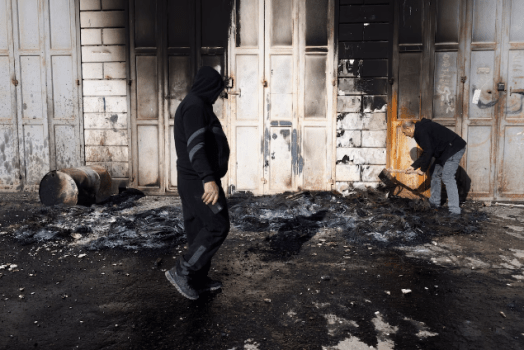
Palestinians clean a burned shop a day after the clashes between Jewish settlers and Palestinians in Huwara, West Bank, on Monday. (credit: Kobi Wolf for The Washington Post)
By Ishaan Tharoor] | The Washington Post | Feb 28, 2023
“The combination of a far-right Israeli government that is escalating confrontations with Palestinians in the West Bank and a Palestinian youth movement that is newly dedicated to terrorism and armed struggle as preferred forms of resistance will only ensure more such days.” — Israel Policy Forum
When confronted by scenes of bloodshed and destruction in Israel and the occupied territories, there’s a tendency to talk of “the cycle of violence.” In this view, the entrenched enmities and existential imperatives that drive conflict between Israelis and Palestinians are so powerful that they create their own lethal logic, a tortuous chain of atrocity that winds its way back a whole century.
Protesters in Tel Aviv hold placards that say “Israeli students fighting for democracy” and “Without democracy there is no academy.” (Credit…Jack Guez/Agence France-Presse — Getty Images)
By Peter Beinart | The New York Times | Feb 19, 2023
The principle that Mr. Netanyahu’s liberal Zionist critics say he threatens — a Jewish and democratic state — is in reality a contradiction.
The warnings come every day: Israeli democracy is in danger.
Since Benjamin Netanyahu’s new government announced plans to undermine the independence of Israel’s Supreme Court, hundreds of thousands of Israelis have demonstrated in the streets. All of Israel’s living former attorneys general, in a joint statement, have warned that Mr. Netanyahu’s proposal imperils efforts to “preserve Israel as a Jewish and democratic state.” Liberal American Jewish leaders are cheering on the protests. Earlier this month, Alan Solow, the former head of the Conference of Presidents of Major American Jewish Organizations, said he and other American Jewish notables “share the concerns of tens of thousands of Israelis determined to protect their democracy.” In a public declaration, Mr. Solow and 168 other influential American Jews warned that “the new government’s direction mirrors anti-democratic trends that we see arising elsewhere.”
The Morningstar website (credit: Louisa Svensson / Alamy Stock Photo)
After a multi-year campaign by Jewish groups, Morningstar—a major firm known for socially responsible investing—is softening its approach to Israeli human rights abuses.
By Mari Cohen | Jewish Currents | Jan 25, 2023
…human rights advocates warn that the policy changes are a blow to efforts to seek corporate accountability.
ON OCTOBER 31ST, the major investment research firm Morningstar, Inc. announced significant changes to the information-gathering practices of its subsidiary Sustainalytics, which gives companies social and environmental responsibility ratings. To arrive at these ratings, Sustainalytics takes account of businesses’ human rights records; accordingly, the firm has historically penalized companies that facilitate Israeli settlement construction or military aggression in the occupied Palestinian territories. Now, however, Sustainalytics was adjusting its approach to Israel/Palestine. It would cease to apply the term “occupied territories” to the West Bank, Gaza, and East Jerusalem, and would stop using data from prominent sources like the United Nations Human Rights Council. Morningstar promised to provide “documented guidance” to its employees stating that a company’s operations in occupied Palestinian territory should not automatically raise red flags—despite the international legal consensus, reflected in the United Nations Guiding Principles on Business and Human Rights, that companies working in conflict areas like the territories merit additional scrutiny.
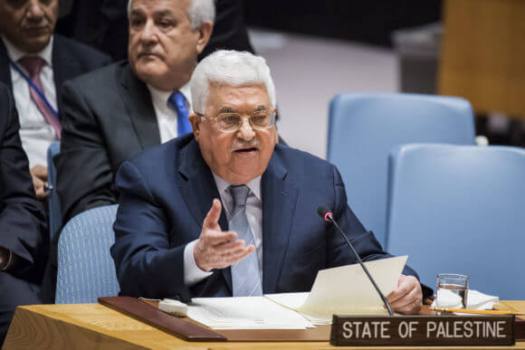
Mahmoud Abbas, President of the Observer State of Palestine, addresses the security council on the situation in the Middle East, including the Palestinian situation, February 20, 2018. (Credit: UN Photo / Manuel Elias)
Israel announced a series of punitive measures in response to a UN resolution calling for the ICJ to issue an opinion on the decades-long occupation. Experts say the measures reveal the true powerlessness of the PA, and warn lack of international accountability will only worsen the situation on the ground.
By Yumna Patel | Mondoweiss | Jan 13, 2023
Just two days after the announcement, Israel revoked the travel permit of Palestinian Foreign Affairs Minister Riyad al-Maliki, banning him from leaving the West Bank. The Israeli-entry permits of three senior Fatah officials were also revoked.
The Israeli government announced that it will enforce a series of measures to punish Palestinians over the Palestinian Authority’s latest push for the International Court of Justice (ICJ) to issue an opinion on Israel’s decades-long occupation.
On January 6, Israeli Prime Minister Benjamin Netanyahu’s security cabinet, which is comprised of some of the most far-right extremist lawmakers in the history of the Israeli government, announced a number of punitive measures targeting Palestinian citizens and officials.
By Jonathan Kuttab | Jan 7, 2023 | Friends of Sabeel North America (FOSNA)
When Israel determined it wanted to be a Jewish state, and further that it wanted to keep all the land of historic Palestine, the results were inevitable.
The new Israeli government started off with a bang, as Benjamin Netanyahu announced the principles that would govern it. First, and foremost, was the principle that Jews have an “exclusive and unquestionable right to all the land of Israel, including the Galilee, the Negev, Judaea and Samaria, and the Golan.” Following the “Nation-State Law” of 2018, he was articulating a view of Zionism and the State of Israel that is openly, frankly, and unabashedly racist and discriminatory, a view that totally rejects any possibility of equality or compromise with the Palestinian Arab population who compose half of the souls living between the the Jordan River and the Mediterranean Sea. Other, more extremist members of his government chimed in reminding us that they, and not him, control the government. Itamar Ben Gvir took on the Ministry of Public Security (the police) and immediately staged a provocative visit to the Haram Al Sharif, contrary to his instructions and the warnings of the entire world, particularly his friends in the US, Jordan, the UAE, and elsewhere.
The closed main entrance to the city of Nablus in the West Bank, Oct. 25, 2022. (Credit: Samar Hazboun for The New York Times)
By Yara M. Asi | The New York Times | Dec 29, 2022
The closure of the city at a time of already escalating military and settler violence was an act of violence in and of itself…
This year, during the lead-up to the Israeli elections, I returned to my hometown, Nablus, in the occupied West Bank, to work on a research project and spend time with my family there. I had received a grant to study the impact on Palestinians’ health of Israel’s restrictions on Palestinians’ movement — such as checkpoints, travel permits (including those required for medical care), the separation wall spanning the West Bank and road closures.
My previous work and the existing research done on Palestinian health and well-being gave me a good sense of what I would find: multiple burdens in access to health care and predictably high rates of depression, stress, anxiety and insecurity.
You must be logged in to post a comment.