Ultra-Orthodox Jews praying in Jerusalem. Resentment has been building in Israel over special privileges and subsidies for the ultra-Orthodox. (photos: Sergey Ponomarev / NY Times)
The question shadows the upcoming Israeli election.
By David Halbfinger | The New York Times | Sep 12, 2019
This election was supposed to be a simple do-over. . . . Instead it has become what Yohanan Plesner, president of the nonpartisan Israel Democracy Institute, calls ‘a critical campaign for the trajectory of the country.’
For years, the resentment had been building.
In Israel, Jewish men and women are drafted into the military, but the ultra-Orthodox are largely exempt. Unlike other Israelis, many ultra-Orthodox receive state subsidies to study the Torah and raise large families.
And in a country that calls itself home to all Jews, ultra-Orthodox rabbis have a state-sanctioned monopoly on events like marriage, divorce and religious conversions.
A series of political twists has suddenly jolted these issues to the fore, and the country’s long-simmering secular-religious divide has become a central issue in the national election on Tuesday.
The Israeli-Arab politician Ayman Odeh (front, third from right) at a campaign rally for the Joint List alliance of Arab parties ahead of Israel’s September election, Aug 23, 2019. (photo: Ahmad Gharabli / AFP / Getty Images)
For the first time in decades, many see an unprecedented opportunity for an Arab-Jewish partnership in Israeli politics.
By Yardena Schwartz | New York Review of Books | Sep 10, 2019
‘The Arab vote actually matters this time. Not since Rabin have we witnessed such attention paid to Arab voters.’ — Thabet Abu Rass, Arab-Israeli co-director of the Abraham Initiatives, an organization promoting equality in Israel
The giant yellow billboard near the Arab town of Nahef in northern Israel declares in Arabic, “This time, we are the decision-makers.” It is a reminder to the nearly 2 million Arab citizens of Israel that in this election, which will be held on September 17, they could decide Israel’s future as a democratic state. Their votes, should they choose to wield them, have the power to end the reign of Benjamin Netanyahu, now Israel’s longest-serving prime minister.
Long relegated to the margins of Israeli politics, Arab voters are playing a central part in this do-over election, triggered when the Israeli parliament, the Knesset, voted to dissolve itself after Netanyahu failed to form a governing coalition following an election in April. Arab voters suddenly find themselves under a spotlight from every direction. On the right, they are being weaponized to scare Israelis into going to the polls and keeping “Bibi,” as Netanyahu is popularly known, in power. On the left, Arab voters are being actively courted by Israeli politicians who finally understand that they need their support to unseat Netanyahu.
An election billboard in Tel Aviv, Israel, Feb 3, 2019. (photo: Jack Guez / AFP / Getty Images)
By defining any public stance critical of Israeli policies as anti-Semitic, the Right is smearing the entire Democratic Party as anti-Israel and anti-Semitic.
By Mairav Zonszein | New York Review of Books | Sep 4, 2019
For years, powerful right-wing American Jewish and Christian pro-Israel organizations and leaders have equated being a good Jewish citizen in the US with unbridled support for Israel — regardless of Israel’s worsening human rights record. Organizations that claim to represent American Jews and their interests . . . have pushed to ensure that those who challenge the pro-Israel consensus in Washington, DC, or advocate for Palestinian rights are silenced.
On August 20, after President Donald Trump told a reporter that any American Jew who casts a “vote for a Democrat . . . shows either a total lack of knowledge or great disloyalty,” outraged reactions flooded social media, attributing to his statement the anti-Semitic trope of “dual loyalty.” This is the idea, rampant in so much nineteenth- and twentieth-century thought, that Jews cannot be trusted because their allegiances are inherently divided between their Jewish and their national identities. Captain Alfred Dreyfus would never have been tried in France without the perception that Jews were disloyal.
Just as troubling in Trump’s statement as any echo of the old charge of dual loyalty, though, was its implication that any Jew who doesn’t subscribe to his politics — to both the policies of his Republican Party and of the current Israeli government — is a disloyal Jew, an inauthentic Jew, a self-hating Jew. Trump was equating Judaism with a messianic vision associated with Israel’s settler right, putting forth a souped-up loyalty test based on his alignment with Israeli Prime Minister Benjamin Netanyahu. In his years in office, Trump has made himself a staunch ally of Netanyahu — withdrawing from the Iran nuclear deal, moving the US Embassy to Jerusalem, recognizing Israel’s annexation of the Golan Heights, and ending USAID to Palestinians in the West Bank and Gaza. If you are Jewish and vote Democratic, then you are triply disloyal — to Trump, Israel, and America.
Screenshot of an Israeli government posting on Facebook. (photo: COGAT / Facebook / Forward)
Israel posted a video on Facebook of a Chicago native who “fell in love” with serving in the occupation forces.
By Muhammad Shehada | Forward | Aug 28, 2019
I thought about my late father, who died before my eyes in the blockaded Gaza Strip after COGAT prevented him from traveling to the West Bank for life-saving medical treatment. Gaza’s own hospitals and supplies were crippled by Israel’s blockade, and my family and I couldn’t find any medications but painkillers to give him. Even when my uncle in the United Arab Emirates managed to obtain some life-saving medicines for my father and tried to send them, it was no use. With rare exceptions, COGAT allows only paper mail into Gaza.
You may not know that in addition to living under occupation and blockade, Palestinians must endure trolling on social media by the same forces that oppress us. It’s certainly not comparable to the daily, systematic humiliations, traumas, and abuse involved in living without civil rights. But there’s something downright dehumanizing about having to watch these abuses repackaged on social media as services for which we should be grateful.
That happened this week, when Israel’s occupation forces in charge of administering civil issues in the West Bank — the Coordination of Government Activities in the Territories or COGAT unit — posted a propaganda video on social media. Their latest message is a promo video starring a young soldier from Chicago named Alyse, who says that she “fell in love” with the Israeli unit that runs the occupied territories.
There is so much wrong with this. For starters, COGAT embodies everything that’s problematic about the occupation of the West Bank. It is a military unit in charge of civilian affairs, a perfect encapsulation of the problem with military rule over a civilian population without the right to vote.
The Federation routinely approved a family’s donations for 15 years, but refused to allow them to donate to IfNotNow.
By Aiden Pink | Forward | Sep 2, 2019
‘A cohesive Jewish community tolerates a certain amount of dissent. It certainly shouldn’t eliminate it.’ — Alan Sussman, who was prevented from donating to IfNotNow
At the beginning of this year, like he did every year, Alan Sussman asked the Jewish Federation of Greater Seattle to donate some of his family fund’s money to a charity of his choice.
This time, though, things went awry.
That’s because the group Sussman wanted to support was IfNotNow, the left-wing Jewish group that has made its name protesting not only Israel but also American Jewish organizations themselves — including the Seattle Federation.
Citing the protests, the federation told Sussman that supporting IfNotNow would go against their policy of “build[ing] a cohesive Jewish community.” . . .
A mural depicting US President Donald Trump on the separation barrier in the West Bank city of Bethlehem, Aug 4, 2017. (Flash90)
Until US lawmakers and major Jewish organizations adjust to the current one-state reality, the acrimony that has marked the last several years under Netanyahu and Trump will only intensify.
By Joshua Leifer | +972 Magazine | Aug 26, 2019
‘If the two-state solution ceased to be possible, 64 percent of Americans would choose the democracy of Israel, even if that meant that Israel would cease to be a politically Jewish state, over the Jewishness of Israel, if the latter meant Palestinians would not be fully equal.’ — University of Maryland poll, 2018
For decades, the two-state solution has been the central pillar of the bipartisan pro-Israel consensus in Washington. Since the signing of the Oslo Accords, every single US administration has been committed, at least nominally, to the establishment of a Palestinian state alongside Israel.
Yet the expiration of the two-state paradigm under Prime Minister Netanyahu and the lack of a clear alternative to take its place has kicked that pillar away, disordering the politics of Israel–Palestine in the United States. Until American decision-makers adjust to the current one-state reality, the acrimony, chaos, and division that have marked the past several years will only intensify.
Palestinian protesters in the West Bank clash with Israeli troops in early August 2019. (photo: Jaafar Ashtiyeh / AFP / Getty Images)
We have peace plans with no partners and movements with no peace plans.
By Thomas Friedman | The New York Times | Aug 20, 2019
Talk about reality denial, the most existential question in Israel — what to do with the 2.5 million Palestinians in the West Bank — is not on the September ballot.
Last week’s ugly mess involving the abortive visit to Israel of two Democratic congresswomen was useful for only one reason: It exposed how much the Palestinian-Israeli peace process has become a pathetic festival of magical thinking, performance art, reality denial, political fund-raising and outright political fraud. It’s become about everything except what it needs to succeed: courageous, fair-minded, creative diplomacy and leadership.
At the official U.S. level, Jared Kushner has spent three years ginning up a peace plan that he still won’t show anyone. So far, his only achievement is an Israeli-Palestinian economic conference in Bahrain that no Israeli or Palestinian officials attended.
Kushner actually seems to believe that the problem can be solved by the Israelis and Gulf Arabs funding a leveraged buyout of Palestinian aspirations for sovereignty and statehood.
President Donald Trump, Aug 16, 2019. (Photo: Nicholas Kamm / AFP / Getty)
Americans increasingly view the Israeli government negatively, with a sharp division along party lines.
By Matt Viser and Rachael Bade | The Washington Post | Aug 16, 2019
‘This is a strategic blunder of epic proportions that Netanyahu and his advisers have made, turning Israel into a branch of the Republican Party. This is a tiny little country in a very bad neighborhood that needs all the friends it can get.’ — Jeremy Ben-Ami, J Street
A politically explosive fight over Israel’s attempt to block two members of Congress from entering the country — at President Trump’s urging — has elevated rifts between it and Democrats who have increasingly started to view the Israeli government and its leader as out of line or, in the eyes of at least two presidential candidates, even racist.
The shift in dialogue has been accelerated by the tight embrace between Trump and Israeli Prime Minister Benjamin Netanyahu, and after a dizzying 48 hours, some Democrats are more openly discussing the unusual step of reconsidering foreign aid to the longtime ally.
The dispute has fractured bipartisan support for Israel and moved debates over it into partisan space more typically home to issues such as abortion, gun control and immigration.
“There is this tectonic shifting of one of the fundamental plates of American politics,” said Jeremy Ben-Ami, president of J Street, a liberal pro-Israel group. “This has been a plank of the rule book for 60 years, and things are shifting in a really important way.”
Israeli soldiers guard at the ‘Bell’ Checkpoint, on road 443 near Beit Horon, Jan 6, 2019. (photo: Yonatan Sindel / Flash90)
Forty years of land grabs, settlement expansion, and the building of a highway that is off limits to Palestinians. This is what is happening to Congresswoman Rashida Tlaib’s village.
By Dror Etkes | +972 Magazine | Aug 18, 2019
It is true that Beit Ur al-Fauqa does not suffer the worst consequences of Israel’s occupation and its land grabbing enterprise. In many ways, it’s just “another village” — and that’s bad enough.
The West Bank village of Beit Ur al-Fauqa made headlines over the weekend, after Democratic Congresswoman Rashida Tlaib announced she would not accept Israel’s offer for a “humanitarian visit” to see family, and particularly her aging grandmother.
Beyond Tlaib’s personal story, however, is the story of a village that has seen decades of land grabs for the purpose of Israeli settlement expansion and the construction of a bypass road, which Palestinian residents of the West Bank have been banned from using for nearly two decades.
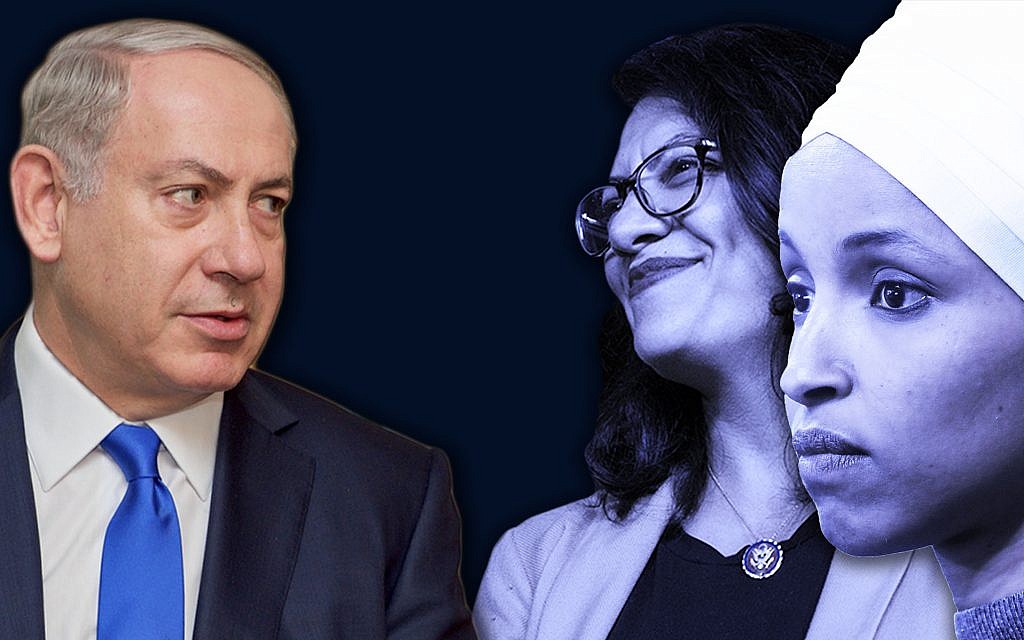
Prime Minister Benjamin Netanyahu, left, and US Reps. Rashida Tlaib, center, and Ilhan Omar, right. (photo: Laura E. Adkins for JTA/Getty Images via JTA)
There will now be more support for policy ideas that rethink the nature of the US-Israel relationship, including exerting more pressure on Israel to change its behavior if it wants to enjoy the same level of friendship from Washington.
By Eric Cortellessa | The Times of Israel | Aug 17, 2019
‘The political debate over Israel in this country is going to get more robust and more wide open. People who have serious criticism of what the [Israeli] government is doing are going to have the freedom to say what they want. There will be less fear of saying these things. The unintended consequences of Netanyahu’s decision is that he has opened it up for critics to push for ideas in the policy space that they couldn’t before.’ — Jeremy Ben-Ami, J Street
This much can be said of Prime Minister Benjamin Netanyahu’s decision on Thursday to bar two American congresswomen from entering Israel: He has unified the Democratic Party in its opposition to him.
Freshmen representatives Ilhan Omar and Rashida Tlaib — who both support the Boycott, Divestment, and Sanctions campaign (BDS) against Israel — have been polarizing figures within the caucus since their November 2018 arrival on Capitol Hill.
Democratic leaders like House Speaker Nancy Pelosi and House Majority Leader Steny Hoyer had more than once argued that their views on the Mideast were marginal — that they are not representative of the party.
But after Netanyahu apparently capitulated to US President Donald Trump’s demands that he prohibit Omar and Tlaib from visiting Israel — under a 2017 Israeli law that allows the country to ban any foreigner who knowingly promotes boycotts of Israel — he turned two figures who were sources of Democratic discord into victims of Israeli oppression.


 HolyLandJustice.org
You must be logged in to post a comment.