A new mental health crisis Is raging in Gaza

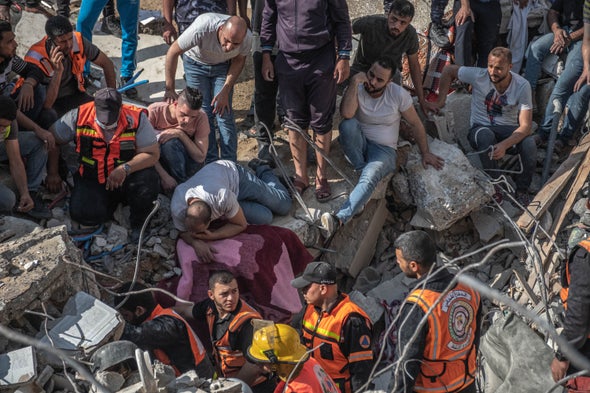
Civil defense workers pore through rubble on May 16, 2021, in the aftermath of an Israeli bombing. (photo: Fatima Shbair / Getty Images)
Recent bombings by Israel have caused more than just physical trauma

By Yasser Abu Jamei |  Scientific American | June 4, 2021

We have just escaped the hell of airstrikes to find the hell of COVID-19 at our doors. We are moving from living under occupation and offensive to life under occupation and blockade, with COVID.

“Have you ever seen a six-month old baby with exaggerated startle response?” One of my colleagues who works on our telephone counseling service was calling me for advice on how to respond to several distraught mothers asking her how to help their babies who had started showing such distressing symptoms of trauma during the recent bombing. Our telephone service was back and responding to callers on the third day of the attacks on Gaza, though of course with certain difficulties.

The question took me back 20 years to when I was a young resident in the pediatric department at Nasser hospital in Khan Younis, Gaza’s second biggest city, in the southern part of the Gaza Strip. Then, my plan was to become a pediatrician. The hospital, on the western side of the city was not far from the Israeli settlements. Often in the middle of the night I used to receive mothers arriving in the pediatric emergency department with tiny children who had started screaming with no clear reason. Physical examination mostly revealed nothing abnormal. Perhaps this was the trigger that made me train to become a psychiatrist.

Continue reading “A new mental health crisis Is raging in Gaza”
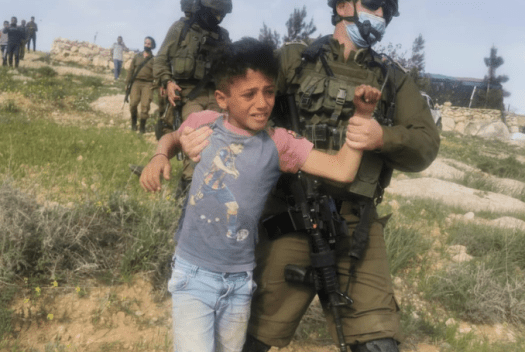
From boarding schools to child detention: The lives of children matter

Child-arrest-678x455
Israeli forces detain five Palestinian children, while they were picking wild vegetables. (photo: via Twitter)
Children everywhere pay the price of our nation state aggression and violence.

By Benay Blend  | The Palestine Chronicle | June 6, 2021

Like settler colonial projects everywhere, including the Americas and Palestine, its “objectives…were always a combination of land appropriation, resource extraction and demographic engineering.”
— Adel Eskander, Assistant Professor of Global Communication at Simon Fraser University

Yes, I am thinking of Palestinian children and undocumented children as well,” mused Diné activist Melissa Tso. “They are literally being killed daily by these settler governments.” As “an essential part of [her] culture,” running helps to “process things,” and so she did the 2.15 run in memory of the 215 Indigenous children who were found in a mass grave at Kamloop residential school in Canada.

On May 29, 2021, Aljazeera reported that the remains of more than 200 Indigenous children, some as young as three, had been found at the site of a former residential school in the western province of British Columbia.

“To our knowledge, these missing children are undocumented deaths,” Tk’emlúps te Secwépemc First Nation chief Rosanne Casimir explained. They are among the many victims of mental and sexual abuse, neglect and other forms of violence over a period of 100 years during which church-supported boarding schools operated across Canada.

Continue reading “From boarding schools to child detention: The lives of children matter”

Tech giants help Israel muzzle Palestinians

netfamiglia
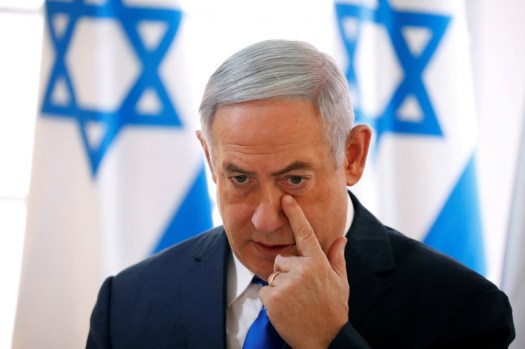
Israeli PM Benjamin Netanyahu has tried to shut down social media posts critical of Israel.  (photo: Amir Cohen / Reuters)
There are concerns that Israel’s politicized approach to crushing online dissent could become normalized worldwide.

By Jonathan Cook | The Electronic Intifada | June 5, 2021

The revelations follow widespread reports last month that social media corporations regularly removed posts that referred to the Jerusalem neighborhood of Sheikh Jarrah…

Israel’s caretaker prime minister, Benjamin Netanyahu, sought to shut down all use of the popular video-sharing app TikTok in Israel last month.

The attempt to censor TikTok, details of which emerged last weekend, is one of a number of reported attempts by Israel to control social media content during last month’s military assault on the Gaza Strip.

Netanyahu tried to impose the blackout as Israel faced an international social media outcry over its 11-day attack on Gaza, which killed more than 250 Palestinians, and the violent repression by Israeli police of Palestinian protests in occupied East Jerusalem and inside Israel.

Continue reading “Tech giants help Israel muzzle Palestinians”

Recognize Palestine … then the negotiations can begin

blinken_and_abbas
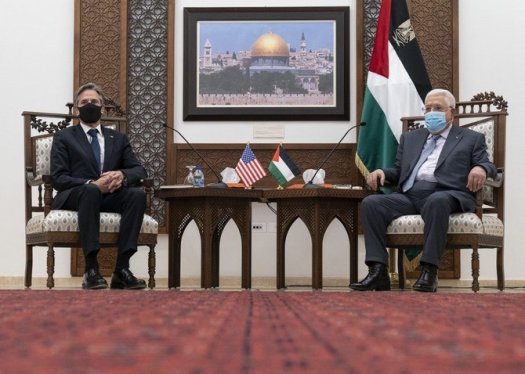
Secretary of State Antony Blinken speaks with Palestinian president Mahmud Abbas in Ramallah. (photo: File/AFP)
A call for recognition of Palestine by the global community must happen before other issues can be negotiated.

By Daoud Kuttab | Arab News | May 30, 2031

Issues such as settlements, Jerusalem, refugees and settlers need to be agreed, not whether the state of Palestine should even exist.

At a time when support for the two-state solution is almost at its lowest level, we are now repeatedly hearing this term. What makes such statements by Western leaders so hypocritical is that it is little more than lip service.

The term “two-state solution” applies to the final status of peace talks that must lead to the state of Palestine being recognized alongside the state of Israel. The world community has long recognized the state of Israel but has balked when it comes to Palestine. In 2012, the UN General Assembly officially voted to recognize Palestine as a non-member observer state. Since that vote, 140 countries have recognized the state of Palestine within the borders that obtained on June 4, 1967. However, among the leading Western countries, only Sweden has recognized Palestine, even though the parliaments of several European countries have passed resolutions calling on their own governments to do so. Many countries have said they will make such a move en masse and use recognition as part of a political deal.

Continue reading “Recognize Palestine … then the negotiations can begin”

America, human rights, and Israel’s war on Palestine

TOPSHOT-PALESTINIAN-ISRAEL-CONFLICT-GAZA
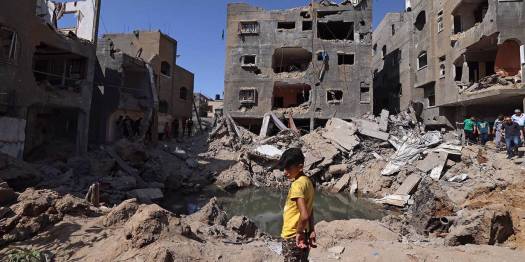
A Palestinian child stands amidst the rubble of buildings, destroyed by Israeli strikes, in Beit Hanun in the northern Gaza Strip on May 21, 2021. (photo: Emmanuel Dunand / AFP / Getty Images) 
Human rights are human rights, and they are part of international law under the UN Charter. Whether the case is Xinjiang and the Uighurs, Myanmar and the Rohingya, or Israel and the Palestinian Arabs, the correct way to defend international law is through the United Nations, starting with an independent investigation under the auspices of the UN Human Rights Council.

By Jeffrey D. Sachs | Project Syndicate | May 25, 2021

The truth is that the US government’s uncritical support for Israel has come to depend more on evangelical Christians, such as former US Secretary of State Michael Pompeo, than on American Jews, who are deeply divided by Netanyahu’s actions.

NEW YORK – Israel’s attempt to justify its latest brutal assault on Gaza rings hollow to anybody familiar with events in Israel, where the government of Prime Minister Binyamin Netanyahu, backed by anti-Arab racists, has systematically, cruelly, and persistently violated the basic human rights of the Arab population. Human Rights Watch, a global NGO with many Jewish leaders, has recently condemned Israel for crimes against humanity.

Israel’s behavior puts US President Joe Biden’s administration, which professes a foreign policy based on human rights, under the spotlight. If that commitment is genuine, the administration should support an independent UN investigation of Israeli human rights violations against the Arab population and suspend military aid to Israel until the inquiry is completed and the human rights of the Palestinians are secured.

Continue reading “America, human rights, and Israel’s war on Palestine”

On the ethics of non-Palestinians promoting nonviolence

Dabke-678x455
Dabke represents a form of solidarity and cultural resistance. (photo: via ActiveStills.org)
Palestinians have employed non-violence for decades.

By Benay Blend | Palestine Chronicle | May 24, 2021

“The problem with the non-violence bandwagon…is that it is grossly misrepresentative of the reality on the ground.”
— Ramzy Baroud, author

In “The Violence Debate: Teaching the Oppressed how to Fight Oppression” (2010), Ramzy Baroud explains that for “progressive and Leftist media and audiences, stories praising non-violence” are preferred, for they invoke a strategy acceptable to liberals in the West. At no other time, perhaps, than the present has there been so much condemnation of the victims for their resistance.

“Whether in subtle or overt ways,” Baroud continues, “armed resistance in Palestine is always condemned.” It is analogous to informing Africans (Blacks) that if they would just do what the police are asking in a polite manner, then they won’t get shot.

“The problem with the non-violence bandwagon,” Baroud concludes, “is that it is grossly misrepresentative of the reality on the ground.” As he points out, Palestinians have employed non-violence for decades going back to the prolonged strike of 1936.

Continue reading “On the ethics of non-Palestinians promoting nonviolence”