UN seeks donations for refugees after US cuts aid

palestinian-refugee-feature
Palestinians hold signs during a protest against aid cut, outside United Nations’ offices in Gaza City. (photo: Reuters)

UNRWA issues a broad appeal in the wake of the Trump administration’s aid cut.

By Reuters via New York Post | Jan 17, 2018


“At stake is the dignity and human security of millions of Palestine refugees, in need of emergency food assistance and other support in Jordan, Lebanon, Syria, and the West Bank and Gaza Strip. The reduced contribution also impacts regional security at a time when the Middle East faces multiple risks and threats, notably that of further radicalization.”
— Pierre Krähenbühl, UNRWA Commissioner-General


The head of the UN agency that provides aid to Palestinian refugees appealed on Wednesday for world donations after the United States withheld about half its planned funding for the organization, a move he said risks instability in the region.

Washington said on Tuesday it would provide $60 million to the UN Relief and Welfare Agency while keeping back a further $65 million for now. The US State Department said UNRWA needed to make unspecified reforms.

Palestinians, already angered by US President Donald Trump’s Dec 6 recognition of Jerusalem as Israel’s capital, denounced the decision, which could deepen hardship in the Gaza Strip where UNRWA helps much of its population of 2 million.

Continue reading “UN seeks donations for refugees after US cuts aid”
US cuts to refugee agency a “death sentence”

afp_ww37l
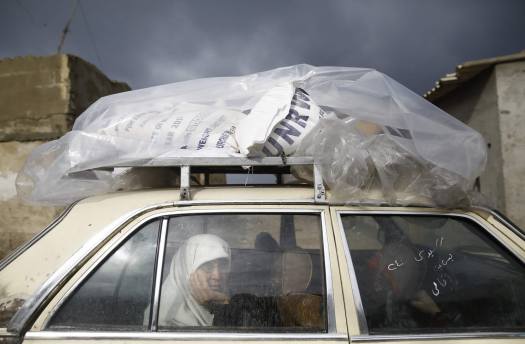
A Palestinian woman rides in a car after collecting aid provided by UNRWA in Gaza City on Wednesday. (photo: Mohammed Abed / AFP / Getty Images)

Trump’s decision to cut aid to Palestinian refugees threatens the well-being of millions.

By Hazem Balousha and Ruth Eglash | The Washington Post | Jan 17, 2018


“We are extremely worried. We support 1 million people with food. . . . [We] just hope we have enough time to persuade them to change their mind and/or to find another donor.”
— Matthias Schmale, UNRWA Gaza Director


The UN Relief and Works Agency, the main body providing aid to millions of Palestinian refugees and their descendants across the Middle East, made an urgent appeal for international support Wednesday, one day after the State Department announced that it will slash its annual funding.

“After decades of generous support, dramatic reduction of US funding to @UNRWA results in most critical financial situation in history of Agency,” the agency’s commissioner general, Pierre Krähenbühl, wrote on Twitter. “I call on member states of the United Nations to take a stand & demonstrate to Palestine Refugees that their rights & future matter.”

In a more detailed statement to the media, Krähenbühl said the U.S. contribution of $60 million, less than half of a planned $125 million installment, is “dramatically below past levels” and jeopardizes the “dignity and human security of millions of Palestine refugees, in need of emergency food assistance and other support.”

Continue reading “US cuts to refugee agency a “death sentence””

Jerusalem: It’s tense, crowded and can feel like a jail

10jerusalem4-superjumbo
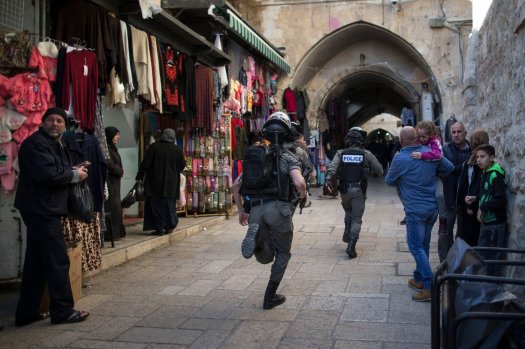
Israeli border police officers responding to a disturbance in the Muslim Quarter after Friday prayers. (photo: Uriel Sinai / The New York Times)

This is a tense city on a good day.

By David Halbfinger | The New York Times | Dec 9, 2017


“There’s a big religion problem in Jerusalem. It’s a city of racism. Once there’s a little bit of balagan [chaos] between Jews and Arabs, Jews won’t go in my taxi, and Arabs won’t go to the mall. And if I go into a religious neighborhood and they find out I’m Arab, they’ll stone my car. . . . There will never be peace here. If they take all the Arabs away, the Jews would eat each other. And the same thing with us.”
— Jerusalem taxi driver Muhammad Ziada


You feel it behind the wheel: The traffic signals turn red and yellow to alert a coming green. Hesitate a half-second before accelerating? A honking horn. Schoolgirls gesture at motorists as they step into a crosswalk, fingertips bunched and faces scowling: Will you wait, or what?

You see it in the crowding: Overstuffed apartments spilling onto one another, in teeming Palestinian neighborhoods, and in ghetto-like ultra-Orthodox enclaves, a few blocks apart on either side of the Green Line, the pre-1967 boundary with the West Bank.

You hear it in the way people talk — “The Arabs,” “The Jews” — about people with whom they have been sentenced to share a tiny patch of soil atop a ridge with no strategic value, over which the world has been battling for thousands of years, and negotiating on and off for decades, with no end in sight.

Continue reading “Jerusalem: It’s tense, crowded and can feel like a jail”

Let the two-state solution die a natural death

AlineBatarseh
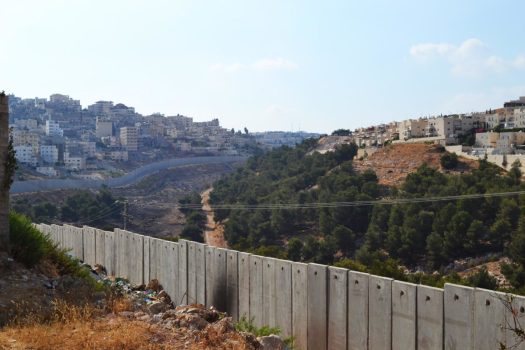
An Israeli settlement sits to the right of Israel’s separation wall in East Jerusalem, diving the Palestinian neighborhood to the left, from other Palestinian neighborhoods in the area. (photo: Eoghan Rice)

The primary political and ethical question is how to create political traction for a secular state shared equally by Israelis and Palestinians.

By Richard Falk | Mondoweiss | Jan 8, 2018


All in all, it seems time to recognize three related conclusions:

  1. The leadership of Israel has rejected the Two-State Solution as the path to conflict resolution;
  2. Israel has created conditions, almost impossible to reverse, that make it totally unrealistic to expect the establishment of an independent Palestinian state;
  3. Trump even more than prior presidents has weighted American diplomacy heavily and visibly in favor of whatever Israel’s leaders seek as the endgame for this struggle of decades between these two peoples.

Despite all appearances to the contrary, those in the West who do not want to join the premature and ill-considered Israeli victory party, are clinging firmly to the Two-State Solution amid calls to renew direct diplomatic negotiations between the parties so as to reach, in the extravagant language of Donald Trump, “the ultimate deal.”

Israel has increasingly indicated by deeds and words, including those of Netanyahu, an unconditional opposition to the establishment of a genuinely independent and sovereign Palestine. The settlement expansion project is accelerating with pledges made by a range of Israel political figures that no settler would ever be ejected from a settlement even if the unlawful dwelling units inhabited by Jews were not located in a settlement bloc that have been conceded as annexable by Israel in the event that agreement is reached on other issues.

Continue reading “Let the two-state solution die a natural death”

Jewish voices for peace have long been banned — by Jews

spinoza1
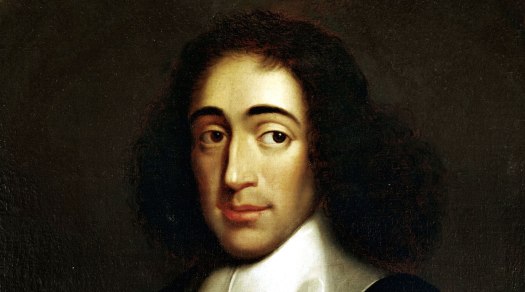
Baruch, later Benedict, Spinoza

From Spinoza to Vilkomerson, exclusion from the Jewish community based on beliefs has a long history.

By Jonathan Ofir | Mondoweiss | Jan 10, 2018


“But the formality of this step — banning outright leaders and key members of a Jewish organization — is yet further concrete evidence of what has been apparent for some time: that even as the Israeli government makes crystal-clear its commitment to having as few non-Jews as possible within its borders, it is also becoming increasingly blatant about possessing criteria for the types of Jews it considers kosher.”
— Natasha Roth


The big news concerning Israel’s fight against the movement for Boycott, Divestments and Sanctions this week is the publication of an Israeli government blacklist of 20 organizations. Notable on the list is the American Jewish group, Jewish Voice for Peace.

Rebecca Vilkomerson, the head of the organization, wrote Monday that “now, contrary to any democratic norm, there’s to be a political litmus test for entering the country.”

It may come as a surprise to some that Jews are actually being banned in an organized and institutional manner — from entering Israel — the Jewish state. But scrutiny of Jewish history reveals how logical this is. They are simply considered “the wrong kind of Jews,” as Zionist leader Chaim Weizmann told Lord Balfour. And the “wrong kind of Jews” can be banned. The Jewish tradition of such societal expulsion of Jews is known in Hebrew as “herem,” the term also applied for “boycott.”

Continue reading “Jewish voices for peace have long been banned — by Jews”

Abbas Calls Oslo Accords Dead

15abbas-master768
President Mahmoud Abbas of the Palestinian Authority, second from right, addressing the Palestinian Central Council in the West Bank city of Ramallah on Sunday. (photo: Majdi Mohammed / Associated Press)

Palestinian Authority leader vows to reject any American role in peace talks.

By David Halbfiner | The New York Times | Jan 14, 2018


“The deal of the century is the slap of the century.”
— Palestinian Authority president Mahmoud Abbas


President Mahmoud Abbas of the Palestinian Authority said on Sunday that Israel had killed the Oslo Accords and angrily assailed the Trump administration over its handling of the conflict. He vowed to reject American leadership of any peace talks and urged Palestinians to reconsider their signed agreements with Israel.

“We will not accept for the U.S. to be a mediator, because after what they have done to us — a believer shall not be stung twice in the same place,” Mr. Abbas said.

“The deal of the century is the slap of the century,” he added, mocking the still-undefined peace initiative that the Trump administration has been working on and promoting in the region. “However, we’ll get back at them.”

Mr. Abbas, 82, stopped well short of embracing an alternative to a two-state solution, the project around which he has built his career. The number of Israelis and Palestinians who hold out hope that such a solution can be achieved is dwindling, but Mr. Abbas said nothing about abandoning it.

Continue reading “Abbas Calls Oslo Accords Dead”

Emboldened by Trump, Israelis try redrawing Jerusalem’s boundaries

israel_likud_party_53721-6c7b5
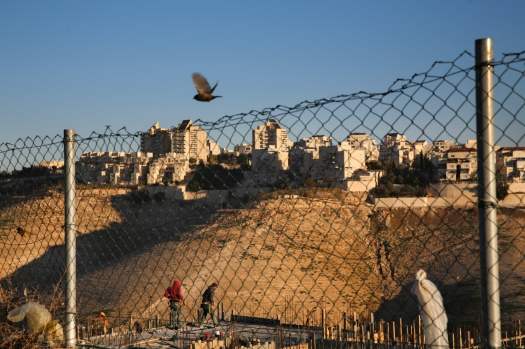
Palestinian laborers work at a construction site in a new housing project in the Israeli settlement of Maale Adumim, near Jerusalem, in Feb 2017. (photo: Oded Balilty / AP)

Israeli leaders are re-engineering Jerusalem’s demographic balance by redrawing the city’s map to exclude Arab neighborhoods and include Israeli settlements.

By Loveday Morris and Ruth Eglash | The Washington Post | Jan 12, 2018


The director of Israeli human rights group B’Tselem [says] there is a battle underway between those who want to continue “smart occupation,” which manages to “fly two inches below international outrage” while incrementally shifting facts on the ground, and those who advocate “dumb occupation” — moving forward with formal annexation.


Since becoming mayor of Maale Adumim more than 20 years ago, Benny Kashriel has doggedly campaigned for his community to be recognized as part of Israel.

Now, with President Trump in the White House, Kashriel thinks it may just happen.

His settlement is around four miles east of Jerusalem in the occupied West Bank. Most of the international community, including the United States, considers its construction to be illegal, built on land captured during the 1967 war.

Still, it has steadily grown from what began as a cluster of prefabricated buildings erected by 23 families in the 1970s into a burgeoning satellite city of Jerusalem. Palm trees line the wide roads of what looks like a Florida suburb. Red-roofed houses and high-rises are home to 42,000 people, who are served by all of the accoutrements of a modern city: schools, restaurants, cafes and a shopping mall.

Continue reading “Emboldened by Trump, Israelis try redrawing Jerusalem’s boundaries”

Palestinian national dish fuels Al-Aqsa protests

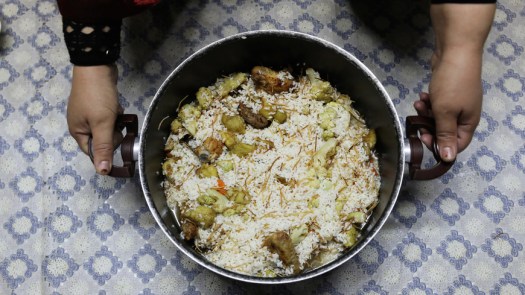
A Palestinian woman prepares maqlouba at her home in the East Jerusalem neighborhood of Jabel Mukaber
A Palestinian woman prepares maqluba at her home in the East Jerusalem neighborhood of Jabel Mukaber, Aug 21, 2017. (photo: Ammar Awad / Reuters)

Maqluba, the beloved traditional Palestinian dish, has become a tradition of the protests in Jerusalem and elsewhere, reinforcing Palestinian community and solidarity.

By Ahmad Melhem | Al-Monitor | Jan 11, 2018


“During the sit-in against Trump’s decision at the Damascus Gate, I made sure to serve maqluba, a popular Palestinian national dish, to the young protesters as a way to underline that Jerusalem is the capital of Palestine, with all its people, food and culture. People are now keen to have maqluba every week with their families in Al-Aqsa’s squares as a kind of tradition and custom to guard the mosque. . . . The true maqluba is not made with rice, chicken and vegetables but with steadfastness, persistence and perseverance and with shouts and cheers when flipped upside down.”


While hundreds of demonstrators shouted slogans on Dec 11 against US President Donald Trump in front of the Damascus Gate, one of the main entrances to Al-Aqsa, Khadija Khweis and her friend Hanadi al-Halawani were flipping pots of maqluba to serve to the protesters. In the last 12 months, this traditional food, also called the “dish of victory,” has become a part of the Palestinian protests.

Every Sunday throughout December, when people of Jerusalem held demonstrations to protest Trump’s decision to recognize Jerusalem as the capital of Israel, they would bring large pots of maqluba, which literally means “upside down” in Arabic, and eat it under the eyes of the Israeli police. The flipping of the pots as the cooks shouted “Allahu Akbar” became a ritual, and the dish also came to be called by both the Palestinians and the Israelis as the “dish of spite.”

Halawani told Al-Monitor, “During the sit-in against Trump’s decision at the Damascus Gate, I made sure to serve maqluba, a popular Palestinian national dish, to the young protesters as a way to underline that Jerusalem is the capital of Palestine, with all its people, food and culture. People are now keen to have maqluba every week with their families in Al-Aqsa’s squares as a kind of tradition and custom to guard the mosque.”

Continue reading “Palestinian national dish fuels Al-Aqsa protests”

Trump’s cut to funding for Palestinian refugees could lead to disaster

3504
Palestinian children during a summer camp activity sponsored by UNRWA in Khan Yunis town, in the southern Gaza Strip. (photo: Said Khatib / AFP / Getty)

The loss of UN money would have a catastrophic affect on Middle East security in both the short and long term.

By Mick Dumper | The Guardian | Jan 12, 2018


Has the US, and Israel for that matter, thought this through? Do they really want 270,000 children in Gaza attending Hamas-run schools? Does Washington really know what it is doing?


Having survived the recent cabinet reshuffle the international development secretary, Penny Mordaunt, is confronted with the biggest headache of her short ministerial career: the fallout of the US intention to cut funding to UNRWA, which constitutes one of the most serious challenges to UK policies in the Middle East.

Donald Trump’s threat to cut financial assistance to the UN agency specifically responsible for Palestinian refugees will be a disaster not only for the refugees but also for Israel and neighboring countries. It does not advance US interests either. Provoked by the Palestinian rejection of Trump’s decision to recognize Jerusalem as the capital of the state of Israel, it takes the notion cutting off one’s nose to spite one’s face to a completely new diplomatic level. Although a final decision by the US is still pending, the loss of the regular subvention of $350m for UNRWA would be catastrophic for the region, with immense military and strategic implications for the US and its allies, including the UK.

If UNRWA were defunded by the US in this dramatic, sudden, and unplanned way, it would be forced to suspend within a few months most of its services to nearly 5 million Palestinian refugees. Half a million children in the Gaza Strip, West Bank, Jordan, Syria and Lebanon would be without schools, consigning them to the already volatile streets at a time when extremists are in full recruitment mode.

Continue reading “Trump’s cut to funding for Palestinian refugees could lead to disaster”

Quakers, Jews and Israel’s BDS Blacklist

rs11675_evanjonesgaza1949-5812013620
AFSC volunteer Evan Jones meeting with Palestinian refugees, 1949. (photo: AFSC)

[subhead]

By Brant Rosen | Shalom Rav | Jan 11, 2018


“The AFSC helped thousands of people in the United States transfer small amounts of money to loved ones in French concentration camps, [and helped] hundreds of children, including Jewish refugees and the children of Spanish Republicans, come to the United States under the care of the US Committee for the Care of European Children in 1941–42.”
— US Holocaust Memorial Museum


Last Sunday, Israel revealed their list of 20 social justice groups from around the world it was henceforth banning from the country because of their support for the Boycott, Divestment and Sanctions (BDS) movement. For me, the list represented more than just another news item of the day. As staff person for one organization included on the list — the American Friends Service Committee (AFSC) — this news struck home personally as well as professionally

As a rabbi who works for AFSC, I’m proud of the important historical connections between Jewish community and this venerable Quaker organization. As the US Holocaust Memorial Museum itself has noted, AFSC was at the forefront of efforts to help and rescue Jewish refugees after 1938, “assisting individuals and families in need . . . helping people flee Nazi Europe, communicate with loved ones, and adjust to life in the United States.”

Continue reading “Quakers, Jews and Israel’s BDS Blacklist”