Philadelphia Orchestra support threatened over planned Israel tour

Activists in downtown Philadelphia protesting the Philadelphia Orchestra’s upcoming Israel tour. (photo: Adalah-NY / Twitter)

Opposition to the tour has spawned the “Philly, Don’t Orchestrate Apartheid” campaign, whose protests are now in their fifth week.

By Susan Landau | Mondoweiss | May 1, 2018


“We are longtime subscribers and donors to The Philadelphia Orchestra. We are human rights advocates, and we support a just peace in Israel-Palestine. We urge the Philadelphia Orchestra to cancel their tour in Israel, scheduled for June 2018, and to refuse to entertain Israeli apartheid. We strongly oppose this trip, knowing it is used to mask egregious Israeli policies of occupation, apartheid, and the dispossession of the Palestinian people.”
— Letter to the Philadelphia Orchestra from supporters and patrons


The Philadelphia Orchestra’s announcement of a Israel trip in June 2018 sparked a tsunami of letters and protests by human rights advocates demanding the cancellation of the trip. Touted as a cultural mission, the trip was immediately clear as a “Brand Israel” propaganda tour — celebrating Israel’s 70th anniversary, while whitewashing the Israel’s expulsion of over 750,000 Palestinians from their homes between 1947 and 1949.

Culture is inseparable from politics. Artists performing in Israel obscure the reality of the lived Palestinian experience of occupation and apartheid. The itinerary, prominently featuring the orchestra’s name and logo, lists visits to notables responsible for the implementation of Israeli policies which violate Palestinian human rights on a daily basis. For example, the Orchestra will have a “VIP visit” to an Israeli army base, plus a June 4 performance with Israeli army musicians. The orchestra also feted the tour at a gala event, led by Israeli Consul Dani Dayan, a longtime leader of Israel’s right-wing settlement movement.

Continue reading “Philadelphia Orchestra support threatened over planned Israel tour”

Columbia University law professor denied entry into Israel

katherine_franke_courtesy_co
Katherine Franke,  Sulzbacher Professor of Law, Gender, and Sexuality Studies at Columbia University. (photo: Columbia Law School)

Professor Franke and another human rights worker were detained and interrogated for 14 hours before being deported.

By Press Release | Center for Constitutional Rights | May 1, 2018


“My interrogation in Tel Aviv made it clear that I was banned from entering Israel because of my work in the U.S. on behalf of Palestinian rights. No government is immune from criticism for its human rights record. The abusive treatment Vince Warren and I received at Ben Gurion airport ironically illustrates how the state of Israel refuses to respect the political and civil rights of its own citizens, of Palestinians, and of human rights defenders globally.”
— Professor Franke


Vincent Warren, executive director of the Center for Constitutional Rights (CCR), and Katherine Franke, chair of CCR’s board and Sulzbacher Professor of Law, Gender, and Sexuality Studies at Columbia University, were detained Sunday, April 29, for 14 hours and interrogated at Ben Gurion International Airport, then denied entry into Israel and deported, arriving back in New York early Monday morning. Warren and Franke were questioned about their political association with human rights groups that have been critical of Israel’s human rights record.

“The Israeli government denied us entry, apparently because it feared letting in people who might challenge its policies. This is something that we should neither accept nor condone from a country that calls itself a democracy,” Warren said. “Our trip sought to explore the intersection of Black and Brown people’s experiences in the U.S. with the situation of Palestinians, and Israel could not have made that connection clearer.”

Continue reading “Columbia University law professor denied entry into Israel”

New South Carolina law outlaws referring to “occupation” of Palestine

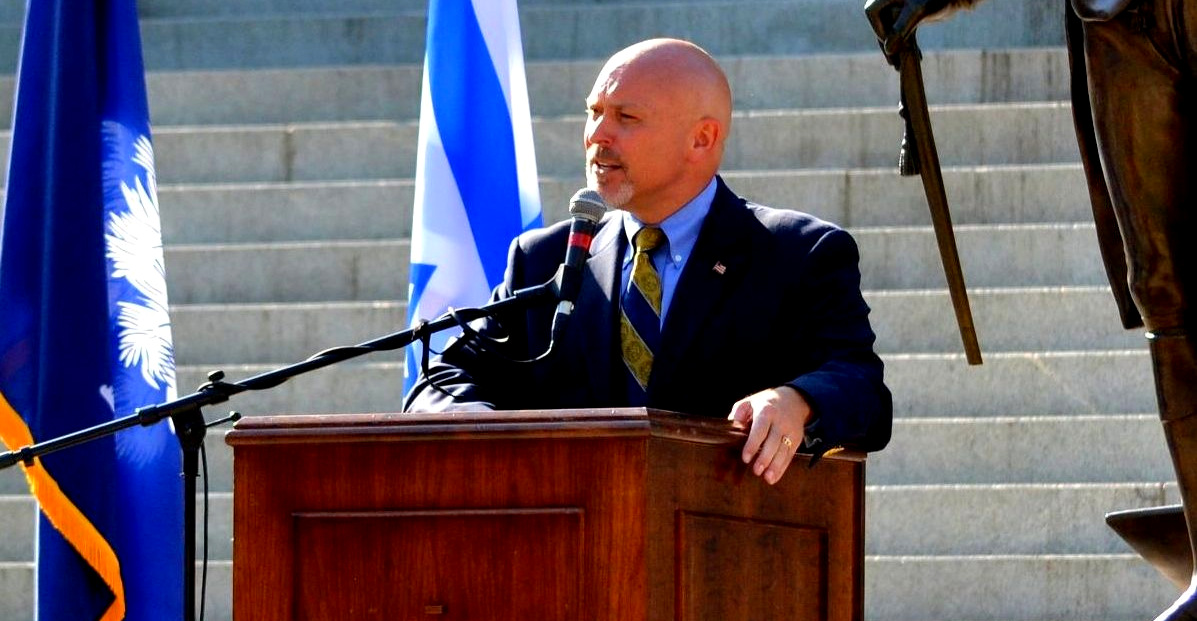
South Carolina State Representative Alan Clemmons delivers an address from the steps of the South Carolina Statehouse in 2011. (photo: Mint Press News)

According to its author, discussing the military occupation of the West Bank, a reality recognized even by israel’s Supreme Court, would be considered anti-Semitic under the new law.

By Whitney Webb | Mint Press News | May 1, 2018


In 2015, South Carolina became the first of at least 22 states to prohibit state agencies or institutions from contracting with any vendor participating in a boycott of Israel.


The state of South Carolina will become the first state in the nation to legislate a definition of anti-Semitism that considers certain criticisms of the Israeli government to be hate speech. The language, which was inserted into the state’s recently passed $8 billion budget, offers a much more vague definition of anti-Semitism that some suggest specifically targets the presence of the global boycott, divestment and sanctions, or BDS, movement on state college campuses. The law requires that all state institutions, including state universities, apply the revised definition when deciding whether an act violates anti-discrimination policies.

Once it is reconciled with an appropriations bill previously passed by the state House, the measure will become law and take effect this July. However, the law will last only until the next budget is passed, meaning that the new legal definition of anti-Semitism must be renewed on a yearly basis unless new legislation making the language permanent is passed in the future.

Continue reading “New South Carolina law outlaws referring to “occupation” of Palestine”

Israel scraps deportation of all African asylum seekers

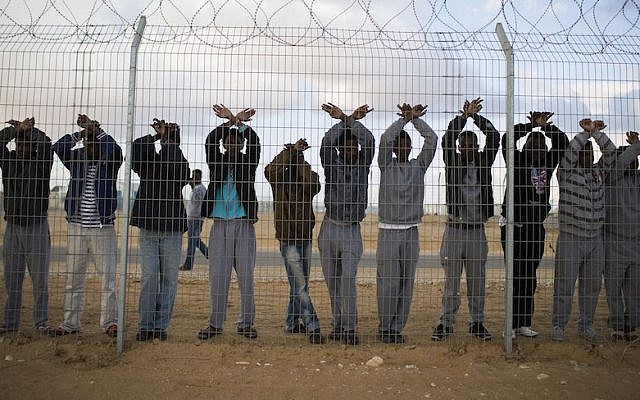
Asylum seekers protesting at the Holot detention center in the southern Negev Desert of Israel, Feb 17, 2014. (photo: Ilia Yefimovich / Getty Images)

In a dramatic turnaround, Israel tells the High Court there is “no possibility” to expel migrants at this time.

By Tamar Pileggi | The Times of Israel | Apr 24, 2018


Israel has struggled with what to do with those already in the country, alternating between plans to jail and deport them and allowing them to work in menial jobs.


The Israeli government informed the High Court of Justice Tuesday it had scrapped its controversial plan to deport tens of thousands of African migrants from the country, after Israeli authorities failed to cement an emigration deal with a third country.

“At this stage there is no possibility of implementing involuntary deportations to a third country. Therefore, as of April 17, 2018, [the state] has ceased to hold hearings as part of the deportation policy, and no more deportation decisions will be made at this time,” the state said.

The admission marked a dramatic setback for the government in its years-long attempts to expel the asylum-seekers, most of them from Eritrea or Sudan, and a triumph for activists who appealed to the court against the government plans.

Continue reading “Israel scraps deportation of all African asylum seekers”

How Natalie Portman became the latest Israel-Palestine flashpoint

Natalie Portman. (photo: Emma McIntyre / Getty Images)

She turned down Israel’s Nobel Prize — and kicked off a major firestorm.

By Zach Beauchamp | Vox | Apr 23, 2018


This is not a marginal controversy, some kind of celebrity sideshow. It is a leading indicator of the rising tensions between liberal American Jewry and the increasingly right-wing Israeli government. Portman is the canary in the coal mine, warning Israel that its policies on the Palestinians and African migrants are putting it increasingly at odds with its most natural friends abroad.


Natalie Portman, one of the most famous Jewish celebrities on the planet, just announced she was boycotting a major Israeli event.

Portman was scheduled to travel to Jerusalem to receive the Genesis Prize, a prominent award sometimes referred to as the “Jewish Nobel.” On Friday [Apr 20], she abruptly canceled her visit, writing that she “did not want to appear as endorsing [Israeli Prime Minister] Benjamin Netanyahu” in an Instagram post explaining her decision. It’s not yet clear what’s happening to the $2 million in prize money that comes with the award.

Celebrities deciding to avoid Israel on political grounds is not all that uncommon. Hollywood is left-leaning, and many celebrities are outspokenly pro-Palestinian. Netanyahu’s government is one of the furthest right in Israeli history, particularly when it comes to the conflict with the Palestinians. Tensions are to be expected.

But Portman is an altogether different case. Continue reading “How Natalie Portman became the latest Israel-Palestine flashpoint”

America’s “most Jewish” secular college votes to divest from Israel

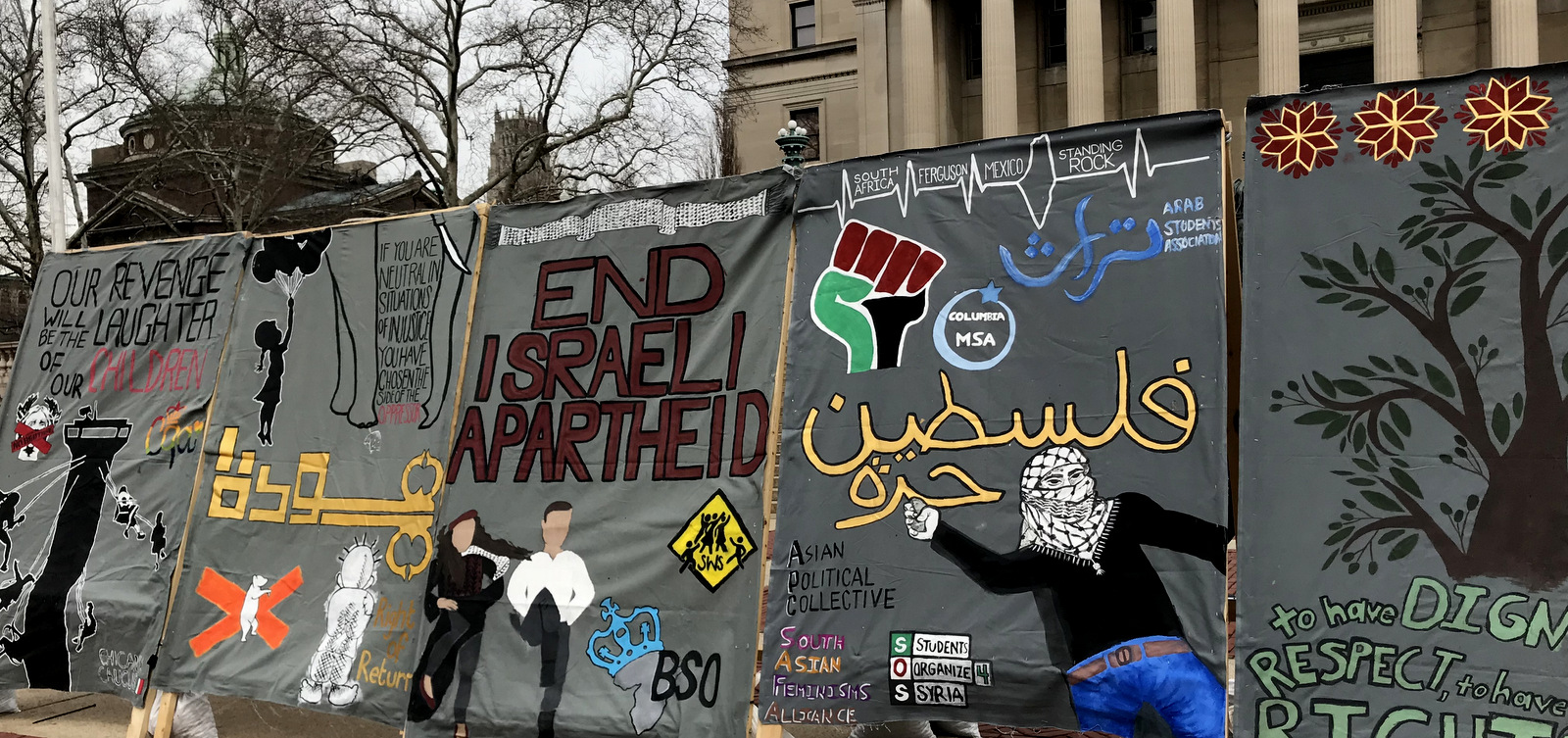
A display erected by students at Barnard College and Columbia University in protest of Israeli apartheid. (photo: Godland / Mint Press News)

One-third of Barnard College’s students are Jewish, the highest proportion among secular colleges in the United States.

By Whitney Webb | Mint Press News | Apr 24, 2018


While the school administration will not move forward with the call to divest, it has nonetheless caused concern among pro-Israel activists that the results will embolden BDS activists, as the vote has been hailed as a major victory for the movement.


Students at Barnard College just voted overwhelmingly to ask the school’s administration to divest from and boycott eight companies that do business with Israel and profit from the Israeli government’s treatment of Palestinians. Barnard, a women’s college that is part of Columbia University, passed the referendum by a 64 to 36 percent margin, with about half of the school’s students participating in the vote — a turnout much higher than in previous votes on the subject, perhaps reflecting Israel’s recent shooting of more than 2,000 unarmed Gazan protesters.

The result of the vote is being hailed as a major victory for Palestinian-rights movement BDS, the campaign to boycott, divest and sanction Israel for its violations of international law in Palestine.

Continue reading “America’s “most Jewish” secular college votes to divest from Israel”

Second Palestinian journalist dies from sniper fire

Palestinian journalist Ahmed Abu Hussein is seen receiving medical treatment after being shot by an Israeli sniper during a protest on the Gaza border, Apr 13, 2018.

Ahmed Abu Hussein was shot by Israeli snipers during a protest near the Gaza-Israel border two weeks ago. He was standing at a distance from the fence and was wearing a PRESS jacket.

By Haggai Matar | +972 Magazine | Apr 25, 2018


“Ahmed had always expected this could happen to him. The situation in Gaza is difficult. There is no work. But Ahmed always had ambition and he wanted to progress. His friends offered him this job, and he would write and photograph for the agency and send materials for publication.”
— Abu Hussein’s mother


Ahmed Abu Hussein, a Palestinian journalist based in Gaza who was shot by Israeli soldiers two weeks ago, died of his wounds on Wednesday at Tel Hashomer Hospital in central Israel. Abu Hussein is the second Gazan journalist to be killed by IDF snipers over the past month, and one of 40 Palestinians killed during the Great Return March protests.

On Friday April 13, Abu Hussein, a 24-year-old from Jabaliya refugee camp, went to take photographs of the protest next to the Gaza-Israel border fence. His mother told +972 that he had been working with a small photo agency named Bisan, and according to the Committee to Protect Journalists, Abu Hussein had worked for a radio station linked to the Popular Front for the Liberation of Palestine (it is yet unclear whether he worked for both places at the same or separately).

Abu Hussein was wearing a PRESS jacket — and was standing with a group of photographers near a press tent at the Great Return March encampment — when an Israeli sniper’s bullet pierced his abdomen, disrupting the blood flow to his brain . . . . His mother says he was struck by a hollow-point bullet, which expands as it hits its target in order to cause maximum damage. This is the same kind of bullet that has been used against dozens of those who have been killed and maimed during demonstrations in Gaza over the past month.

Continue reading “Second Palestinian journalist dies from sniper fire”

Blasted limbs, broken dreams

gazalegs
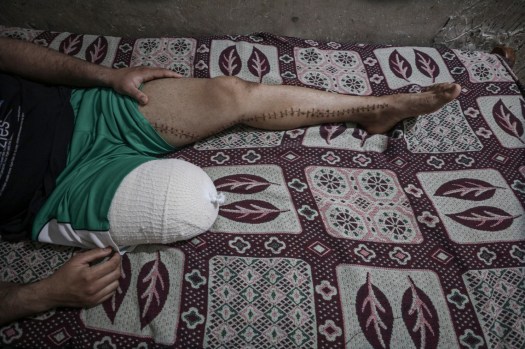
Palestinian cyclist Alaa al-Daly, 21, rests at his home in Rafah in the southern Gaza Strip on April 19. Daly’s dream of competing in the Asian Games was shattered after he lost his leg, struck by a bullet fired by an Israeli soldier during a protest along the Gaza border. (photo: Wissam Nassar / The Washington Post)

Israel appears to be targeting the legs of protesters, then denying them access to medical care in Israel.

By Eric Cunningham and Hazem Balousha | The Washington Post | Apr 28, 2018


“The deployment of snipers, careful planning and significant number of injuries to the lower limbs does reflect an apparent policy to target [those] limbs. [Targeting protesters’ legs] does not make the policy any less illegal. The use of live ammunition to any part of the body invariably causes serious injury and even death.”
— Omar Shakir, Israel-Palestine director at Human Rights Watch


Mohammad al-Ajouri is a lanky teenager who loves to run, a medal-winning track star with ambitions to compete abroad.

But last month, while participating in a protest along Gaza’s border, he was struck by a bullet fired by an Israeli soldier. It penetrated his calf, shattering his leg before exiting the shin. Doctors tried to save the limb, but an infection soon spread. The leg had to be amputated.

During the past month of demonstrations along the border between Gaza and Israel, at least 17 Palestinians have suffered gunshot wounds that ultimately cost them their legs, according to the Palestinian Health Ministry in Gaza.

In at least three of the cases, Israeli authorities rejected the transfer of wounded Gazans to the West Bank, where they could receive medical care that might have saved their limbs, according to lawyers and one of the patients’ families.

Continue reading “Blasted limbs, broken dreams”

Paraguay pledges to move embassy to Jerusalem

Paraguayan President Horacio Cartes. (photo: notihispanic.com)

Paraguay would become the third country to commit to moving its embassy to Jerusalem.

By Tovah Lazaroff | The Jerusalem Post | Apr 30, 2018


  • Guatemala is the only country besides the US that plans to move its embassy to Jerusalem.
  • Romania and Honduras are also considering the move.
  • The Czech Republic plans to open a consulate in Jerusalem, but not an embassy.
  • Currently 87 countries have embassies in Israel, none of them in Jerusalem

Paraguayan president Horacio Cartes pledged to relocate his country’s embassy from Tel Aviv to Jerusalem at a special celebratory event in Asunción to mark Israel’s 70th anniversary.

Cartes said that he would like the move to take place before he leaves office in mid-August. Foreign Ministry spokesman Emmanuel Nahshon tweeted about the statement under the heading “good news.” But he later said that it was still unclear if plans to relocate the embassy were in the works.

Continue reading “Paraguay pledges to move embassy to Jerusalem”

Pompeo and Palestinians have “nothing to discuss” amid Gaza crisis

Secretary of State Mike Pompeo, left, met with Prime Minister Benjamin Netanyahu on Sunday. (photo: Thomas Coex / The New York Times)

No one at the State Department called Palestinian leaders to ask for a get-together with Mr. Pompeo, according to Palestinian officials.

By Gardiner Harris and Isabel Kershner | The New York Times | Apr 29, 2018


“No meeting in Ramallah on his first visit sets an ominous tone about prospects for any progress, or even dialogue, with the Palestinians.”
— Daniel Shapiro, former US ambassador to Israel


Secretary of State Mike Pompeo came to Israel Sunday in the midst of the worst crisis in relations between Israelis and Palestinians in years, but he did not meet a single Palestinian representative and mentioned them publicly once.

For decades, American diplomats saw themselves as brokers between the two sides, and secretaries of state typically met Palestinian representatives on regional tours like this one. When relations between the two sides deteriorated, the United States sought to bridge the divide.

No more.

Continue reading “Pompeo and Palestinians have “nothing to discuss” amid Gaza crisis”